Legal Matter Triage to Reduce Outside Counsel Referrals
Routing, not invoice review, is where AI cuts outside counsel spend.
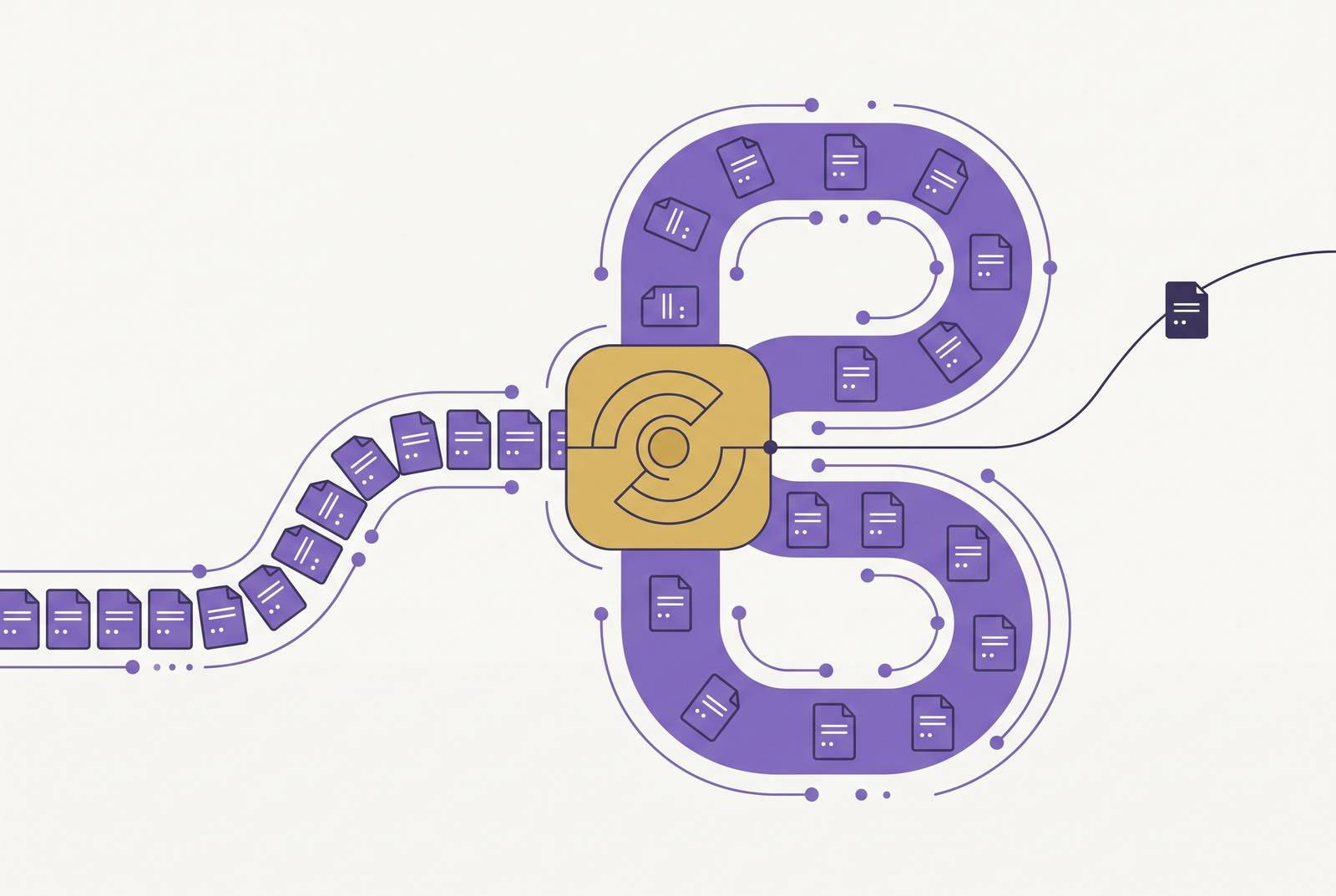
Reducing outside counsel referrals starts with legal matter triage. Effective triage forces three decisions before work leaves the department, namely whether it needs doing, who should do it, and at what resource level. AI agents move spend off the outside counsel line when they own that intake-to-routing workflow end-to-end, under documented rules and against a baseline finance can audit.
Why outside counsel bills are a triage failure, not a cost control failure
Sort a quarter’s outside counsel invoices by work category, and the small jobs that come up again and again stand out. NDAs, vendor MSAs, DPAs, first-pass diligence and short research memos accumulate across the billing lines. These are throughput tasks that may need little judgment. Their individual cost can appear unremarkable, while their frequency reveals how much routine work has entered an external billing relationship.
The structural cause sits in an intake process without a systematic channel. A Slack message, a hallway conversation or an email chain starts work without forcing a decision about its destination. Referral becomes the default response to demand. A request that could have been answered with a policy reference or handled against an internal playbook instead reaches outside counsel, where the choice of resource has already been made. Routing low-value work to a high-rate partner is an intake error before it becomes a billing problem.
Billing-side AI, including e-billing software, spend analytics and invoice enforcement, can recover a fraction of committed spend, but it operates after outside counsel is engaged and the clock is running. Work-side AI handles suitable requests inside the department before it commits to that spend.
The target is not external expertise itself. Bespoke, adversarial and genuinely complex assignments still justify outside counsel. The avoidable expense comes from treating patterned work as though it needs the same destination. A department cannot correct that distinction consistently at invoice review because the decision that created the expense has already passed.
The three decisions that triage must force earlier
Effective triage is a decision architecture. Its first question is whether the requested work needs to happen at all. An incoming request does not automatically establish a legal obligation or require a new legal workstream. A standard response, template or policy reference may be all it takes to answer the request. This first decision removes unnecessary work before the department allocates resources to it.
For requests that remain, the next question is who should handle them. Novelty and risk concentration provide a better basis for that choice than complexity alone, because high volume does not make patterned work bespoke. Low-value, low-risk requests should be automated, delegated or handled inside the department. Work should go to outside counsel only when it needs outside expertise. The distinction is between repeatable execution and a need for judgment that the internal route cannot adequately supply.
Chuck Kable’s first week at Innovative Renal Care illustrates the cost of failing to draw that distinction. The CFO sent an NDA request that took three attorneys and nearly three days. The same request, routed through an AI-assisted triage workflow, runs in minutes using a standard template and AI-assisted first review. The work still receives legal treatment. What changes is the route and the amount of attorney attention consumed before a routine request can proceed.
Only after the destination is decided should triage determine the level of resource. Even an external referral can begin with an annotated draft rather than a cold read, allowing internal first-pass work to narrow outside counsel’s scope. Everlaw and Wakefield Research’s survey found that 56% of respondents expected to keep paying outside counsel for business and commercial insight, with a similar majority expecting to pay for managing complex work.
What an AI agent must own to make triage work at volume
Triage can work without AI, but a steady flow of requests changes how much work it takes. Someone or something must classify every request, apply the routing rules, complete suitable first-pass work and escalate exceptions with context. An agent must own that sequence end-to-end. A tool that accelerates one task does not, by itself, establish whether that task should remain inside the department.
The sequence begins with intake categorization by request type, risk level and novelty, without attorney intervention. Those categories help set the keep-vs-send threshold for the incoming work. The agent then applies that threshold to route the request to automation, an internal attorney or outside counsel with scope already defined. Classification must lead to an operational decision. Otherwise, the department has organized its inbox without changing where the work goes.
For retained work, the agent must execute the first pass before a lawyer touches the request. That can mean reviewing a contract against a playbook, producing a legal research answer with citations or preparing a template-driven draft. Where attorney attention is required, escalation must include a structured summary. Without the context in that summary, someone still has to link routing to the work that follows by hand.
A contract review or research point tool can deliver useful results, but its value does not determine where requests should go. If an NDA is reflexively sent outside, an internal review tool never gets the opportunity to reduce that bill. Intake ownership is therefore a prerequisite for systematic referral reduction. Confidentiality is a separate deployment prerequisite that also needs explicit evaluation. Legal AI handling confidential data should be assessed for purpose-built architecture, including zero-data-retention, SOC 2 Type II compliance and legal-specific confidentiality terms, rather than treated as interchangeable with general-purpose AI tools.
Where most triage deployments break before they produce results
The gap between a convincing demonstration and production referral reduction is structural. Intake data may not support classification, workflows may never have been documented, and governance may be absent when the agent begins making routing decisions. Better model output does not close those gaps. Deloitte’s 2025 Emerging Technology Trends Survey shows a wide divide between organizations that are exploring or piloting agentic AI and those that have it in production. Experimentation is not evidence that an operating workflow exists.
Historical data is a particularly hard constraint. If prior requests were not tagged by type, risk and routing destination, the department lacks the training signal for its intended triage decisions. Gartner attributes 60% of AI project abandonments through 2026 to a lack of AI-ready data.
The same problem appears in process and measurement. Workflows that exist as institutional habit give automation no written process to own, while missing category-level spend data prevents the department from verifying savings. Governance adds another unresolved dependency when an agent routes an NDA to execution without per-document attorney sign-off. The authorization parameters must be documented, reviewed and tested. Written authorization policy, rollback protocols and stale-context failure testing belong before autonomous routing.
Requiring an attorney to approve every routing decision can make the system look controlled while leaving the way it works unchanged. In that arrangement, AI assists while the old decision bottleneck remains. It is the prototype trap. The presence of an AI tool does not establish that referrals have fallen, and an unchanged intake process leaves the original default-to-external pathway available. Reader skepticism is justified when deployment claims substitute for evidence that these structural conditions have been resolved.
How to audit a legal department's triage readiness before deploying
The practical response is an AI Operations Audit before deployment. It should start with last year’s outside counsel spend by work category, sorted by the number of billing lines and the total cost. Routine, patterned categories are the initial triage targets. This exercise grounds the business case in identifiable work rather than a general efficiency ambition, while establishing the baseline for later ROI claims. The audit is an operational intervention because it exposes what must change before the agent can own the workflow.
Strategy and business case form the first readiness dimension. Each initiative should be tied to a specific cut in outside counsel spend by category. Data readiness then tests whether historical requests are tagged by type, routing destination and cost, with the risk information needed for classification. Process maturity asks whether intake workflows are documented and instrumented. These dimensions connect the proposed financial outcome to the information and process required to produce it.
Governance tests where the agent’s authority begins and ends. A written policy should identify what it can route autonomously, what requires attorney sign-off and how rollback will work. Leadership and operating model then establish a named executive owner accountable for the ROI outcome. Otherwise, technical completion can be mistaken for the business result that justified the investment.
Talent and AI literacy address whether attorneys understand what the agent will and will not handle. That understanding supports trust in routing decisions. Change readiness asks whether adoption will be measured from day one. Together, these seven dimensions test whether the department can operate the system it proposes to buy or build. Closing the gaps before deployment is preparation for production.
How to measure the reduction in outside counsel referrals once triage is live
The audit’s baseline becomes the denominator for post-deployment claims. It must include outside counsel spend by work category, the number of requests by type, the average cost per type and whether each request was routed inside or outside the department. Spend alone is insufficient to describe a routing change because it does not show what share of intake stayed inside. Referral rate supplies that missing distinction. Measuring by category then links the change in where work goes to the outside counsel spend for that work.
Evidence should progress through three tiers rather than treating deployment as realized value. Capability ROI establishes that the infrastructure exists, the agent is deployed and attorneys are trained. Trending ROI shows directional movement through falling referral counts, shorter cycle times and rising throughput. Realized ROI requires audited evidence of reduced outside counsel spend by category, traceable to work triaged and retained internally. Each tier supports a different claim to finance.
The strongest measurable lever is outside counsel spend reduced by work category. Next is the matter referral rate, the share of intake routed externally rather than handled internally, which is the central triage KPI. Contract cycle time measures intake-to-resolution time on retained work, while attorney capacity freed captures hours recovered from routine routing and first-pass execution. Compliance responsiveness measures time-to-response on standard requests. These measures should be kept separate because faster responses and hours saved do not, on their own, prove that the outside counsel bill is lower.
The financial calculation can stay brief. AI ROI (%) = [(Financial Gains from AI − Total AI Investment) ÷ Total AI Investment] × 100. It should be run per work category. Thomson Reuters’ 2026 AI in Professional Services Report found that a majority of corporate legal department respondents were either not collecting AI ROI data or were unsure whether they were doing so. That measurement gap prevents a defensible claim that savings exist.
The CFO conversation should therefore rest on a concrete comparison. The legal ops leader shows last year’s outside spend in a category, this year’s spend in the same category and the routing log identifying work kept in-house. The evidence connects a changed decision to a financial result. A deployment announcement cannot supply that connection. An auditable category-level record can, making triage a measurable operational system.