Measuring AI ROI in In-House Legal Departments
A four-part framework lets legal prove AI value to finance.

Measuring AI ROI in in-house legal departments requires more than a tally of hours saved. Most teams believe AI is working but cannot substantiate that belief for finance. A defensible case separates cash savings, capacity value, risk reduction, and throughput, using pre-deployment baselines and auditable records to show both what AI saved and what those savings enabled.
Why most in-house legal departments cannot answer the CFO's question
The CFO asks what AI has delivered for the legal department. The team can say that work is faster, users give good feedback, and routine tasks take less time. Producing a defensible financial return is much harder. Legal departments are spending more on AI than ever before, but measurement has not kept pace with adoption. The resulting credibility gap is a defining condition of legal AI use.
Axiom's 2026 report frames the divide as one between systematic and informal measurement. Only a small fraction of AI-using teams have established metrics and track returns regularly, while the majority rely on impressions. Teams are assessing value, and their preferred measures include error reduction, labor cost, hours saved, and outside counsel spend. Those are useful inputs, but when teams collect them informally, finance cannot use them to reach the same conclusion.
The same report describes a majority of legal teams reporting favorable returns despite acknowledging that those returns are not formally measured. Confidence therefore runs ahead of the evidence. Finance asks how the return was derived, which costs were included, and what comparison supports it. A credible answer requires a measurement process built into the deployment. Eigenomic, an enterprise AI agent builder that puts complete legal and operational workflows into production within weeks, is one provider that anchors engagements to measurable returns.
Why tracking only hours saved and cost reduced makes the problem worse
Thomson Reuters Institute's research found that only one-quarter of legal departments were measuring ROI at all. Of those measuring it, 80% tracked internal cost savings. That narrow approach creates an “efficiency trap.” When a department says AI's value comes only from making legal cheaper, it invites the C-Suite to judge its work by cost reduction and put pressure on budgets and headcount.
The institute's Four Spinning Plates model says the GC's responsibilities are to give effective advice, work efficiently, protect the business, and help it reach its strategic goals. Efficiency is only one of those responsibilities. The outcomes GCs want from AI, including better output on meaningful tasks and more proactive strategic insight, extend beyond the cost of producing work. Hours saved measure an input without establishing what the department accomplished with it.
Finance understands hours saved and costs avoided, but it also understands prevented risk and revenue-enabling speed. Cost measurement should be kept and used to connect lower effort to faster advice, stronger protection, or better business support. Otherwise, the ROI report can obscure the very contribution that the investment was intended to improve.
A four-category measurement framework that finance can audit
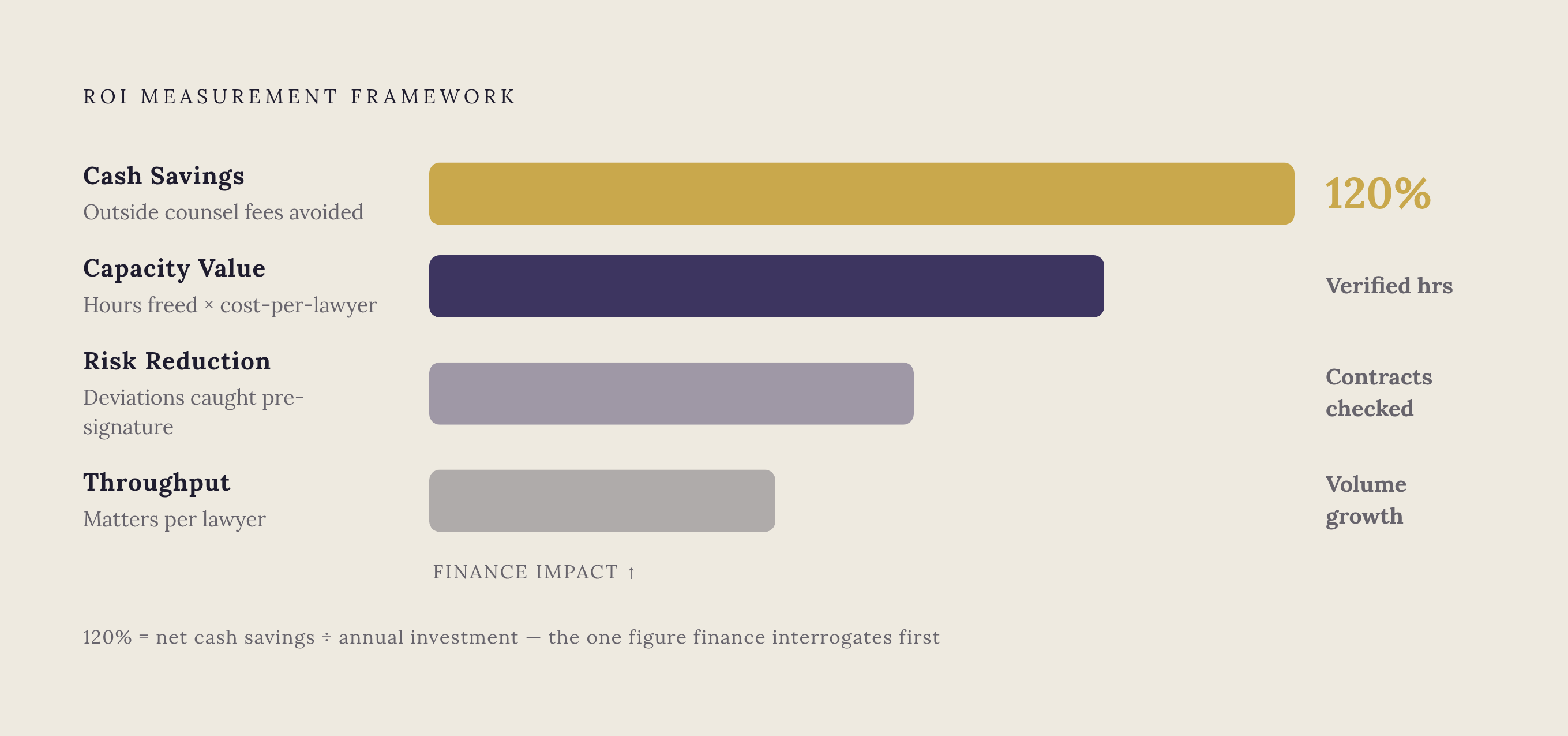
Legal leaders should replace impression-based reporting with four distinct value categories, each supported by its own evidence. The categories answer different questions and should remain separate until overlaps have been identified. This is an accounting discipline. The same framework can apply across platforms and workflows.
Cash savings are the outside counsel fees and other expenses avoided, minus the extra cash costs of doing the work in-house. GC AI's framework starts with invoices for comparable work, including recurring contract reviews, research memos, standard-form negotiations, and repeat multi-jurisdiction questions. Its savings-only ROI calculation is net cash savings minus annual investment, divided by annual investment, multiplied by 100. Its illustrative eight-lawyer model produces savings-only ROI of 120%, with cost recovery in well under a year.
Capacity value is the verified time spent on other legal work in hours, multiplied by the cost per lawyer per hour that finance has approved. It is not another cash savings line. If those hours produced the outside counsel savings, exclude them from additional capacity value and document the overlap by task. The capacity left over should be linked to results such as faster support for product launches, finding compliance risks earlier, or better strategic advice.
Risk reduction and contract quality measure protection. The framework calls for teams to track contracts checked against standard positions, deviations caught before signature, matter volume, and turnaround time. Pre-signature deviations provide evidence that review is identifying exposure before the business accepts it. These measures show whether faster work is also producing stronger protection, a question beyond the scope of a cost-only report.
Throughput measures matters per lawyer and volume handled without headcount growth. It makes the capacity argument visible to business stakeholders. A team supporting greater contract volume as the company grows demonstrates enablement, particularly when turnaround and quality remain part of the assessment. Unlike an hours-saved estimate, this category records work that the department actually handled.
Why pre-deployment baselines determine whether any of this is measurable
To use the framework, teams need to know how the work went before deployment. Without that comparison, a faster review or lower invoice does not establish the size of the improvement. The number becomes difficult to reproduce or audit. Baseline data should include the matter volume for each attorney each month, contract cycle time for each agreement type, outside counsel spend for each work category, and rates of errors or revisions on standard forms. Matter management systems and billing records are the starting points.
GC AI suggests a two-week timing test as the least a team needs to do to set a usable baseline. A representative group of lawyers selects three recurring tasks and records the time required without the platform. The group then runs the same work through it, with counsel verifying the output before recording the comparison. Review time belongs in that comparison. Otherwise, the test measures generation speed rather than the time required to complete usable legal work.
Before deployment, finance should also agree on the hourly rate, matter classifications, and how the comparison will be made. That agreement removes an avoidable dispute from the later ROI discussion. The baseline must capture both where time went and how much time work consumed. Only then can the department show whether the time freed up went to different work, instead of assuming that every saved hour helped the business.
What the high-performing deployments actually look like in practice
The clearest deployments have high-volume, repeatable, structured workflows and clean baselines. The way contracts are processed in manufacturing supply chains and SaaS subscription environments shows why these conditions help. Standardized work is easier to compare before and after deployment. Repeated transactions also make changes in processing time and volume visible in operational records.
At Bridgewater, Harvey reduced vendor contract review from an average of two days to two hours, enabling attorneys to reallocate time to higher-value legal work. That example illustrates review speed and released capacity. It does not, by itself, establish cash savings. A financial calculation would still need to distinguish work brought in-house from other uses of the time and account for the investment required.
A mid-size tech company shows the throughput side of the picture. After it began using AI contract review, its legal team cut the cycle time for standard agreements and handled far more contracts as the company grew, without adding headcount. These illustrations show how cycle time, capacity, and throughput can describe different aspects of the same deployment.
Attorney satisfaction and retention, knowledge accumulation, and junior attorney development remain largely unmeasured in legal AI accounting. When AI takes over routine volume work, the loss of opportunities to build judgment is a potential liability. Honest ROI accounting names what is still unmeasured while giving credit to the gains that have been measured.
Where legal AI ROI measurement reliably breaks down before it starts
Returns can fall far short of what vendors predict because finishing legal work takes more than producing a first output. Approval and oversight consume part of the speed advantage. Legal tasks therefore have constrained productivity gains from AI agents, although no tracked dataset establishes them as the lowest of any enterprise function. A model that excludes governance review risks pricing a faster draft as a faster completed process.
Compliance costs also belong in the calculation. Under the EU AI Act, high-risk uses in HR, credit, hiring, or critical infrastructure face requirements including human oversight, bias testing, and explainability documentation. These obligations affect the cost of operating a deployment. Legal departments working in EU jurisdictions need to account for applicable compliance requirements rather than treating model performance as the whole economic case.
Other failures begin before meaningful performance data exists. Data may be present but inaccessible to AI, or the use case may be too broad to define a useful comparison. No one may own the output. On-prem infrastructure without an upgrade path can constrain deployment, while a successful pilot can be mistaken for production readiness. These gaps undermine the conditions needed to produce auditable numbers, so readiness must be assessed before the measurement framework is applied.
Using an operational audit to build the measurement foundation before deployment
A pre-deployment operational audit should assess delivery processes, workforce skills, architecture, data quality, governance, and leadership alignment. Its outputs are a scored assessment, a gap analysis, and a prioritized roadmap. For legal operations, the audit must establish whether the department can define the work, own the output, and measure the result against an accepted baseline.
Data quality deserves particular attention because every value category depends on usable records. Gartner predicts that through 2026, organizations will abandon 60% of AI projects unsupported by AI-ready data. In legal, that means accessible matter records, contract repositories with clean metadata, billing data classified by work type, and privilege-safe data architecture. Records must support deployment and comparison alike. A repository that cannot distinguish work categories will not provide a sound basis for attributing savings.
The audit should show how efficiency gains help the business as well as check technical readiness. Axiom's report identifies establishing measurement infrastructure as the most common answer to what teams would do differently, ahead of different tools, more budget, or stronger executive support. That finding shows why the audit should help teams build measurement into their work as well as assess the technology.
Agentic deployments raise the readiness requirement further. Agents handling complete workflows, including contract intake, review, escalation routing, and reporting, require stronger data and governance foundations than point tools. An audit limited to adoption would miss that distinction. Its scope must reflect the operational process being delegated, including the conditions required to measure the completed workflow.
How to present the ROI case to the CFO once the measurement exists
The CFO-ready report should answer three questions about the investment. What did it cost, what did it return in cash, and what did it enable? The financial result should be based on records of expenses and outside counsel work kept in-house, valued at what firms charge for similar work. Capacity value should be shown separately, using an hourly rate that finance has approved. Any overlap should be disclosed by task so that the report cannot count the same benefit twice.
The operational evidence should then explain the use of that capacity through contracts reviewed, deviations caught, matter volume, and cycle time. Business outcomes give those measures their significance. Faster product launch support, earlier compliance intervention, or contract review that did not bottleneck M&A diligence makes the enablement case concrete where the records support it. Legal spend as a percentage of company revenue adds context by showing how the function scales with the business and supports peer comparison.
The report should also name costs that the savings calculation does not fully capture, including attorney development, knowledge accumulation, and error risk from reduced repetition. Acknowledging these liabilities strengthens the accounting boundary by distinguishing measured benefits from unresolved effects. Finance can then evaluate the investment without mistaking an incomplete calculation for a complete one.
The measurement infrastructure is itself a governance asset. A department that can reproduce its ROI number from invoices, matter records, and agreed comparisons demonstrates control over how AI is deployed and evaluated. That operational maturity strengthens its claim to continued investment. It also positions legal to participate in AI investment decisions with evidence about business value, rather than relying on confidence that the technology is working.