AI Operations Audit for Legal Departments
A structured diagnostic of the controls that make legal AI defensible.
An AI Operations Audit for a legal department is a structured diagnostic of the governance gaps that keep AI deployments from becoming dependable operational systems. It examines missing audit logs, unclear ownership, poor data readiness, and inadequate contractual rights. Its central conclusion is practical. Production-grade legal AI depends on controls that make its actions defensible and its operational value measurable.
Why legal departments are the wrong place to run ungoverned AI
Legal is well positioned to understand governance obligations, yet often applies them late to its own AI stack. That tension becomes consequential when rapid deployment meets duties of confidentiality, supervision, and evidentiary integrity. Legal outputs are not merely operational artifacts. They may become evidence, privileged communications, or regulatory submissions, so the conditions under which they were produced can become as important as their content.
Generative AI adoption has reached a majority of corporate legal departments, more than doubling from the prior year, although adoption varies widely by segment. Deployment, however, is not the same as operational maturity. Across enterprises, AI agents are more widely adopted than deployed at a scale that produces measurable business value. An absent decision trail can become a discovery liability, while uncontrolled disclosure of confidential inputs can create a privilege waiver risk.
What an AI Operations Audit is and what it is not
An AI Operations Audit examines the department’s entire AI deployment stack, including governance controls, data architecture, workflow integration, and vendor contract rights. The unit of analysis is the operating workflow. A tool may perform well in isolation while remaining unsuitable for production because its permissions, data flows, or approval requirements have not been defined.
This distinguishes the audit from a SOC 2 review, which addresses data-handling security controls rather than model accuracy, training data provenance, or output quality. It also differs from a vendor evaluation because it examines how the department has configured and integrated AI, regardless of supplier. Nor is it a one-time compliance checkbox. It maps current conditions against the requirements of a production-grade system.
The diagnostic tests how three conditions work together: deterministic execution, data sovereignty, and governance controls. Deterministic execution concerns whether outputs are reproducible, explainable, and auditable, while data sovereignty concerns whether sensitive information stays within approved environments. Governance controls encompass role-based access control, audit trails, approval workflows, and version control. Together, these distinguish a workflow-oriented system with customer-isolated architecture and actions tied to a matter, case, contract, or entity from a general-purpose tool that provides none of those properties by default.
The governance layer: what audit logs, ownership, and data controls actually require in legal
An auditable legal workflow needs an immutable execution log that records the document version ingested, clause deviations flagged, routing logic triggered, and exact timestamps. Dashboard visibility alone is not enough. Records must also be exportable for regulators and opposing counsel, because a discovery request or challenge to an output requires a usable account of the process. Without that account, the department may be unable to establish which inputs and rules governed a particular result.
Who owns each workflow step must be just as clear. The ability to build workflows, change playbook thresholds, and approve final exports requires segmented permissions. Unclear ownership contributes to the governance gap, but it should not be confused with the named causes of cancellation. Gartner’s June 2025 forecast identifies escalating costs, unclear business value, and inadequate risk controls as the three primary causes.
Public LLM APIs can create privilege waiver risk when representation-related information reaches a third-party provider without enforceable confidentiality protections, including protections against model training. Private or private-cloud-hosted agents therefore require contractual scrutiny. The audit establishes data residency requirements and tests whether zero-data-retention commitments and private-hosting terms are binding.
Human review also needs an enforceable boundary. Negotiation strategy, multi-party dispute analysis, and interpretation of counterparty intent require consultative draft summaries. Article 26’s stand-alone Annex III high-risk obligations apply from December 2, 2027 and offer a governance standard to plan for, while ordinary lawyer-facing tools have no current duty to meet them. Most such tools fall outside Annex III point 8, but documented escalation thresholds remain central to accountable legal workflows.
The vendor contract layer: what legal departments are and are not entitled to examine
Internal controls cannot give the department rights it never got from its vendors. An offer of “full audit rights” may cover only SOC 2 assurance and performance benchmarking, leaving training data provenance, fine-tuning practices, subprocessor data flows, and incident logs outside its scope. Assurance is not the same as examination. Receiving a SOC 2 Type II report does not give the buyer a contractual window into model behavior or accuracy on legal tasks.
GDPR Article 28 requires a processor handling personal data on a controller’s behalf to provide information necessary to demonstrate compliance and to allow and contribute to audits, including inspections. Those rights concern data handling. A compliant data processing agreement does not, by itself, establish rights to assess how the model performs on the department’s legal work.
Ironclad’s published DPA lists cloud providers as infrastructure subprocessors but does not extend audit rights to those entities. Luminance’s enterprise terms pass through some subprocessor audit rights limited to security controls, with AI model behavior outside their scope. Neither example establishes a vendor deficiency.
The audit therefore identifies rights to incident logs, visibility through the subprocessor chain, and confirmation that departmental data is not used to fine-tune models available to other customers. Professional duties reinforce that scrutiny. ABA Formal Opinion 512, issued July 29, 2024, applies duties of competence, confidentiality, communication, supervision, candor, and reasonable fees to generative AI. The opinion expects lawyers to understand the tool’s terms and risks and get informed client consent before they enter representation-related information into a self-learning tool.
The regulatory layer: what the EU AI Act, US state frameworks, and evidentiary case law are adding to the audit scope
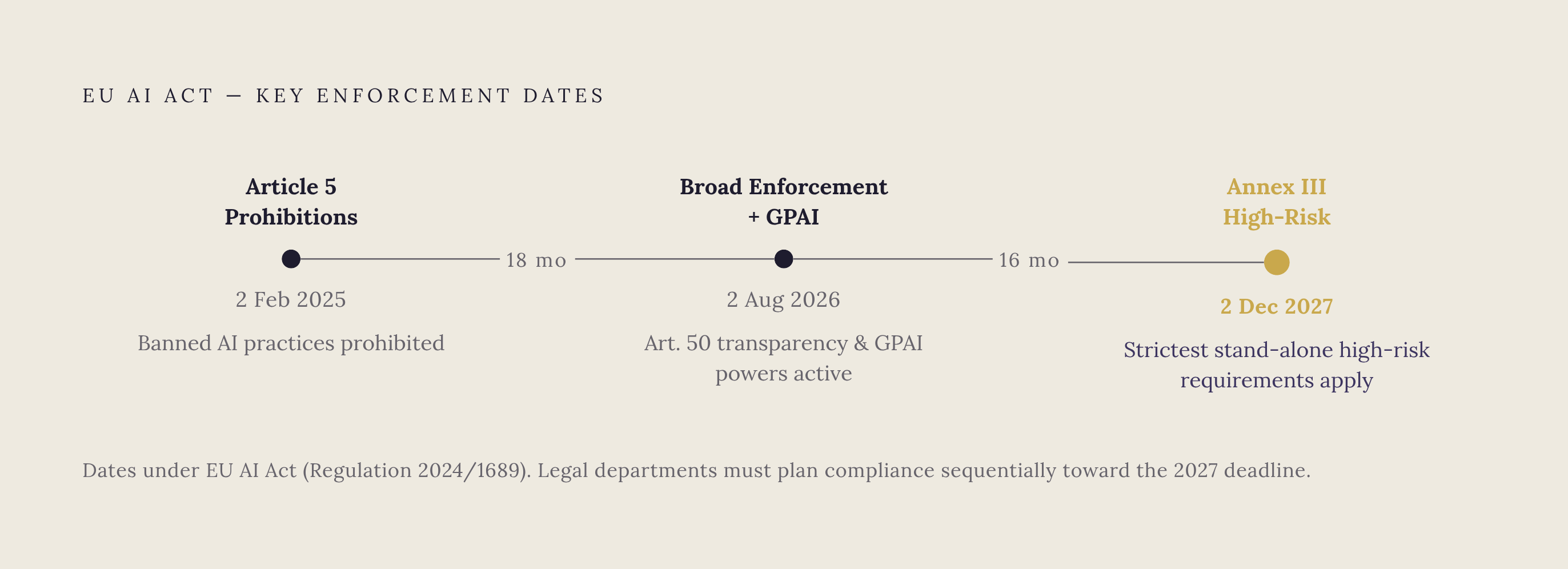
The EU AI Act calls for a map of when each duty applies because compliance has more than one deadline. Article 5 prohibitions applied from February 2, 2025, before broad enforcement began on August 2, 2026, activating Article 50 transparency obligations and GPAI enforcement powers. The strictest stand-alone Annex III high-risk requirements apply from December 2, 2027 for most systems. Timing changes the audit’s scope and remediation priorities.
Classification is as important as the calendar. Most contract review, research, and document analysis tools used by lawyers are unlikely to fall within Annex III point 8, which addresses AI used by judicial authorities. Legal departments nevertheless need to map organizational systems and document those that qualify as high-risk, including relevant HR, credit, hiring, and critical infrastructure uses. Ties to supply chains and businesses in other countries also bring pressure even where the Act does not directly apply.
US obligations require jurisdiction-by-jurisdiction tracking. California requires certain AI systems to have meaningful human oversight and bias testing and to keep records for multiple years. Colorado’s 2026 replacement law, SB 26-189, ended the earlier requirement for an annual AI impact assessment. These differences affect the control map. Monitoring that treats a California office and a Texas office as subject to identical requirements can leave compliance gaps.
Evidentiary exposure adds a separate test of defensibility. More than 600 AI hallucination cases on record, implicating 128 lawyers, establish that inaccurate AI-assisted legal work is not a hypothetical liability. For an in-house department, the question is whether embedded AI outputs can be defended as accurate and appropriately supervised. That question also belongs in board governance discussions, where risk classifications and records of controls help the board treat AI as a fiduciary risk as well as a technical update.
Where the audit’s findings concentrate: the workflows legal departments have automated without adequate controls
Contract intake and first-pass NDA review bring risks together because they handle high volumes, make decisions bound by rules, and are deployed quickly. These characteristics make them practical starting points for automation, but do not establish readiness. The audit examines whether clause deviations and routing decisions have immutable, timestamped records and whether permissions are separated by workflow step. A measurable turnaround improvement does not answer either question.
Research and case analysis need a different chain of evidence. Thomson Reuters uses Claude in Amazon Bedrock as part of its strategy to power CoCounsel, helping legal and tax professionals synthesize expert knowledge. Anthropic’s case study identifies rapid testing and deployment of new Claude models while maintaining strict security standards as one of three factors in that approach. It illustrates why even well-resourced deployments warrant questions about source traceability, protection against training on privileged inputs, and documented lawyer verification of generated citations.
Compliance monitoring brings a similar risk of mistaking what a system covers for the judgment it can make. A system that tracks SEC rules, state corporate governance statutes, and international frameworks needs a written account of which sources it watches and which it misses. An attorney must also review impact assessments before anyone acts on them. Across these workflows, the failure pattern is similar, with inconsistent execution becoming visible only when someone asks for a decision trail that does not exist. The diagnostic is intended to expose that gap before it forces a deployment to be shelved.
What the audit produces: a remediation map, not a compliance report
The output is a prioritized remediation map linking current gaps to production requirements. Its starting point is the department’s documented readiness, including logging requirements agreed with legal and compliance, established data residency requirements, defined RBAC scope, applicable compliance frameworks, and human escalation thresholds.
For legal ops leaders, the next step is to separate contractual remediation from workflow remediation. The contract portion shows where the department lacks access to incident logs, visibility into subprocessors, and protections against using its data to train models for other customers. The workflow portion prioritizes failures by risk concentration, with high-volume contract intake and research gaps creating more immediate exposure than weaknesses in lower-volume processes.
The map also records the baseline against which improvement will be measured. Without it, the department cannot reliably tell what automation changed, what stayed the same, or what needed more review. Implementation still follows the diagnostic. The document specifies the path to production, while the subsequent work establishes the permissions, contractual protections, logging, and oversight needed to operate there.
How legal ops leaders should measure the operational value the audit makes possible
Legal ops leaders should connect the resulting controls to four operational measures, namely hours per lawyer per week available for higher-value work, outside counsel fees avoided, contract cycle time, and matters per lawyer. Usage statistics cannot substitute for those measures. Finance leaders increasingly expect direct financial impact rather than general productivity claims, so attribution and documented baselines are essential to a credible investment case.
Contract review provides a concrete illustration of the calculation. A department processing a high monthly volume can compare the fully loaded cost of lawyer-led review with the cost of an AI first pass followed by lawyer review. At sufficient volume, the annual savings can run into seven figures. The calculation is defensible only when first-pass outputs are logged, attributed, and assessed within defined accuracy thresholds.
The comparison must also include the cost of supervision. Legal tasks achieve a more modest productivity multiplier from AI agents than other functions because governance review consumes part of the speed advantage. The objective is efficient oversight. Risk classifications, control records, incident logs, and remediation status then give general counsel the documentation needed to explain both the operational gains and the residual exposure to the board.
Departments that run the audit now are building the governance infrastructure that makes production-grade AI defensible. Those that skip it accumulate technical and legal debt with each new deployment.