NDA and Low-Risk Contract Auto-Approval Workflows
Risk-scored routing clears routine NDAs fast and escalates the rest.
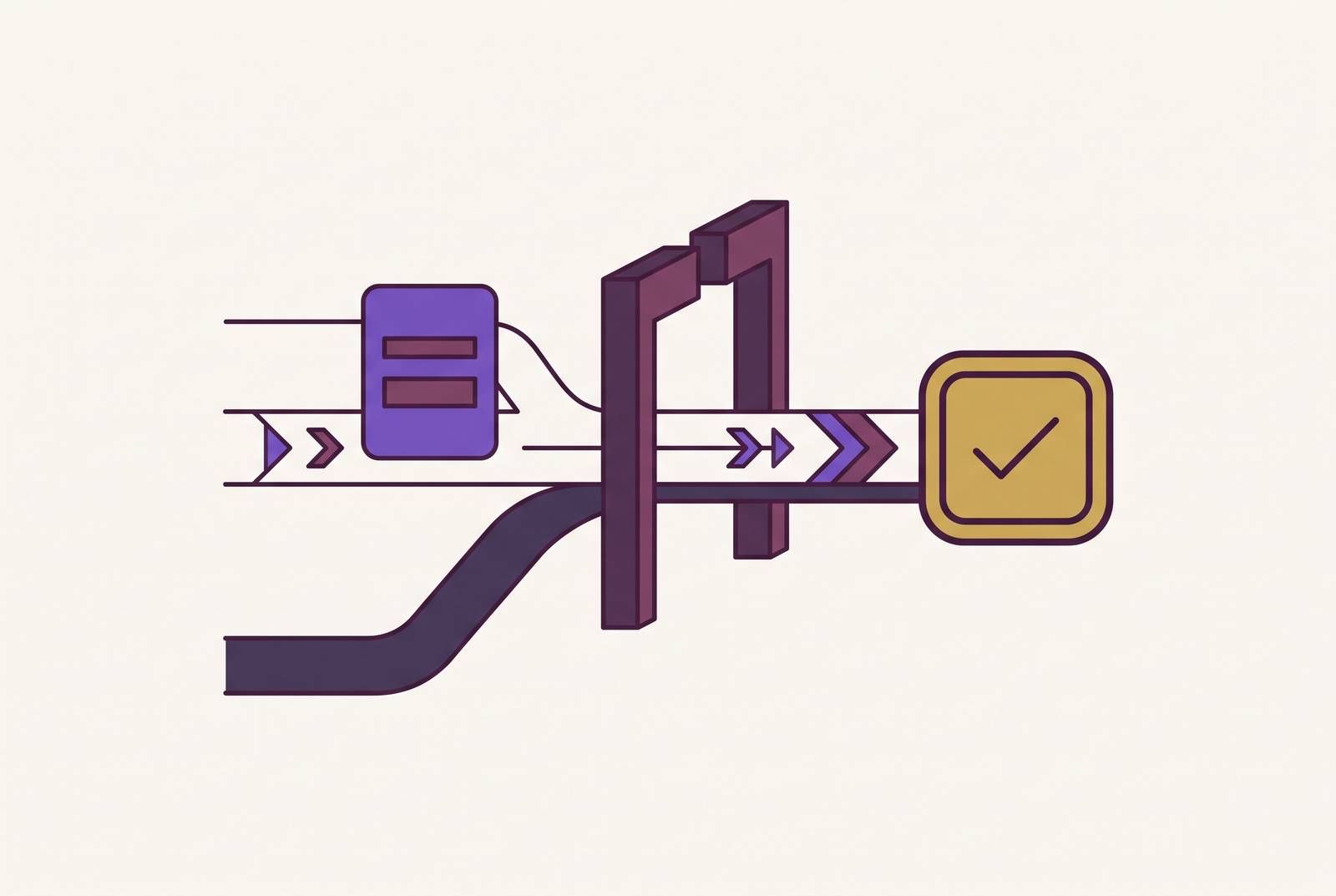
An NDA that takes five days to turn sits in a negotiation queue while a faster-moving competitor reaches the data room first. The delay is not caused by legal complexity. It is caused by a workflow that routes every agreement, routine or not, through the same manual queue. NDA auto-approval solves this when it is built as a routing system: risk-scored triage, playbook-matched clause review, and conditional escalation that reserves human judgment for the agreements that actually need it.
Why NDA approval is a workflow problem, not a document problem
A five-to-seven-day NDA turnaround is a process failure, not a drafting failure. The documents themselves are mostly standard: mutual or unilateral, a fixed confidentiality definition, a term length, a governing law clause. The hours disappear into routing, queueing, and re-review, not into hard legal analysis, which is the kind of end-to-end operational workflow that enterprise AI agent builders such as Eigenomic take on, putting agents into production within weeks. Ontra and Wakefield Research found that a majority of legal and deal professionals spend six or more hours per week on NDAs alone, time drawn entirely from the workflow rather than from any legal complexity in the documents. The downstream cost is delayed partnerships and missed business opportunities.
In private equity the consequence is concrete. Every day an NDA sits in a negotiation queue is a day a faster-moving competitor can access the data room first. The fix is not faster lawyers. It is a workflow redesign that routes the routine majority away from lawyers entirely, sending only the deviations and edge cases to human review. That distinction shapes everything that follows.
The triage principle: how incoming NDAs get classified before any review begins
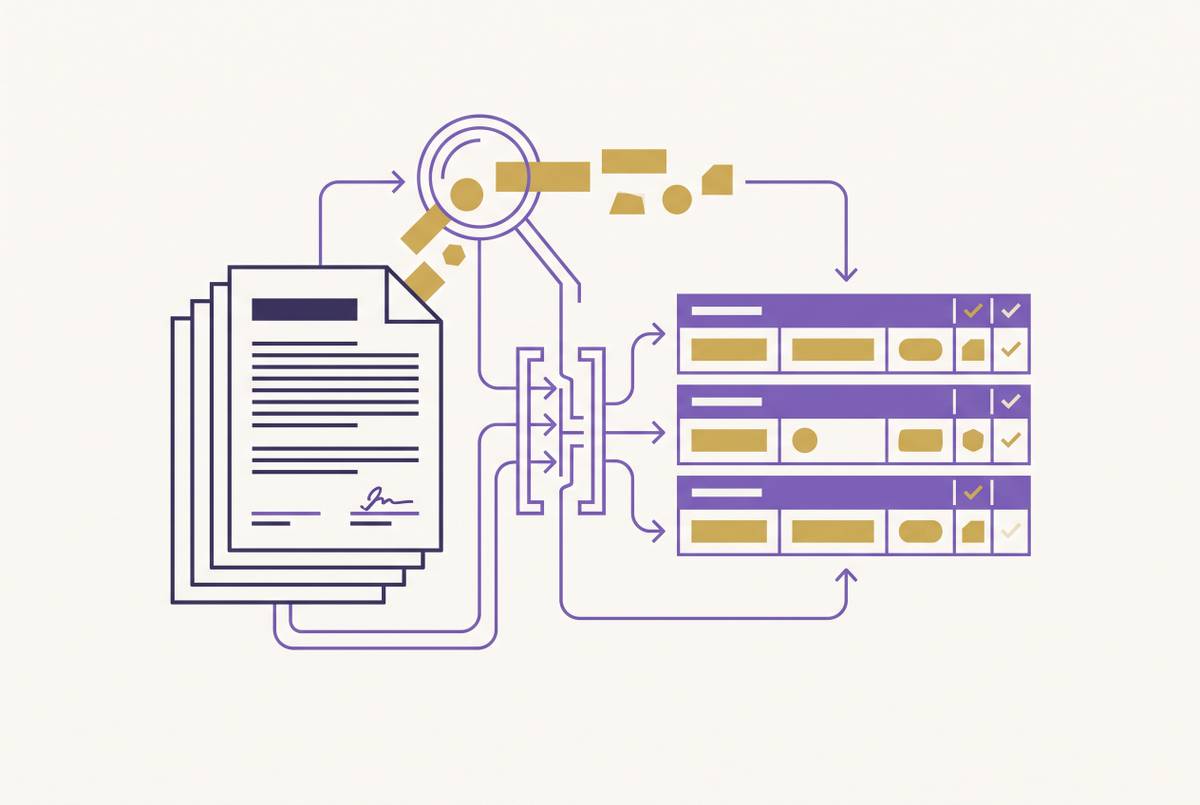
The entire auto-approval architecture rests on a single upstream decision: classifying each incoming agreement by type and risk before a human or an AI agent spends any time on it. Classification happens at intake. The system detects whether the NDA is mutual or unilateral, whether it uses the organization's own template or a third-party form, and whether any surface-level signals place it outside the standard risk envelope. Jurisdiction, industry, and counterparty type are the signals that matter at this stage.
The principle is straightforward: automation should handle intake and classification without legal involvement for standard NDAs, and legal should only see agreements that deviate from approved terms. Ontra's workflow illustrates the intake step concretely. An incoming NDA is forwarded to a dedicated inbox, AI automatically detects key terms on receipt, and sends an email confirmation. There is no manual sorting or routing required.
The obvious objection is that classification errors push high-risk agreements into the auto-approval lane. The answer is that classification is only the first gate, not the only one. The risk-scoring layer that follows is what catches those cases. Classification feeds directly into scoring: it establishes what kind of agreement this is and which playbook applies, and scoring then determines whether that agreement can close autonomously.
Risk scoring: how the workflow decides which contracts auto-approve and which escalate
A risk score assigned at intake is what separates contracts the workflow can close autonomously from those it must escalate. Without this layer, auto-approval is guesswork. The scoring mechanism evaluates incoming third-party agreements against the organization's standard positions on key terms: definition of confidential information, term length, carve-outs, jurisdiction, and governing law.
Contracts that score within the approved band on all key terms can be approved immediately. Contracts with one or more deviations are routed to legal with the deviations flagged. Sirion's Issue Detection Agent performs risk and deviation detection against established playbooks, identifying potential issues before they surface as compliance problems.
Cross-border NDAs require an additional scoring dimension. Jurisdictional variation in enforceability, local language requirements, and regulatory constraints each add risk that a single global score would miss. Sirion's global NDA framework addresses this through jurisdiction-specific playbooks that standardize process while accounting for local legal requirements.
The strongest objection here is accuracy. AI clause identification on standard NDAs is high but not perfect, and a misclassified clause in a cross-border or non-standard agreement carries real liability. The structural answer is that the scoring system is calibrated to escalate on uncertainty, not to approve it. The first cohort of auto-approved agreements should be shadow-reviewed to validate that the threshold is set correctly.
Playbook-matched clause review: what the AI actually checks and how it decides
Auto-approval only holds up legally and operationally when the AI's clause-by-clause decisions are grounded in a documented, pre-approved playbook, not in a general-purpose language model's inference. A legal playbook encodes the organization's preferred, fallback, and final positions for each key clause: definition of confidential information, exclusions, term and termination, return-of-information obligations, governing law. And the playbook is authored and owned by legal, not generated by the AI.
Ontra's playbook model shows how this works in production. The customer's digital playbook guides every negotiation round, preferences are synced digitally across teams, and it creates a single source of truth. Where a counterparty's language deviates from a preferred position, the agent surfaces the deviation, proposes the pre-approved fallback language, and flags it for confirmation, rather than accepting or rejecting unilaterally.
The architectural requirement is retrieval-augmented generation grounded in verified source documents. Deploying a general-purpose LLM without this grounding is a critical failure mode for legal review. Automation without a playbook replicates that problem at scale.
Conditional routing: what happens when the workflow cannot auto-approve
A well-designed auto-approval workflow is defined as much by its escalation paths as by its approval logic. The routing rules for non-qualifying agreements determine whether the whole system is trustworthy. Escalation triggers fall into three categories: a clause that falls outside the playbook's coverage entirely, a risk score above the approval threshold on one or more dimensions, or a counterparty or jurisdiction flagged for additional scrutiny.
When escalation fires, the agent hands off to a human reviewer with a structured brief. This is not dropping the document in a queue with no context. It is a bounded handoff. Ontra's model routes agreements to a vetted member of its Legal Network, who reviews the AI-assisted markup, applies professional judgment, and returns a first markup to the counterparty within 24 hours. The human step is time-limited, not open-ended.
Escalation and exception are different routing outcomes, and a production workflow must distinguish between them. The routing decision itself must be logged: which rule fired, why, and who received the escalation. That log is what allows the workflow to be audited and improved over time, and it is what the next section builds on.
The full NDA lifecycle in production: drafting, redlining, execution, and post-signature tracking
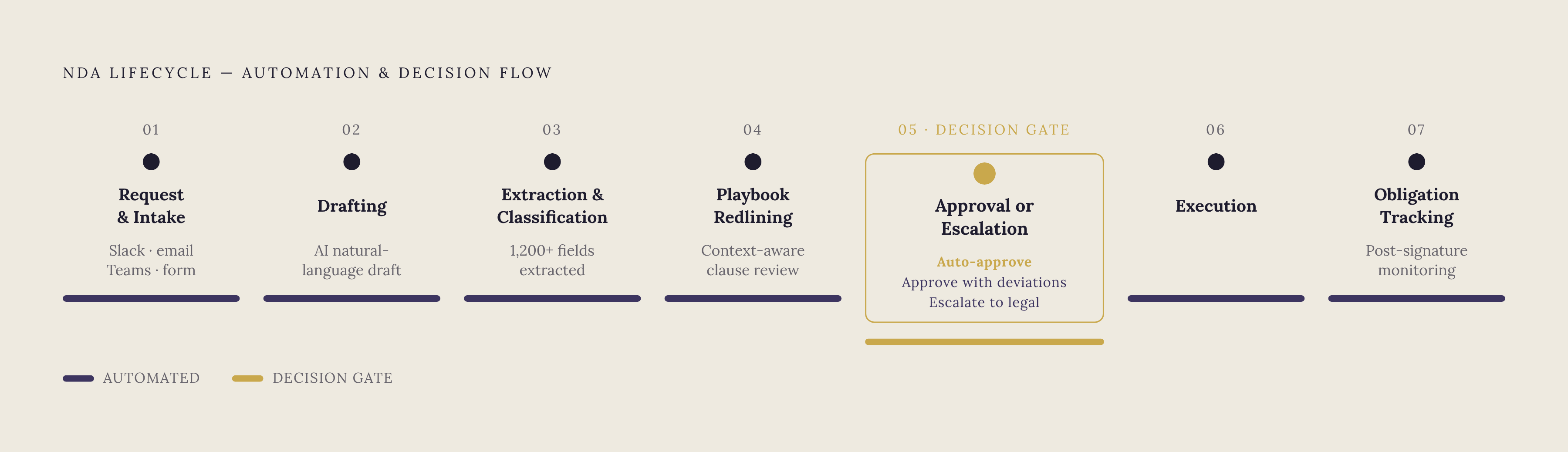
Auto-approval is one step in a seven-stage lifecycle. An organization that automates triage but leaves drafting, redlining, execution, and obligation tracking manual has not solved the throughput problem. The stages run from initial request through post-signature obligation management, and they can be handled within a single platform or orchestrated across integrated tools, depending on the organization's existing stack.
Stage 1 is request and intake. Business users submit NDA requests through a self-service form, Slack, email, or MS Teams integration. Stage 2 is drafting. Sirion's AskSirion agent supports natural language drafting, leveraging past insights and approved language.
Stage 3 is extraction and classification. Sirion's Extraction Agent extracts over 1,200 fields including obligations without requiring coding expertise. Stage 4 is playbook-matched redlining. Sirion's Redline Agent provides context-aware clause redlining with detailed explanations, identifying issues during redlining compared to manual review and enabling AI-assisted issue remediation.
Stage 5 is approval or escalation. The risk score and playbook match determine the routing outcome: auto-approve, approve with noted deviations, or escalate to legal. CFlow's no-code workflow model adds that automation should provide full audit trails and contract version control throughout, not just at the approval stage.
Audit trails and governance: what makes the workflow acceptable to legal, risk, and compliance
A well-instrumented auto-approval workflow is easier to audit than a manual one, precisely because every decision step is logged, timestamped, and attributable. Every step the agent takes should produce a record: which clauses it extracted, which playbook rules it checked, which deviations it flagged, where a human approved or overrode it. When those steps land in a single audit trail, a reviewer or auditor can reconstruct exactly why a contract was flagged, escalated, or approved.
Manual NDA workflows produce no such record. The scorecard is the artifact that turns an AI decision into a reviewable record. Governance lag is the real risk. The audit trail is what prevents both.
Where auto-approval breaks down: the failure modes to design against
Auto-approval works for qualifying agreements. The workflow fails when the qualifying logic is miscalibrated, or when the agreements sent through it are not actually routine. The "low-risk" framing for NDAs collapses in specific cases: cross-border agreements where enforceability varies by jurisdiction, non-standard counterparty NDAs with unusual clause structures, and agreements in regulated industries with sector-specific disclosure obligations. These require human judgment, and the triage layer must be calibrated to catch them.
Cross-border complexity is the most common underestimated failure mode. Sirion's global NDA framework supports over 100 languages and more than 70 countries precisely because a single-playbook approach fails when jurisdictional requirements diverge. Jurisdiction-specific playbooks are the architectural response. Citation verification and playbook-grounded inference are non-negotiable in legal AI deployments.
Scope creep in the auto-approval lane is the most operationally common failure mode. As volume grows, teams are tempted to push increasingly complex agreements through the automated lane to avoid bottlenecks. This requires active threshold governance, not just initial configuration. The auto-approval workflow addresses this only if routing rules prevent non-standard agreements from being resolved without qualified review. The fix for each failure mode is the same structural principle: the system escalates on uncertainty rather than approving through it, and the escalation threshold is reviewed and tightened as the playbook matures.
How to assess whether your organization is ready to deploy an auto-approval workflow
The bottleneck to NDA auto-approval in most enterprises is not the technology. It is the absence of the operational preconditions the workflow requires to function safely. Five preconditions determine readiness.
First, a documented legal playbook. Bind's analysis notes that enterprise legal teams handle anywhere from 200 to 2,000-plus NDAs annually. At the high end, the math of manual review makes automation a business necessity.
Third, a defined NDA taxonomy. The organization needs to know what types of NDAs it issues and receives, in what volumes, and which types are genuinely routine. The workflow needs to connect to the organization's contract repository, e-signature platform, and if applicable its CRM or deal management tools. A workflow that lives in a separate system from where contracts are actually managed creates its own overhead.
Fifth, ownership. The payoff for getting preconditions right is measurable ROI achieved faster and sustained longer. The precondition work is not overhead. It is the reason the workflow delivers results from day one rather than stalling in configuration.
Measuring what an auto-approval workflow actually delivers
The value of an NDA auto-approval workflow is measurable in contract cycle time, legal hours recovered, and risk items surfaced. Each of these requires a pre-deployment baseline to be credible. The primary metrics are average NDA cycle time before and after deployment, volume of agreements processed per legal FTE, number of risk deviations flagged per cohort versus a human-only review baseline, and rate of escalation, which indicates whether the auto-approval lane is properly calibrated. Sirion's platform benchmarks report faster contract review cycles of 60% as a primary measurable outcome, with negotiation cycle improvements cited as a secondary, downstream benefit of their AI redlining agent. Reporting cycle time reduction alone understates the value and risks rejection at CFO or audit committee level.
The baseline problem is structural. The minimum requirement is to log current cycle times, error rates, and legal hours per NDA before the workflow goes live, so that post-deployment figures have something to compare against. The escalation rate is itself a quality metric. A well-calibrated workflow escalates a predictable fraction of agreements. An escalation rate that is too low suggests the risk thresholds are too permissive, and one that is too high suggests the playbook needs expansion to cover more cases automatically.
For organizations moving from pilot to production, the measurement infrastructure must be in place before go-live, not added afterward. An NDA auto-approval workflow is not a tool that reduces legal work. It is a system that directs legal effort to the agreements where it actually matters, while producing a complete record of every decision made on the agreements it handles autonomously.