Automating Outside Counsel Billing Guideline Enforcement
AI can flag billing violations, but only owners recover the money.

Automating outside counsel billing guideline enforcement turns written spending controls into a repeatable review process. Manual review cannot keep up with the number of legal invoices and the complex charges they contain. AI can apply rules across line items and route exceptions, but recovering the spend those rules were written to protect also requires current data, controlled decisions, and people responsible for acting on flags.
Why outside counsel billing guidelines fail before enforcement even begins
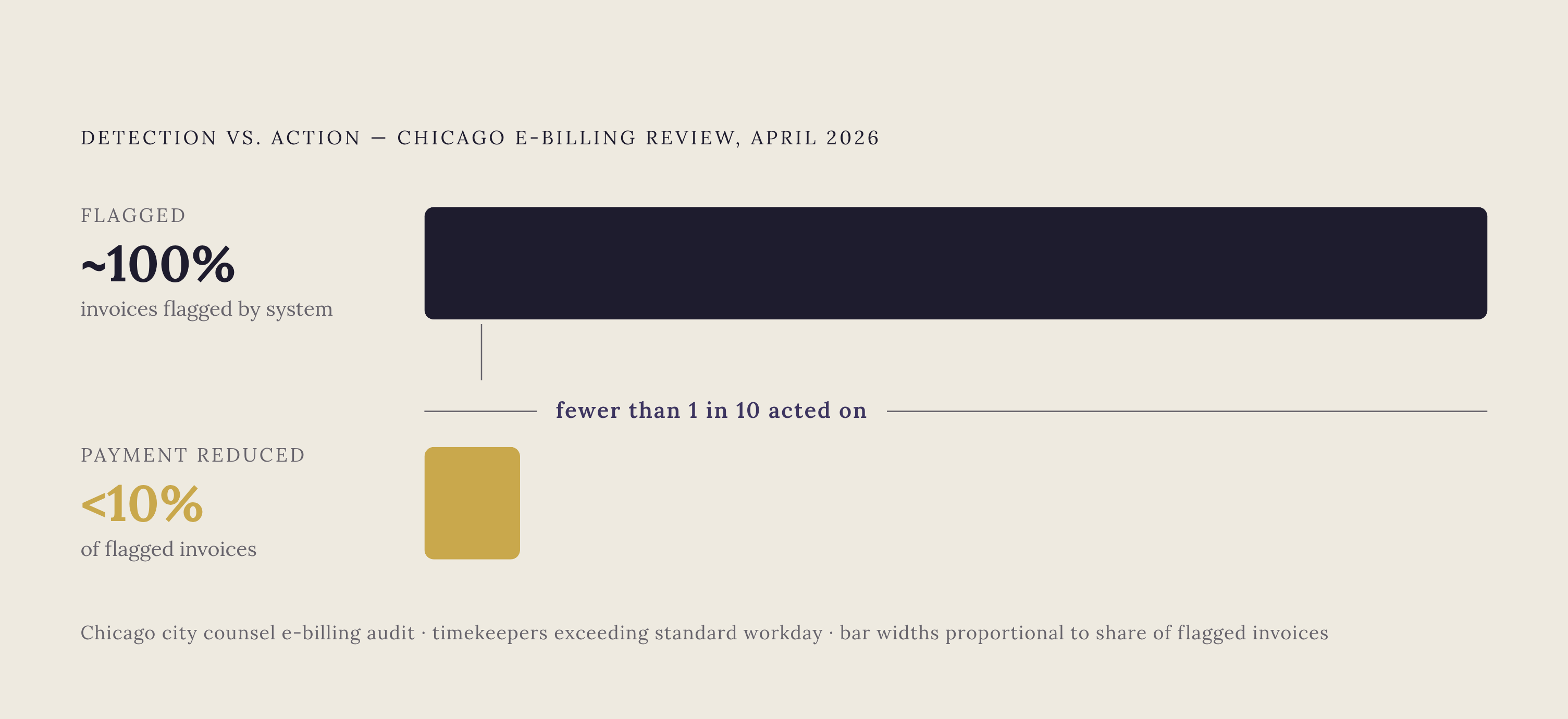
In the Chicago city billing case reported in April 2026, an e-billing system flagged a large number of invoices involving timekeepers logged at more than a standard working day in a single day. Yet payment was reduced on fewer than one in ten. Detection was not the missing step in that process. The gap lay between identifying an outlier and assigning someone to decide what to do about it.
That gap is structural. Legal departments have hundreds or thousands of invoice line items to check from different firms and matters. Each line may require comparison against approved rates, staffing rules, narrative standards, budget caps, and engagement terms. A single invoice can combine block billing, vague descriptions, unapproved timekeepers, administrative charges, and rate exceptions.
An in-house attorney checking every entry has less time for the legal work the department exists to handle, so review is rationed. Even a sound policy cannot protect spend consistently when its application depends on how much attention a reviewer can spare.
How law firm AI adoption is making the enforcement gap more expensive to ignore
When AI accelerates drafting, research, or document review, historical expectations about the time those tasks require become less reliable. The billable hour measures time. An entry can therefore comply with an approved rate and contain a clear description while still requiring scrutiny of the hours charged.
Legal Bill Review frames this shift as a question of whether the hours billed were reasonable for the work the matter actually required. As work takes less time, an invoice needs to be considered in that context if the client is to benefit from the efficiency gain. This changes the billing relationship.
The distinction also defines the limits of conventional enforcement. A rules-based engine can compare rates, find duplicates, and flag entries for administrative work. Those checks do not establish whether the hours were justified. Understanding the work behind an entry requires context that a scan cannot supply, creating a new review responsibility for legal departments that calls for judgment.
What outside counsel billing guidelines actually contain and why that complexity defeats manual review
Outside counsel guidelines are layered rule sets. Rate provisions set out the approved charges for each timekeeper, rate caps, and the approval needed before a new timekeeper starts work. Staffing provisions address the number of people assigned to a matter or hearing and unnecessary duplication. These are different tests, even when they apply to the same entry.
An entry such as “work on matter” may fail a specificity requirement, while a detailed entry may still violate a prohibition on block billing by combining distinct tasks under one time figure. Administrative exclusions cover clerical activities, scheduling, filing, and copying. Research provisions determine what research is billable and whether AI-assisted research receives different treatment.
Other checks reach beyond the description of legal work. Expense rules govern travel thresholds and approvals for disbursements above a set amount. Invoice provisions cover submission deadlines, required formats, and budget approval triggers. Mitratech identifies LEDES as the standard for e-billing compatibility.
Chuck Kable’s experience at Cardon Outreach illustrates the effort involved in applying these distinctions manually. He questioned why three firms were on one matter, moved billing increments from quarter-hour to tenth-of-an-hour, and stopped administrative charges. Those gains required challenges at the line-item level. The workload compounds across firms because agreed rates and matter-specific terms differ, leaving reviewers to determine not only whether an entry complies, but which rules govern it.
How AI applies billing rules at line-item level: the mechanics of automated enforcement
Automated enforcement begins by making the governing rules available as structured references. The system needs the guidelines, engagement letters, approved rate schedules, and matter budgets that apply so it can check invoice lines against them. Scope is part of the rule itself. A timekeeper cap or budget threshold for one matter must remain distinct from a block billing prohibition that applies across all matters.
Rate checks compare the billed rate with the approved rate for that timekeeper. Approval checks flag a new timekeeper who appears without prior authorization. These are among the clearest comparisons because the billed entry can be tested against a defined reference.
Narrative analysis checks the parts of the invoice that have less structure. It finds entries that group separate tasks under one time figure, describes possible block billing, and flags the entry for a payment decision. It also evaluates whether a description concerns excluded clerical, scheduling, or filing work. Vague entries are tested against the department’s specificity requirements. Pattern detection adds potential duplication and unusual staffing to the review.
Routing then separates findings by the decision they require. A structured exception queue distinguishes confirmed rule violations, such as rate breaches or unapproved timekeepers, from pattern flags that need contextual review. Legal operations and finance can focus their manual review on those exceptions. The output is a first-pass review.
Where human judgment remains necessary and how it fits into the enforcement workflow
An invoice alone cannot establish whether a staffing choice was appropriate. Several timekeepers may be warranted by a matter’s complexity, scheduling orders, or engagement terms. At the same time, a description that sounds right may hide work that does not fit the matter’s history. AI can identify the question without possessing the context needed to answer it.
Reasonableness of hours presents the same boundary. A reviewer must consider the work actually required, including the implications of AI-assisted delivery, rather than treating compliance with a rate schedule as sufficient. Matter context mismatches also need someone who can judge whether the billed work followed the scheduling order and engagement.
The Chicago case demonstrates the operational consequence of leaving that responsibility undefined. Outlier detection did not reliably lead to payment reductions because the gap between flag and decision remained open. A review queue needs an owner and an action path. Automation saves time on routine checks only if the exceptions it flags reach people who can resolve them.
“Permanent reduction” rules offer a narrower route for the clearest violations. Recurring administrative charges or specific rate cap breaches can receive automatic adjustments, with human review if the adjustment is appealed. That is a defined enforcement policy. It frees people from repeating the same simple check so they can judge disputes and findings that need context.
What the enforcement mechanism recovers and what it does not
Automated enforcement addresses spending after work has already gone outside the department. It detects charges that do not comply with the agreed terms and reduces the effort required to review them. Its financial reach is therefore bounded by the invoices submitted. Whether the work should have been outsourced in the first place falls outside its scope.
Provider reports show that the tools can save money, but leave open how they rank against each other. Wolters Kluwer ELM Solutions reports up to a 10% annual reduction in legal spend from AI-powered bill review. Legal Decoder reports meaningful savings on external legal spending. PERSUIT and Apperio report a notable reduction in outside counsel costs and significantly less time spent managing billing and approvals. Onit’s research study found that large language models substantially outperform experienced lawyers on invoice review accuracy at scale.
Those findings support a consistent first-pass review mechanism. Bringing routine work in-house prevents the invoice from existing at all and is the larger strategic lever, while enforcement offers the faster, more immediately measurable gain. The two approaches can operate together.
Mitratech identifies visibility into spend by matter type, practice area, and firm as a basis for better panel allocation, rate negotiation, and budget forecasting. That value depends on connecting enforcement results to the broader spend record. Rejected charges save money right away, and the data from those checks can help guide what the department buys in the future.
What production-ready enforcement infrastructure actually requires before go-live
Reliable deployment depends on review capability, governance, and integration. Many initiatives fail because the operating layer needed to handle real invoices is missing. A system may identify violations convincingly in a pilot yet remain unfit to act at production scale. The practical distinction is whether its permissions, decisions, and interventions are controlled from the outset.
Deployment needs sufficient volume, rule-demonstrable cases, and a measurable baseline. Invoice review usually fits because repeated rate breaches, block billing, and administrative charges can be checked against clear rules. Savings can be measured against approved invoice totals. However, a department with too few invoices to justify integration costs, or a process requiring fresh judgment on nearly every entry, does not have the same automation case.
Before go-live, an AI agent needs non-human identity governance and permissions scoped to least privilege. Behavioral monitoring must provide trace-level observability from the first day of production. Human approval checkpoints must be designed into the action categories that require them before go-live. A kill switch must let people suspend the system at once, and retention schedules for audit logs must meet the regulatory requirements that apply.
Rule maintenance requires equally explicit control. Billing guideline “learning” must not silently alter the terms the system enforces. Changes to encoded rules should need approval, and the log should record each change and who made it. Otherwise, a department cannot know whether an adjustment reflects its agreed policy or an unapproved change in how that policy is being applied.
How to assess whether a legal department is ready to deploy enforcement automation
Before choosing a go-live date, a department should check how its rules are documented, the quality of its data, who owns exceptions, and how integration will work. The purpose is to identify operating gaps. Guidelines that exist only as PDFs still need to become references the system can evaluate. Vague provisions require attention because they produce inconsistent flags.
The same assessment should check whether approved rates, timekeeper records, and matter budgets are up to date and easy to access. Stale reference data produces false positives that erode confidence in the review. Exception handling needs named responsibilities, thresholds, and time frames. Without them, the department recreates the Chicago case’s gap between identifying a concern and resolving it.
The output needs integration to become part of the department’s financial record. Enforcement must connect with the e-billing and enterprise legal management systems used for matter management and invoice approval to support useful spend visibility. An AI Operations Audit provides a structured review of strategy, governance, data controls, and operational readiness. A vendor implementation assessment evaluates fit for a specific tool.
The useful output is a remediation sequence. It identifies which rules need encoding first, which data sources need connecting, and which exception workflows must be defined before live invoices enter the process. That sequence turns the decision to automate into an operating plan. Deployment is ready when the department can apply the right rules, trust the reference data, and assign responsibility for the decisions that follow.