Preferred Panel Management With AI Workflow Routing
AI agents need live credentialing data and human oversight to route work safely.
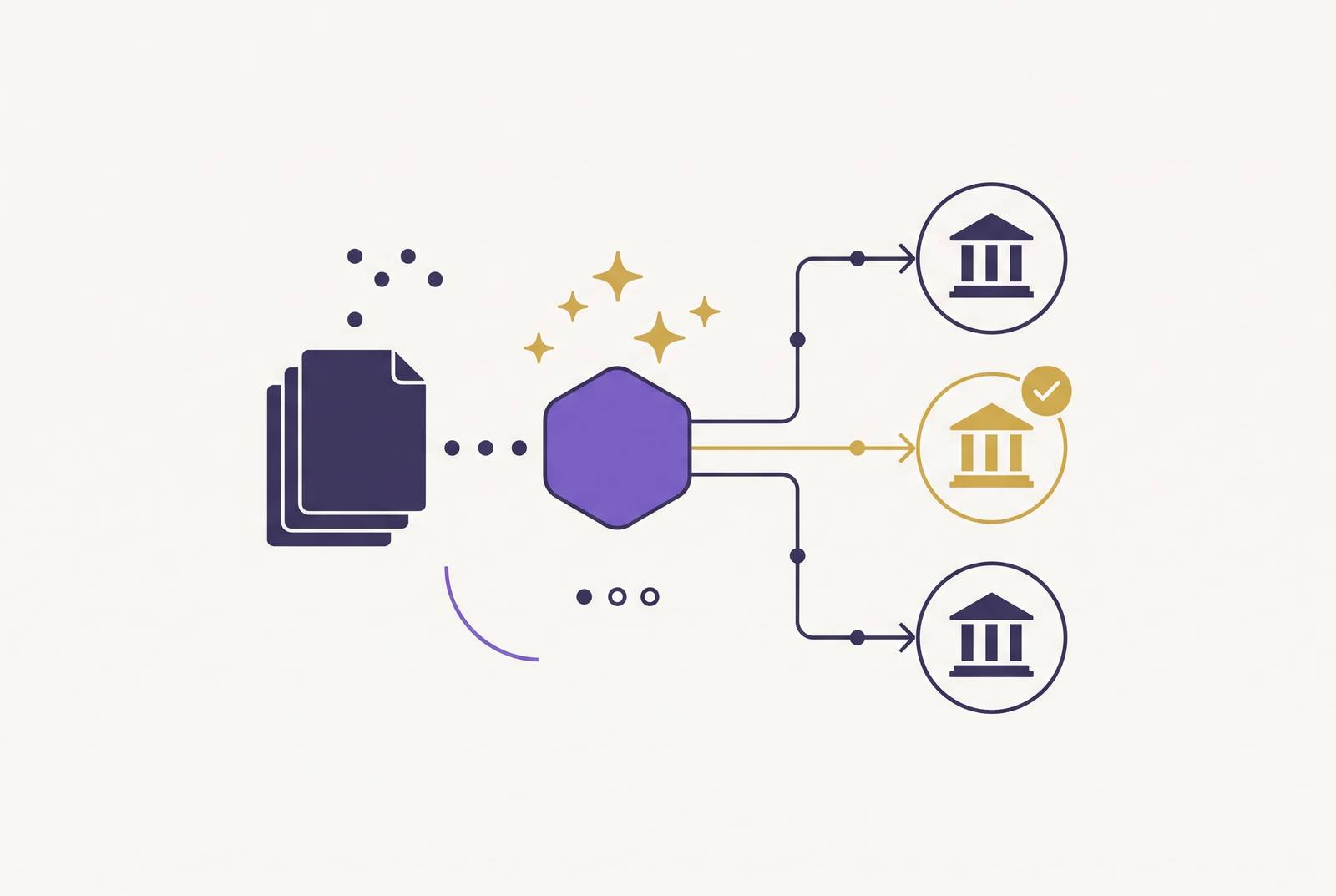
Preferred panel management with AI workflow routing uses the context to decide who gets work in place of rigid assignment rules, while keeping the approved panel and its compliance boundaries. The operational gain depends on more than model quality. Before a routing agent can safely take on live work, it must own the handoff, use current credentialing data, and stay within limits that people set and can measure.
Why preferred panel management breaks under modern claims and case volume
Preferred panel management directs claims, cases, or service requests to credentialed, pre-approved vendors, attorneys, or repair facilities. Its routing logic was designed for predictable, lower-volume work. A static rule tree checks claim type, jurisdiction, and severity, then assigns a vendor or escalates to a human adjudicator. That structure works only under the conditions its rules were built to handle. When intake falls outside them, another person must interpret what the rules cannot.
Three failures follow from that dependence on predefined conditions. An unusual damage pattern, conflicting case signals, or a referral spanning coverage categories enters a catch-all queue because the tree cannot read the missing context. Meanwhile, panel rosters, credentials, and preferred-vendor agreements can change while the routing rules still rely on what was true before. Work can therefore reach a vendor whose status has lapsed. As volume rises, exception queues grow faster than organizations can staff them, turning human review from a safety valve into a bottleneck. In automotive claims, legal intake, and healthcare prior authorization, these failures also put compliance at risk.
What AI workflow routing actually replaces and what it keeps
AI workflow routing replaces the decision layer that assigns work and keeps the panel itself in place. The credentialing structures, vendor agreements, and compliance boundaries stay in place. The intelligence layer interprets intake signals, including damage descriptions, case history, and patient record flags. Planning and retrieval logic then apply configured thresholds to determine the appropriate handler category. These are separate architectural decisions, rather than capabilities supplied by choosing a reasoning model alone.
Execution integrations link those decisions to the claims platforms, case management systems, scheduling tools, and credentialing databases that carry them out. The action layer sequences the work, selects a deterministic rule, an AI agent, or a human reviewer, and triggers the next step from the previous outcome. Memory and observability capture routing results and flag systematic mismatches for threshold adjustment. This closes the operational loop without giving the model unrestricted authority. Operators set how high confidence must be for automatic resolution, and cases with low confidence or high stakes go to human review.
A chatbot answers prompts but does not own assignment or update the case record. A copilot supports a human decision without executing routing autonomously. A routing agent interprets intake, assesses handler fit, executes assignment, and hands work to the next step without waiting for a person to initiate each action.
How the routing layer handles the three situations static rules cannot
Unanticipated context requires interpretation beyond the fields anticipated by a rule tree. In a single reasoning pass, the agent reads the damage description text and prior claim history, along with geographic routing constraints and which vendors are available. The distinction is the breadth of the intake considered. A case can stay out of human review even when the information it needs falls outside a predefined field. It can still require review when the combined signals leave confidence below the operator’s threshold.
Stale panel data requires a different remedy. The routing layer queries a live credentialing store when it assigns work, rather than relying on status assumptions embedded in rules. Querying a live credentialing store at assignment time is a data architecture requirement.
Exception overflow is addressed through configurable escalation thresholds. Operators set the automatic-resolution boundary to match organizational risk tolerance and adjust it as outcome data accumulates. Human reviewers then get work that is truly unclear or high-stakes, while cases the old tree failed to anticipate no longer all need their review. In healthcare, the practical division can include reading denial letters and assembling corrected documentation before routing the result for nurse approval. Automation prepares the handoff without removing the approval checkpoint.
What vertical compliance requirements add to the routing architecture in insurance, legal, and healthcare
Insurance routing requires a reconstructable decision trail. Aspire General Insurance’s January 2026 launch with Liberate illustrates an uninterrupted first notice of loss workflow. Customers call the AI voice agent Nicole or submit a digital form, and data transfers into the claims system in real time. The system creates a claim number, starts internal workflows, and sends confirmations by text or email. For panel assignment, the additional audit requirement is explicit. The carrier must be able to reconstruct why a claim reached a particular facility, the confidence level, and the outcome.
Legal routing has a narrower boundary for autonomy. Intake agents can collect case information and interact with calendars to schedule consultations, but substantive panel selection requires human confirmation. Legal work involves ambiguity, negotiation, and contextual judgment that predefined templates cannot capture. The routing layer must therefore surface the case to a credentialed attorney before confirming a substantive panel assignment. Triage and scheduling are not authority to make engagement decisions.
The AMA identifies prior authorization as a manual, time-consuming process that diverts resources from patient care. Reading denial letters, preparing corrected documentation, and routing for nurse approval help with that time-consuming paperwork. Protected health information must also be covered at the agent layer itself. A business associate agreement that covers the database but stops short of orchestration leaves a gap in the deployment’s compliance coverage.
Why most AI routing pilots never reach production panel management
A controlled pilot can demonstrate assignment quality without establishing who owns a live routing failure. That is the organizational gap production exposes. If an agent directs work to a lapsed vendor, someone must own the decision, the exception, and the associated risk. Agent deployment without formal governance leaves those responsibilities unresolved. Better model performance does not settle them.
The allocation of deployment spending reinforces this distinction. Organizations that scale routing successfully devote proportionally more resources to evaluation infrastructure, monitoring tools, and operational staffing, and less to model selection than stalled organizations. Their total spending on AI may be no higher. Treating vendor selection as the deployment decision omits the functions needed to keep the workflow operating safely. Gartner forecasts that a significant share of agentic AI projects will be canceled by 2027 because of escalating costs, unclear business value, or inadequate risk controls. Those are identifiable operating failures that leave open the possibility of moving routing from prototype to production.
The operational criteria that define a routing agent ready for live panel management
Production readiness requires real users, accepted outputs, a responsible owner, explicit permissions, a support process, and a recovery path. The pre-deployment gate applies three criteria to the candidate workflow, which are high volume, rule-demonstrability, and measurability. Transaction volume must justify automation and generate enough outcome data to calibrate thresholds, while routing requirements must be demonstrable. A before-and-after metric, such as cycle time, misrouting rate, escalation volume, or vendor utilization, must exist before deployment begins.
SSO integration maps agent sessions to named human identities, while audit logging connected to a security monitoring system makes routing actions queryable. Sandbox isolation constrains agent execution, and incident response runbooks define the support response. For panel management, the audit trail is indispensable. It gives a carrier, law firm, or health system the means to reconstruct an assignment when a regulator, client, or auditor asks.
An AI Operations Audit assesses readiness across six domains before scaling is authorized. Business establishes whether the problem is bounded and valuable, while Data tests whether inputs are usable, lawful, and reliable. Security addresses access and sensitive information, and Governance assigns ownership of decisions, exceptions, and risk. Operations tests whether the system can be monitored, supported, and stopped. Measurement establishes whether value and failure can be tracked continuously.
Aviva provides a benchmark for measurable deployment. Its deployment of more than 80 AI models achieved a 23-day reduction in liability-assessment time, a marked improvement in routing accuracy, a sharp reduction in complaints, and a sevenfold improvement in Net Promoter Score. Aviva built monitoring and KPI infrastructure before deployment. Those results illustrate the value of that discipline.
What the measurement gap means for organizations that cannot tell whether their routing is working
A routing system can appear productive while moving its error costs into human review. If reviewers correct assignments without logging misrouting events, throughput receives credit and the exception queue absorbs the failures. The apparent gain is then incomplete accounting. KPMG’s Q3 2026 Global AI Pulse found that only a small minority of organizations consistently assess AI value against cost, with that practice much more common among organizations with established returns.
The corrective action is to define misrouting before the agent goes live. Every exception should be recorded as a typed event, including a wrong vendor, lapsed credential, or wrong coverage category. Exception rate and throughput belong on the same dashboard so that faster assignment cannot conceal more corrective labor. This makes the measurement boundary match the workflow boundary. It also gives threshold calibration a concrete basis, rather than leaving operators to infer quality from the number of completed assignments.
Organizations with fully integrated AI are more likely to report AI-driven revenue growth than those still piloting, at a ratio of nearly four to one. That association strengthens the case for measuring the deployed operation.
How routing ownership reshapes the roles that currently manage panel compliance
When an agent owns assignment, managers no longer spend the same effort approving routine routing decisions, chasing status updates, and reconciling exception reports. Their work shifts toward workflow design. They set the thresholds for when assignment is automatic and when a human must confirm it, look for patterns in exceptions, and update routing parameters as regulations or business priorities change. The responsibility remains human even when execution is automated. Its focus moves from individual handoffs to the conditions under which handoffs occur.
Reviewers face a corresponding change in workload. Escalated cases should be truly unclear or high-stakes, so reviewers need to judge the context, negotiate, or work with people in other functions. This change calls for planned training as well as written steps for the process. Governance also moves upstream, with its owner reviewing threshold configuration and exception logs on a defined cadence. That owner decides whether to give the agent more or less authority to act on its own, with permission still open to review after a successful launch.
What an enterprise deploying AI panel routing should expect in the first 90 days
Days 1–30 establish whether a workflow qualifies for deployment. An AI Operations Audit checks the six readiness domains, finds gaps in data quality, especially in credentialing records, and sets the thresholds for the first live work. The candidate workflow must meet the high-volume, rule-demonstrable, and measurable criteria. The output is a documented go/no-go decision. A proof of concept alone does not satisfy that gate.
Days 31–60 move the qualified workflow into constrained live operation. Human reviewers examine every auto-resolved case to validate the threshold setting and the completeness of exception capture. Misrouting events must be typed and queryable so that operational errors become usable evidence. This period tests whether the monitoring and support structure works with live assignments.
Days 61–90 use the first live outcomes to adjust thresholds and decide whether another workflow qualifies. Expansion is judged against the same three entry criteria. Autonomy grows only within the evidence available. For an enterprise considering deployment, the logical first step is therefore a readiness audit that establishes the workflow’s limits, ownership, and measures before the routing agent takes control.