AI Contract Intake Triage for In-House Legal Teams
AI can sort legal requests before attorneys see them, turning chaos into prioritized work queues.
- Written by
- Priya Subramaniam
- Published
- October 14, 2026
- Reading time
- 10 min read
What this covers
In-house legal departments do not lose control of their workload because the legal questions in front of them are hard. They lose control because of what arrives before any legal judgment gets applied: a volume of requests, in no particular order, from no single channel. CLOC's State of the Industry research found that workload and bandwidth rank as the top challenge for most legal departments: a large majority expect demand to keep climbing, but headcount stayed flat for more than half of the departments surveyed. That gap between rising demand and fixed staff does not get absorbed somewhere painless. It lands on intake, the point where every request, regardless of size or stakes, first has to be read, understood, and assigned.
Requests arrive through email, Slack, procurement tickets, and executive messages, all at once, with no shared queue to catch them. A lawyer ends up watching four or five channels just to know what's being asked of them, time spent monitoring rather than practicing law. A system with five entry points and no funnel will drop items by design, simply because the volume overwhelms any one person's ability to track it. If there's no formal intake process, whatever request is loudest or most recent wins attention, so low-stakes noise from a chatty Slack channel can push ahead of a high-risk contract that landed quietly in an inbox because it came through the wrong door.
The deeper cost of this disorder is that it makes legal illegible to the rest of the company. A department that cannot see its own request volume cannot show where its capacity is actually going, cannot point to data that justifies another hire, and cannot describe its own bottlenecks in terms the business will act on. Legal ends up busy without being able to prove it, which is a weak position to negotiate from when budget season arrives.
What manual triage costs the legal team doing it
Manual triage is a recurring draw on attorney time that compounds, request by request, into real delay across the business. Someone has to open every incoming item, figure out what kind of matter it is, decide who should handle it, and send it along, and none of that is legal work in any meaningful sense. Sandstone's 2026 analysis notes that manual data entry alone can eat up hours each week that would otherwise go to the legal judgment attorneys are actually trained for.
That lost time does not stay contained to the triage step. Longer triage produces longer cycle times, and longer cycle times mean the business sits waiting on legal to move. A request from the general counsel's own leadership, if it gets buried in a cluttered inbox, does not just slip a contract by a day or two. It can stall a deal outright, and it chips away at how much the rest of the company trusts legal to keep pace with it.
Once that pattern repeats, the business adapts around it in ways that make triage even less reliable. Sales starts marking every request urgent because urgent is the only label that gets a response. Procurement routes contracts through the employment queue because that's the inbox someone happens to be watching. Genuinely high-risk items arrive mislabeled, and whether anyone catches that depends on how carefully an overloaded attorney happens to be reading that day.
How the AI reasoning layer works before the human queue
AI contract intake triage does not just make the inbox faster to scroll through. It inserts a reasoning layer ahead of the human queue, one that turns an unstructured flood of requests into matters that are already classified, routed, and prioritized before an attorney looks at a single one. That layer does four distinct things: it classifies the incoming request by type and complexity, pulls out the relevant business context, routes the request to the right attorney or playbook based on intent and historical patterns, and either escalates it for human judgment or deflects it if it doesn't need one.
Sandstone's 2026 analysis describes this as happening the instant a request comes in. The system classifies the request type, assesses urgency, and routes it to the correct owner based on intent, business context, and historical pattern, all without waiting for a lawyer to open the queue and sort through it manually. That is a different model from a faster inbox. The sorting decision gets made before a human is in the loop.
The context the system attaches to the request is what separates this from a basic form router. When something arrives, the system surfaces the business signals around it: the deal stage, the customer's value, prior contract history, relevant organizational context. The attorney who eventually touches the matter sees the full picture the moment they open it, instead of spending the first twenty minutes reconstructing background that someone else already knew.
Self-service deflection works alongside that routing function. Routine, high-volume questions, policy lookups, standard NDA guidance, process questions about how a particular workflow runs, can be answered automatically from approved templates and playbooks. The request resolves on its own and never lands in an attorney's queue. That is where a meaningful share of attorney time gets returned: from never seeing the easy matters, not from working faster on hard ones.
The three technical models in-house teams are choosing between
The intake and triage market has settled into three distinct technical approaches, and the right one for a given team has less to do with which vendor has the loudest marketing and everything to do with where the intake failure actually sits inside that team's operation.
The first model is contract lifecycle management with an AI layer built in. Platforms like Ironclad handle the full span of contract work: intake, routing, redlining workflows, e-signature, the repository, and reporting, with AI added on top for clause extraction, risk flagging, and AI-assisted review. This model fits teams that treat contracts as a core operational asset at real scale, where the contract lifecycle itself, not just the inbox feeding it, needs a single system of record.
The second model is standalone AI intake and triage. Platforms like Checkbox focus narrowly on capturing, classifying, and routing incoming legal requests, and they typically extend into knowledge FAQ functions, answering internal policy questions directly without requiring a lawyer. This model suits teams drowning in request volume with no visibility into where that demand is coming from, regardless of what CLM or matter management system sits downstream of intake.
These two models are not interchangeable, and a third consideration follows from that: a team needing full contract lifecycle coverage is solving a different problem than a team that only needs the intake layer sitting on top of systems it already runs. Picking between them starts with an honest look at where the actual failure sits, not with whichever product a procurement cycle happened to surface first.
What a production-ready intake agent requires to function reliably
The most common reason AI intake triage fails in practice has little to do with the underlying model. It comes down to the absence of the operational groundwork that model needs in order to produce outputs anyone can trust.
Mitratech's October 2026 analysis lays this out: before AI can generate anything useful, legal teams need a clear system of record for matters, spend, documents, and workflows, clean and structured data feeding into it, solid permissions and access controls, and standard operating procedures that define how the work is supposed to happen. Skip that groundwork and AI does not fix the team's weaknesses. It amplifies them, routing requests faster into a system that was already disorganized.
Data architecture carries a particular kind of risk in legal work that it doesn't carry in most other back-office functions. If you run a large language model for legal intake without a retrieval-augmented generation architecture that grounds its outputs in verified source documents, you open the door to hallucination, and in a legal context, hallucination carries material liability consequences, not just an embarrassing error. Verifying every citation the system produces is not optional.
Privilege and confidentiality sit at the center of this as well, not at the edge of it. Swiftwater's 2026 guide points to a federal judge's ruling in US v. Heppner, which found that information entered into publicly available, consumer-grade AI tools without attorney direction may not carry privilege protection. Purpose-built legal AI platforms are built to address that specific exposure, through zero-data-retention architecture, SOC 2 Type II compliance, and confidentiality terms written for legal use, protections that general-purpose consumer-tier tools typically do not offer.
Human review stays mandatory under the current regulatory environment, because it is a structural requirement, not just a courtesy step. Mitratech's agentic AI framework calls for every AI output to go through human review before anyone acts on it, with a complete audit trail recording each AI-assisted action along the way.
The pilot-to-production gap that stops most implementations before they deliver
Most in-house legal AI initiatives fail because the implementation never makes it out of the pilot stage and into a system the department actually runs day to day.
The failure pattern is structural. The real barriers to reaching production are a lack of deterministic execution that produces auditable outputs, data governance that was never built out, and no one clearly assigned to own the system once it's running, not model quality and not vendor capability. A pilot can perform beautifully in a demo and still have no path to production if these three pieces are missing.
Legal carries an added layer of caution here. Some regulated contexts still lack clear regulatory guidance on how AI agents should handle decisions in high-stakes situations. Until that guidance firms up, agents belong in support and triage roles, a scope limitation that fits where the regulatory ground currently sits as deployment continues.
The way through this gap is a phased rollout with a named owner, a defined scope, governed data, and auditability designed in from the first phase, not a pilot that keeps expanding its ambitions before any single piece of it has actually reached production use.
Implementing AI contract intake triage in four operational phases
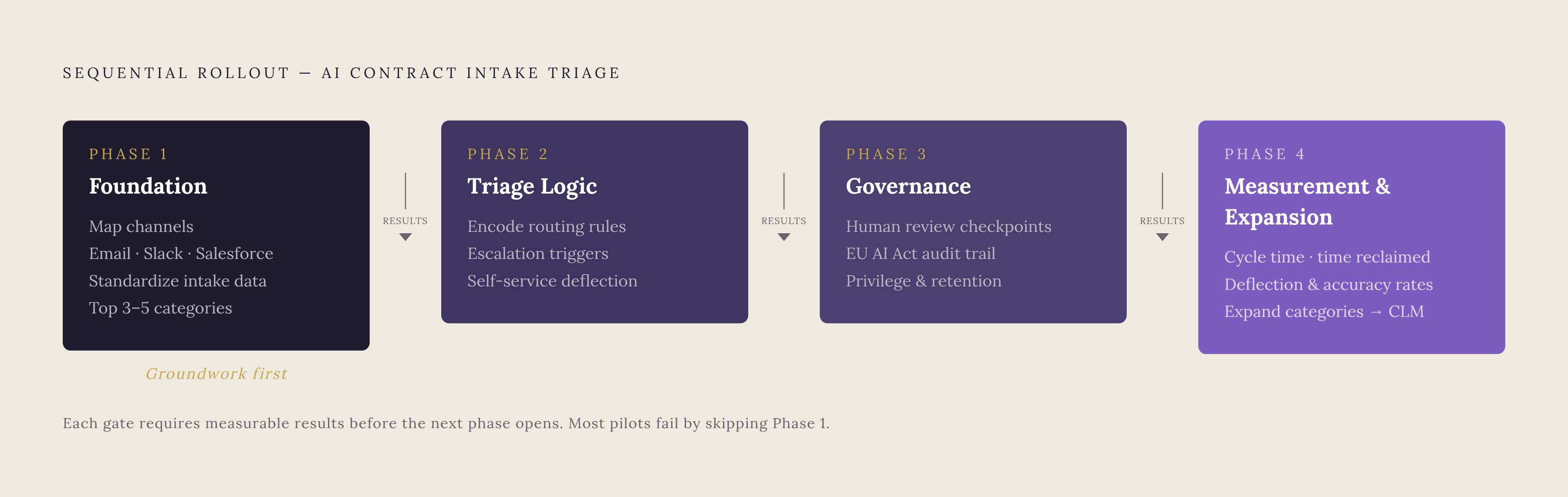
A four-phase rollout that actually reaches production starts with the operational foundation rather than the AI model itself, and each phase only expands once the one before it has shown measurable results.
Phase 1 is foundation work: map out where requests currently arrive, whether that's email, Slack, Salesforce, or procurement systems, standardize the intake data the AI will depend on (request type, requester, business context, urgency signals), and identify the three to five highest-volume request categories that will anchor the initial routing logic.
Phase 2 builds the triage logic itself: encode routing rules for each of those initial categories into the intake layer, set the escalation triggers that send a request to a human for review, and define the self-service deflection scope, deciding which request types the AI can answer directly from approved playbooks and which need an attorney's involvement. The distinguishing feature at this stage is that the system classifies request type, assesses urgency, and routes based on intent, business context, and historical pattern, rather than relying on form fields a requester fills in by hand.
Phase 3 is governance and the audit trail: put human review checkpoints in place for AI-assisted routing decisions, build the audit trail needed to satisfy EU AI Act requirements for oversight of high-risk AI systems, and confirm the privilege and data-retention architecture before anything goes live. Mitratech's framework treats this audit trail as non-negotiable: every AI-assisted action has to be logged and reviewable, with the review step captured before the output gets acted on.
Phase 4 is measurement and expansion: define the metrics that prove the system works, cycle time from request to routing, attorney time reclaimed from triage, the self-service deflection rate, and escalation accuracy, then use those figures to justify expanding into additional request categories or connecting the intake layer to downstream CLM and matter management systems.
What Intake Data Reveals
A functioning AI intake layer does more than move requests along faster. It produces the operational data that lets legal leaders run the department as something measurable, rather than as a cost center nobody outside the department can see into.
Without structured intake, legal leadership has no way to show request volume, pinpoint where capacity is actually constrained, or back up a headcount or tooling request with numbers. The team can be working at full stretch and still have no way to prove it or decide where to direct effort next. Once structured intake is running, a different set of numbers becomes available: request volume by type, source, business unit, and urgency; cycle time from submission to resolution; escalation rates; self-service deflection rates. Those numbers become the basis for resourcing conversations and decisions about outside-counsel spend that used to run on instinct alone.
Ironclad's State of AI in Legal 2026 report found that faster response times to stakeholders was one of the most frequently cited benefits of AI in legal work, a benefit that only becomes visible once cycle time data exists to measure it against. The case for reducing outside-counsel spend shifts the same way, from anecdote to evidence: once intake data shows what categories of work the AI layer is handling internally, legal can quantify what used to go to outside firms and price out the in-house cost of handling that same volume. That reframes the conversation from a plea for more headcount into a case built on capacity architecture.
A general counsel who can show request volume by business unit, average cycle time, and how much outside-counsel spend has shifted in-house is making a fundamentally different argument to a CFO than one who says the team is stretched thin. The first version comes with numbers attached to it. The second is a feeling, however accurate it may be. Intake visibility is what turns legal from a function that reacts to whatever lands in front of it into one that can be measured, resourced, and planned around like any other operational system in the business.