AI-Driven Outside Counsel Spend Analysis for In-House Teams
Stopping work before it goes out saves more than auditing bills.

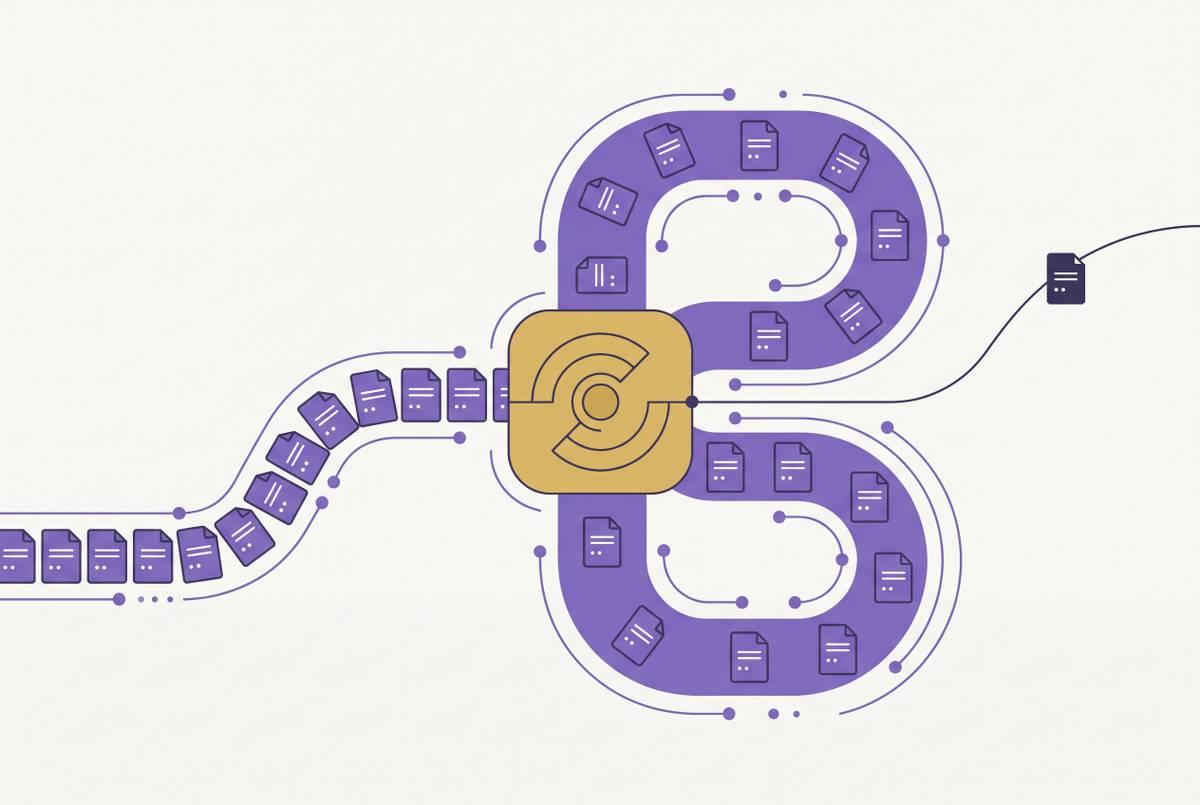
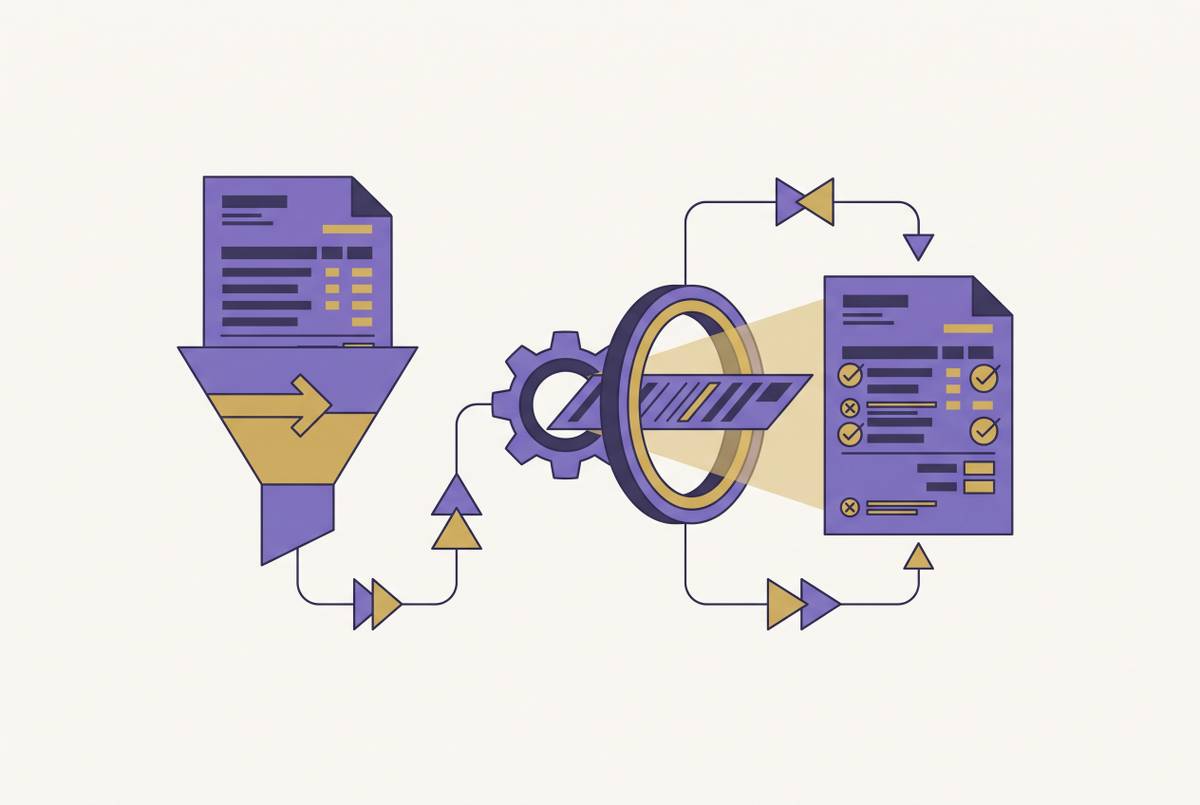
AI-driven outside counsel spend analysis reduces costs at two points, by policing bills for work sent out and by helping in-house teams retain work that never needed to leave. The second layer offers more room to save. Teams that combine both can systematically reduce their dependence on outside counsel.
Why in-house teams spend more on outside counsel than the work requires
Outside counsel often receives work because the in-house team lacks time to absorb it. A request arrives through a Slack message, a hallway conversation, or an email chain, without systematic categorization at intake. Attorneys must decide where it belongs while managing the work already on their desks. With that pressure, high-volume, lower-complexity matters can go to firms that bill for work in-house attorneys could otherwise do.
The ACC 2024 Law Department Management Benchmarking Report puts median annual outside counsel spend in the millions and finds that roughly half of total legal spend at mid-market companies goes to outside firms. Top-quartile departments spend far more on outside counsel alone. That makes routing a budget decision, even when it looks like an administrative one. The cost of weak intake grows with the volume of work passing through it.
Chuck Kable, General Counsel and Corporate Secretary at Innovative Renal Care, demonstrated that this problem could be solved by design. Arriving at Emerus mid-deal, he found three law firms billing on the same litigation matter. He consolidated firms, challenged invoices line by line, and built internal capacity for “stuff that we kind of categorized as otherwise being able to be handled internally”. That category of outside spend went to zero before legal AI existed as a product category. His approach changed both the bills and the decisions that created them.
The two layers of AI-driven spend reduction and why the upstream one dominates
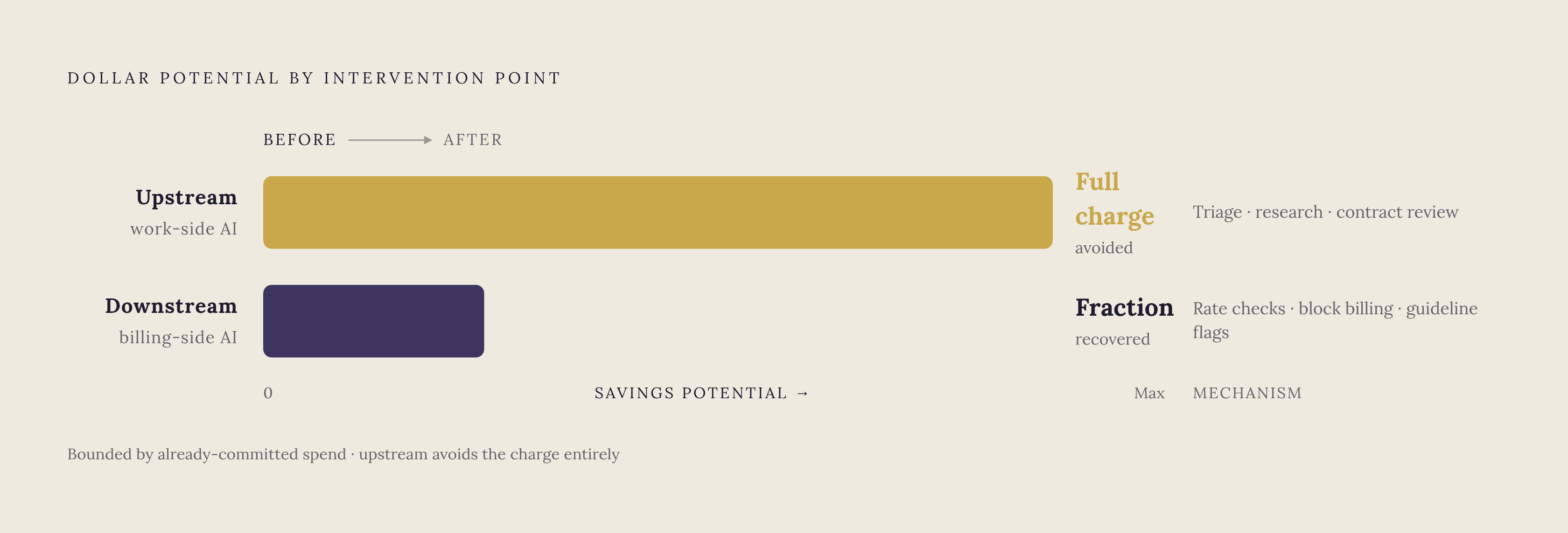
Billing-side AI operates downstream, after a matter has reached a firm. E-billing platforms, spend analytics tools, and enterprise legal management software enforce billing guidelines, flag rate deviations, catch block billing, and recover overcharges. These controls make external work more accountable. Their savings, however, remain bounded by the work already committed and billed.
Work-side AI works upstream, helping attorneys do the work in-house so that fewer matters go to outside counsel. Billing enforcement can recover only a fraction of flagged errors on engaged matters, while insourcing avoids the entire outside counsel charge for matters never sent out. That asymmetry gives the upstream layer its larger dollar potential.
GC AI's December 2025 customer study found that in-house teams reduced outside counsel spend through upstream prevention, translating into substantial annual savings for the median department. This establishes why the two interventions should be treated differently. A department with rigorous billing controls can still send too much routine work outside, leaving the larger source of savings untouched.
Five mechanisms through which AI prevents outside counsel spend before it accrues
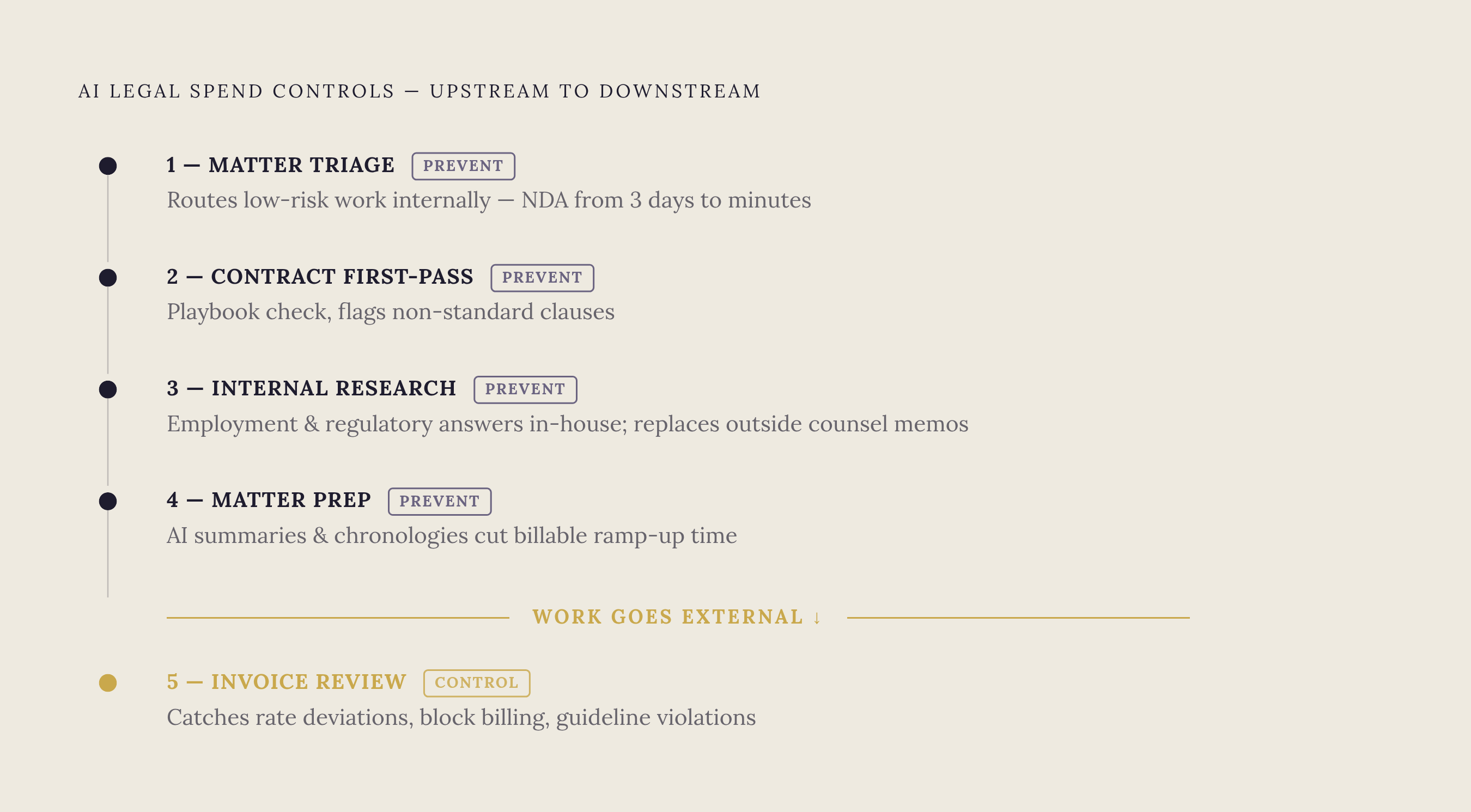
The first mechanism is matter triage at intake. Incoming work should be sorted by value and risk, with low-value, low-risk matters automated, delegated, or handled internally. At Innovative Renal Care, a CFO NDA request took three attorneys and nearly three days, while the same request through AI-assisted triage runs in minutes. Triage does not require AI, but AI makes it sustainable at volume. The intervention prevents a routing decision from becoming an unnecessary external engagement.
The second mechanism is contract first-pass review, where much of outside counsel's contract billing concentrates. AI checks the contract against a playbook, flags non-standard clauses, and puts the issues into a structured list. If a firm is still needed, it receives an annotated draft. KT Farley, Chief Privacy Officer, Head of Compliance, and Associate General Counsel at Helix, described the economics plainly. “The cost of a license is a couple of hours of outside counsel time, and it will completely transform your outside counsel budget”.
The third mechanism is internal legal research. An employment question, regulatory issue, or contract clause that the team has not seen before can otherwise lead to a quick call that starts the outside counsel clock. AI research tools provide concise, practical answers with citations for in-house review. An employment nexus question that once led to a multi-thousand-dollar memo from outside counsel can instead be answered in a short in-house research session.
The fourth mechanism helps teams prepare for matters that need advice from outside counsel. AI-generated summaries, chronologies, and issue lists cut the time counsel needs to get up to speed before working on the matter itself. This reduces the billable time spent getting ready to exercise specialized judgment.
The fifth mechanism is invoice review. Unlike the preceding four, this is a downstream control, catching rate deviations, block billing, and guideline violations on work that went external. The Everlaw/Wakefield Research survey identifies outside counsel performance and billing review among the litigation tasks in-house teams most expect to absorb. It complements prevention by controlling the cost of the matters that remain.
How AI adoption has already shifted the leverage between in-house teams and their outside firms
The Everlaw/Wakefield Research In-House Innovation Report drew on a survey of 300 U.S. in-house legal professionals in June–July 2026. Among departments using outside counsel, a majority said AI had already reduced the volume of work sent out. Nearly all the rest expected a reduction within a year. Departments that used GenAI widely were already sending much less work to firms and showed the clearest change in where work went.
The change also extends to the price of external work. Everlaw's 2025 research found that most in-house respondents had seen no AI-related savings from outside counsel. The 2026 follow-up found that nearly all respondents working with firms using GenAI reported such savings. In-house teams are setting expectations for clear disclosure of AI use, measurable efficiency gains, and lower fees or fewer billed hours.
Gloria Lee, Chief Legal Officer at Everlaw, described the resulting division of labor. “As in-house teams take more control of certain types of work, our law firms can act as true strategic advisors on our highest-value challenges”. Early case assessment and matter scoping are among the tasks teams most expect to bring inside, together with performance and billing review.
What the metrics that actually capture spend reduction look like in practice
GC AI's scorecard structure connects outside counsel cost to the work that creates it. Its core measures include outside counsel spend and share, matter allocation by type, first legal review turnaround, and net time recovered. Spend records currency incurred and the percentage of total legal cost. Allocation records which work goes out and why, while turnaround and recovered hours reveal whether internal capacity is absorbing it. Each measure needs a defined workflow and period to make changes interpretable.
Kerrie Forbes, CLO at JSX, described building a dashboard for matters and spend, supported by regular team meetings, quarterly priorities, and incoming-work triage. She tested AI on a defined task and measured staff time before and after, including time spent checking output. She also tracked what the team did with recovered hours. That distinction matters because faster review can free capacity without reducing payroll.
An update to the CFO should explain what caused the change, since a falling number alone is too little proof. Payments to outside counsel may fall because an invoice is late, even if there is no lasting change in matter allocation. Quality also needs to sit beside speed, since an increase in substantive corrections warrants investigation before expansion. The Thomson Reuters Institute's legal metrics framework connects reporting to effectiveness, efficiency, protection, and enablement. Spend becomes more useful when matter mix and internal capacity explain what moved it.
Why most in-house teams are not yet capturing both layers of savings, and what stops them
The obstacle is primarily organizational and operational. Legal departments face demands to govern AI, implement it, and assess its effect on providers from budgets already under pressure. A new license therefore competes with existing commitments even when it could reduce future external spend. Billing-side tools are easier to justify because their recoveries are visible and auditable. Upstream savings require a more deliberate record of work retained and capacity recovered.
Data readiness adds another constraint. Matter information is often siloed across e-billing systems, email, and document management platforms that do not communicate with one another. Without usable data, teams struggle to establish where work goes, what it costs, and which categories could move inside. That makes data ownership an early deployment issue.
Reliability and governance create equally real hesitation. Hallucinated evidence and case law make verification workflows necessary, particularly in litigation. Meanwhile, the work of evaluation and monitoring is often split across existing teams, with no clear owner. Under those conditions, a successful pilot does not necessarily become a dependable production workflow. Legal operations faces the practical challenge of funding, measuring, verifying, and owning the change.
How to build a deployment sequence that gets both layers working within weeks
The first step is to audit matter allocation before selecting tools. Recent outside counsel spend should be categorized by matter type and complexity to identify high-volume, low-complexity work currently sent out. This assessment should establish a bounded, measurable problem, usable inputs, and responsibility for decisions and exceptions. Getting ready should take weeks of in-house work and avoid the need for a six-figure engagement. A diagnostic that consumes a meaningful fraction of implementation cost defeats the purpose of a bounded start.
The second step is to use upstream tools for the type of work that offers the best place to start. Contract first-pass review and legal research offer fast paths to measurable returns because they are repeatable, structured workflows. GC AI's Playbooks apply company standards to pre-built reviews for NDAs, DPAs, MSAs (SaaS), and MSAs (commercial purchases), returning a structured issue list. The baseline should capture staff time, verification effort, and the use of recovered hours before broader rollout. This gives finance a comparison grounded in completed work.
The third step is to add billing-side enforcement to the matters that remain external. Once in-house workflows cut the number of matters sent out, invoice controls can enforce guidelines on the work that firms still handle. Outside counsel spend and share should be tracked against the change in allocation. The combined result shows whether the department is reducing both unnecessary engagements and avoidable charges.
The fourth step is to give AI operations a clear owner before expanding their use. One team should be in charge of evaluation, production monitoring, and incident response, with those duties brought together under it. Each agent or workflow should have logged actions, scoped permissions, and written stop conditions. These controls make a production deployment governable.
What the pricing model shift means for teams that get both layers working now
The Everlaw/Wakefield Research survey found that a large majority of in-house respondents expect outcome-based pricing to eclipse the billable hour within five years. A large share expect that change within three years. A majority expect flat or fixed fees to become the most widely adopted alternative fee arrangement for AI-enhanced work. These are expectations rather than a completed market transition, but they show where corporate buyers believe pricing is headed.
The leverage to influence that transition comes from reduced dependence on external firms. An in-house team that can demonstrate it has absorbed lower-complexity work has a stronger basis for changing what it buys and how it pays. That demonstration requires an operational upstream layer, supported by evidence of changed matter allocation and internal capacity.
Respondents still expect to pay outside counsel for business and commercial insight, complex matter management, and specialized legal expertise. Fewer than a third expect to pay for document review or routine legal work. That distinction clarifies the relationship between the two savings layers and future pricing. Teams using both now can show which work belongs inside and which merits an external fee, rather than wait for pricing conventions to change around them. They have not simply renegotiated spend but restructured the work that produces it.