LEDES Invoice Auditing With AI Agents
AI agents catch LEDES billing errors before submission, leaving legal judgment to people.

LEDES invoice auditing with AI agents moves compliance checks out of the rejection queue so billing errors can be fixed before the invoice is sent. The strongest approach checks every line that can be audited against the invoice, rate agreements, and client guidelines, while people keep control of legal judgment and approval. Its value lies in upstream prevention.
What LEDES invoices contain and why auditing them manually fails
LEDES, the Legal Electronic Data Exchange Standard, represents invoices as structured flat files. Every billable line contains a date, timekeeper ID, units, rate, and narrative description. Fee lines have a UTBMS task code and activity code, and the expense code is blank. Expense lines reverse that arrangement, using an expense code while leaving task and activity codes blank.
The American Bar Association, the Association of Corporate Counsel, and PricewaterhouseCoopers jointly developed the UTBMS coding system. The LEDES Oversight Committee explains that these codes let the systems that receive submissions test them electronically and apply billing guidelines the same way each time. Machine reading is therefore part of the design. Manual review works differently, with an auditor consulting a static PDF guideline binder and checking a sample. That leaves gaps precisely where the invoice and supporting agreements already contain the information needed for a complete check.
The seven checkable dimensions an AI agent can audit on every line
Botminds Legal Bill Review sets out eight checks and the roles that agents and people have in them. Seven check compliance on each line, while budget phase tracking also checks how much has been spent so far. The boundary is the same across all eight. An agent can test what the invoice and supporting records establish, but it cannot assume authority to approve an exception or decide whether legal work was necessary.
Arithmetic comes first because the amounts must be right for the later checks to work. The agent recomputes units multiplied by rate, includes any adjustment, compares the result with the line total, and reconciles all lines against the invoice total. It reports discrepancies without changing billed figures. A person asks the firm to correct the file. Rate compliance then compares each billed rate with the applicable year’s agreement, flags excess charges, and calculates the excess, while a person retains responsibility for approving rate changes in writing.
Staffing approval checks whether each timekeeper is on the case’s approved staffing list. The agent flags time from anyone not named, and a litigation specialist approves or refuses that timekeeper. Block-billing review examines whether one time charge covers distinct tasks and quotes the tasks grouped together. A person checks whether the entry really includes more than one task. For vague or clerical entries, the agent compares descriptions with wording rules and overhead exclusions, quotes the offending words, and leaves the decision to hold, reduce, or pay with the reviewer.
Prior-approval checks compare research or expert fees above a threshold with approvals on file. The agent identifies the approval or its absence. If the agreement calls for advance approval, the litigation specialist must have approved before the work took place. Duplicate and pattern checks compare entries with earlier invoices and other timekeepers’ entries on the same day, reporting matches for human assessment. A pattern alone never justifies a reduction.
Budget phase tracking applies each line’s task code to the approved phase budget and projects when the matter will exhaust its budget. A litigation specialist retains responsibility for revising that budget. The agent has no authority to decide legal necessity. Botminds identifies that decision as defense counsel’s judgment and notes that courts and bar ethics committees have drawn this boundary. For insurers paying panel firms, automated review does not displace that allocation of responsibility.
Why block billing and narrative compliance are harder than arithmetic — and how language-capable agents handle them
Botminds illustrates block billing with the entry “Prepare for deposition of driver Curtis Dunmore; review ELD logs and dash-camera stills; draft outline; telephone conference with client safety director; email to G. Lindqvist”. The charge is a single entry, but its description contains several activities. The reviewer needs to understand which activities constitute distinct tasks and whether one time charge improperly groups them under the applicable guideline.
This requires interpreting language. A language-capable agent can identify the grouped tasks, quote the relevant text, and explain the rule that prompted the flag. The output is evidence for review. The person reviewing it still checks whether the description shows prohibited block billing or gives allowed detail about the work.
Narrative compliance uses the same capability to check wording against each client’s rules and overhead exclusions. Errors such as “Description Contains Phrasing Not Allowed By Client” and “Insufficient Line Item Description” depend on reading the description. Code consistency adds another language-dependent comparison. An agent can flag a narrative that appears inconsistent with its assigned UTBMS code, but a human decides the correct code.
How Outside Counsel Guidelines become machine-enforceable rules
Outside Counsel Guidelines define acceptable rates, staffing, task codes, billing practices, and narrative conventions for a given matter. Without a machine-readable policy layer, automated auditing remains largely confined to format and arithmetic. The guidelines supply the compliance standard for the other checks. Converting them into rules the agent can query makes that standard available when a time entry is drafted.
Approved rate schedules establish comparisons by timekeeper level and matter type, while named staffing approvals populate the validation list. Rules on prohibited practices set out block-billing restrictions, travel caps, and overhead exclusions. Prior-approval thresholds set out when research, experts, or travel need proof of approval. Client-specific UTBMS restrictions delimit acceptable codes. Each rule needs to remain tied to the client and work it governs, because a valid code or rate in one guideline set may be unacceptable in another.
Access boundaries are part of this policy layer. The agent must operate only within the permissions granted to its API credential and must not access unrelated firm matters. The platform must not use documents from the client workspace to train foundation models. These are production constraints that must be in place before deployment.
Missing required fields, wrong date formats, expense lines without supporting detail, and codes from a different client’s guideline set can all cause failures. A rules-based format check should therefore run before the AI agent touches the file. This separates structural defects from questions that require interpretation of the guideline or narrative.
The difference between upstream prevention and downstream correction, and what it costs firms to get this wrong
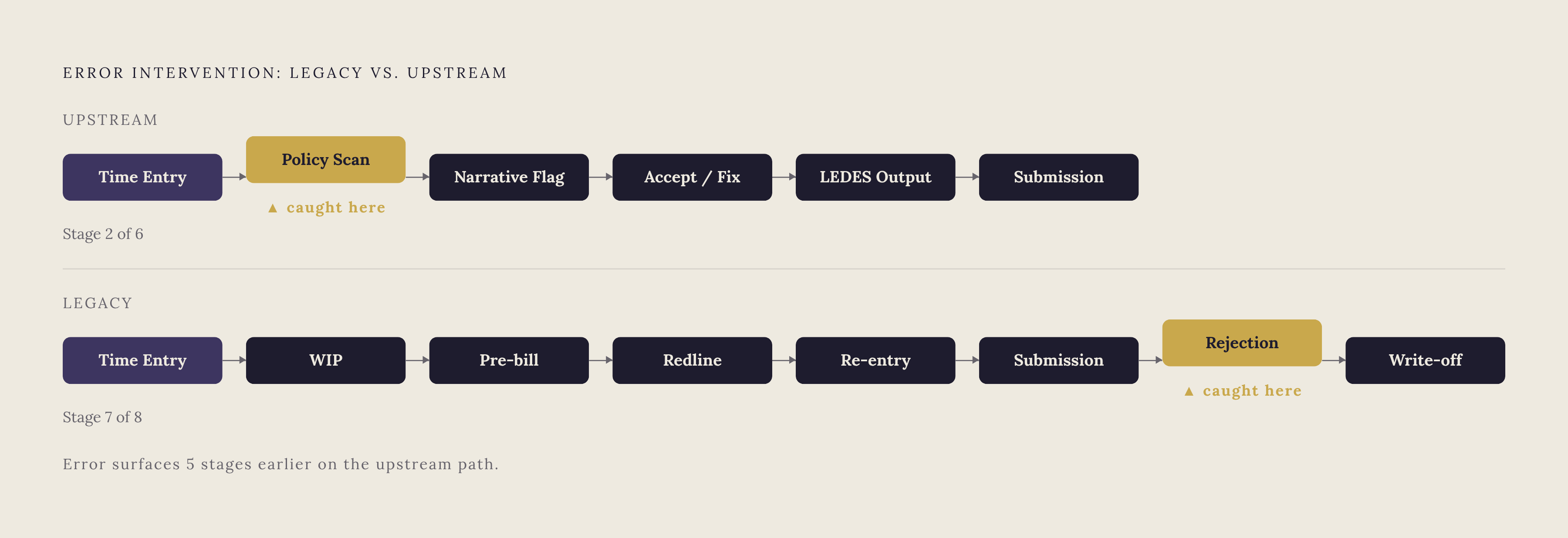
The legacy workflow moves from time entry through unchecked work-in-progress, paper pre-bill, partner redline, manual re-entry, submission, client rejection, and partner write-off. More work has already been done by the time each downstream correction is made. A rate error found after rejection has already consumed a billing cycle and introduced friction with the client. The cost is not simply processing a rejected file, but the write-down that can follow non-compliance and failures in contemporaneous time recording.
Time entry is followed by an instant policy scan, narrative flagging, human acceptance or correction, clean LEDES generation, and submission. The reviewer intervenes before the error reaches the client. This placement also puts narrative corrections closer to the recording of the work, rather than leaving them for a later correction cycle.
At drafting, the agent can identify every line above the agreed rate and calculate the excess for correction. After rejection, a manual reviewer can find the same discrepancy, but cannot recover the elapsed billing cycle. Checking every line also closes the sampling gap when the billing records already hold the answers. It still leaves payment uncertain and valid client disputes open, because decisions that call for judgment stay outside the automated audit.
What production-ready LEDES audit agents require that pilots typically omit
A working demonstration proves that an agent can perform a check. Every flag needs an auditable reason identifying the rule, field, and guideline clause, so a reviewer can accept or waive it and the firm can demonstrate compliance. Human acceptance must also control changes to the billing system. Narrative rewrites and code corrections can be drafted by an agent, but must not be pushed back automatically.
Arithmetic integrity is the first trust gate for this process. An agent that cannot reproduce an invoice total from its lines provides no sound foundation for further review. Teams also need tracing, evaluation, and monitoring to understand what the agent does and find out why checks fail. They belong in the design from the start. A pilot that produces plausible flags without these controls has not yet established production readiness.
Governance documentation must precede access to live invoice data. It needs to identify who owns agent performance after deployment and which baseline metrics were captured before the pilot launched. Those responsibilities connect technical performance with the billing operation that depends on it. Permission limits, restrictions on training use, and reviewer authority must remain enforceable as the workflow moves into routine use.
LEDES auditing offers a comparatively bounded deployment problem. It is high-volume, rule-bounded, and schema-defined, with enumerable checks and independently verifiable outputs. Infrastructure remains necessary, and evaluation has a concrete object because a team can inspect whether a line was tested against the correct agreement and whether the resulting flag supports its stated reason. The production case is stronger when the agent owns this defined workflow rather than an open-ended mandate to assess legal work.
How existing legal spend management platforms approach LEDES auditing, and where agents extend beyond them
Thomson Reuters eBillingHub streamlines invoice submission to client portals and forwards rejection notifications to billing teams. That notification function operates after submission, when the portal has already rejected the file. Thomson Reuters 3E, through Elite Validate and eBillingHub, combines financial reporting with rules-based checks intended to catch e-billing errors before invoices reach client portals. The distinction is between handling a rejection and preventing one.
Brightflag provides automated parsing for PDF, LEDES, and global e-invoicing XML invoices, together with spend categorization, rate benchmarking, and budget tracking. These tools help corporate legal teams see how money is spent and how well law firms use their staff. Mitratech TeamConnect combines configurable business rules, LEDES auditing, and vendor management in an architecture capable of handling large invoice volumes. Legal hold tracking comes through the separate, integrated Mitratech LegalHold product.
CounselLink, a LexisNexis product, provides automated LEDES validation, strategic vendor scorecards, and rate management for multinational corporate legal teams managing global spend. Its scope combines billing controls with oversight of outside counsel. These established platforms therefore provide substantial parts of the operating environment in which an audit agent would work. The controls these platforms already have are still useful when language-capable review is added.
The incremental claim for agents is narrower than replacing legal spend management. Rules-based validation can check structured rates, codes, and formats against the values set for them. Language-capable auditing also reviews what descriptions mean under block-billing restrictions, prohibited wording, and narrative requirements. It also connects those findings to the supporting policy and human decision. The relevant distinction is the auditable surface each workflow covers.
Where a workflow deployment approach fits LEDES auditing
Eigenomic is one option for enterprises seeking this deployment model, as an end-to-end AI workflow agency for regulated, document-heavy operations such as legal that builds agents to execute complete workflows. Its approach fits the division established here, with agents running checkable lines and people retaining judgment, while results can be assessed through write-down prevention and billing cycle time.
For an enterprise deciding whether to build, buy, or deploy an agent, the AI Operations Audit provides a structured first step to establish baseline metrics and governance documentation before a pilot launches. That assessment grounds the decision in the billing workflow’s rules, access boundaries, and review responsibilities.