EU AI Act Compliance Obligations for In-House Legal AI Deployments
A post-Omnibus timeline shows which duties already bind legal teams.

EU AI Act compliance for in-house legal AI deployments is a sequence of duties. Some obligations already apply, while the standalone high-risk requirements arrive on 2 December 2027. The practical task is to identify each system’s role and risk classification, attach the right duties to it, and maintain evidence that those duties are being met.
What the EU AI Act actually is and who it reaches in a legal department
The EU AI Act regulates AI through four risk tiers, namely prohibited, high-risk, limited-risk, and minimal-risk. Its reach extends beyond organizations established in the EU. It covers providers placing systems on the EU market, EU-based deployers, and providers and deployers elsewhere when their systems’ outputs are used in the EU. A US legal team can therefore fall within scope through EU use of its AI outputs.
The organization’s role determines its share of responsibility. A provider develops an AI system or model and places it on the market, while a deployer uses a system under its own authority professionally. Legal departments often support both roles, using vendor tools while advising on products that contain AI. Those roles can also change during a deployment. A deployer making a “substantial modification” to a vendor’s high-risk system becomes a provider, acquiring a substantially heavier obligation set.
The compliance calendar after the Digital Omnibus: what has already applied and what comes next
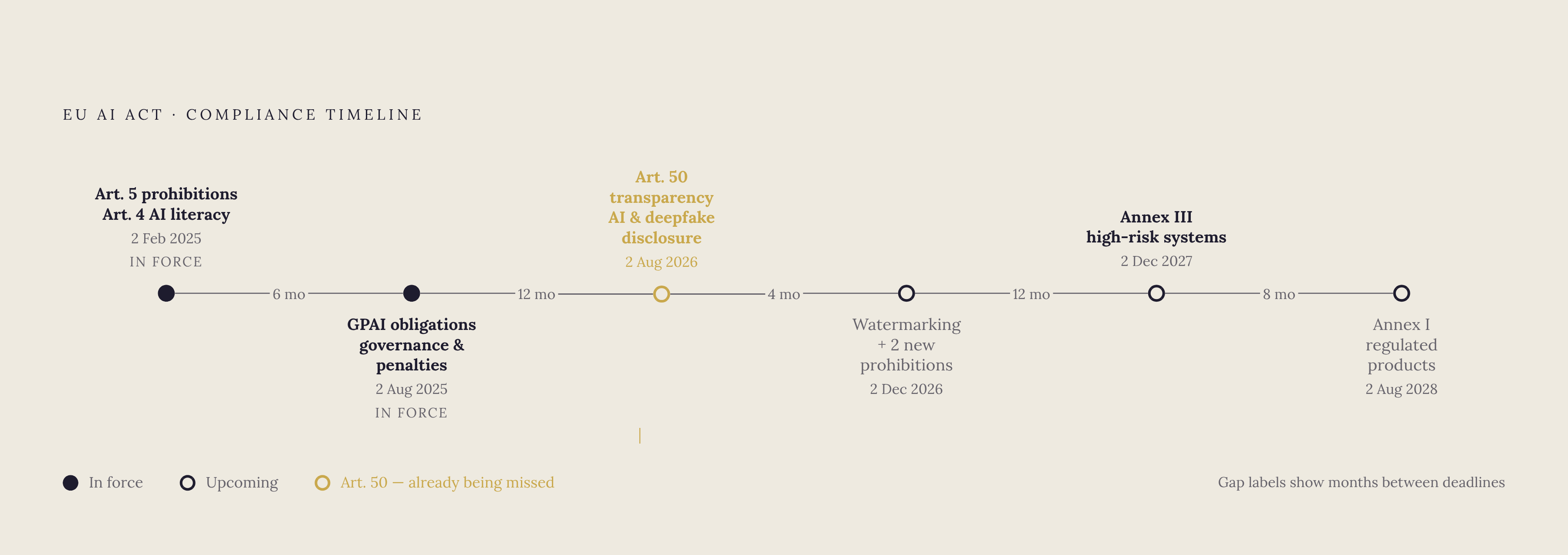
The Digital Omnibus on AI received final Council approval on 29 June 2026 and came into force on 27 July 2026. It reset the high-risk timetable, making plans based on the original August 2026 deadline materially wrong. It did not defer every obligation, however.
2 February 2025 marked the application of Article 5 prohibited practices and the Article 4 AI literacy obligation. On 2 August 2025, Chapter V general-purpose AI model obligations, the governance structure, and most penalty provisions followed.
2 August 2026 remained the date for Article 50 transparency duties, including AI-interaction disclosure, machine-readable content labeling, emotion-recognition and biometric-categorisation disclosure, and deepfake disclosure. Systems placed on the market before that date have until 2 December 2026 for machine-readable watermarking. That December date also ends the transition for two newly added prohibitions on systems that can generate non-consensual intimate imagery and child sexual abuse material without adequate safeguards.
2 December 2027 is the new deadline for standalone high-risk systems under Annex III, replacing 2 August 2026. Systems under Annex I, including AI embedded in regulated medical devices or machinery, have a 2 August 2028 deadline. The Omnibus also extended lighter documentation requirements and reduced fines from SMEs to small mid-cap companies, bringing more organizations within the simplified framework.
Why the Article 50 transparency gap is the obligation most legal teams are already missing
The high-risk extension provides no shelter from Article 50. Its requirements applied on 2 August 2026, and organizations with uncovered gaps are already in violation. For legal teams, the immediate exposure includes customer-facing chatbots and voice assistants where people must know they are interacting with AI. A plan that schedules all AI compliance work for 2027 leaves those interactions unaddressed.
Externally sent AI-generated contract language and communications also require scrutiny for applicable transparency duties. The duties differ by output and deployment context. Article 50 includes provider-side machine-readable marking, as well as deployer disclosure for deepfakes and AI-generated public-interest text. When emotion-recognition or biometric-categorisation tools are used internally, the people exposed to them also need to be told. The 2 December 2026 watermarking grace period is limited to older systems’ machine-readable marking, with the deadlines for these other duties unchanged.
How the risk-tier classification works and which legal AI systems land in the high-risk category
Classification begins during design and must be documented before deployment. It is not merely a procurement judgment. Under Article 6(2), systems are high-risk through the Annex III route if they have specified uses, including employment, administration of justice, and access to essential services. Article 6(1) provides the separate Annex I route for safety components in products governed by EU harmonization legislation. That distinction determines whether the December 2027 or August 2028 timetable applies.
An AI contract review tool used purely to assist drafting, without making or substantially influencing decisions affecting individuals’ rights, is more likely to be limited-risk or minimal-risk. An AI-driven performance evaluation platform that influences employment decisions falls within Annex III, point 4. Point 8, by contrast, covers systems intended to assist judicial authorities with researching and interpreting facts and law, applying law to concrete facts, or similar work in alternative dispute resolution. Ordinary legal research assistance does not become point 8 solely because lawyers use it.
Article 6(3) permits a provider to determine that an Annex III system does not pose a significant risk because it does not materially influence decision-making outcomes. One of four specified conditions must be met. These cover narrow procedural tasks, improving work a human has completed, finding decision-making patterns without replacing human assessment, or preparing for an Annex III assessment. The determination must be documented before deployment. Where classification remains ambiguous, treating the system as high-risk from the outset is the more defensible approach.
The internal-use assumption that invalidates most legal departments' current compliance plans
Internal use creates no exemption from Article 26. A high-risk system used only within the organization attracts the full deployer obligation set, whether purchased or built in-house. Employee performance evaluation, recruitment, and work-management or allocation tools bring Annex III, point 4 into the legal department itself. The system’s function governs its classification in both internal and client-facing deployments.
Internal tools may get less scrutiny when they are bought, even though their use in employment puts them within the high-risk framework. If the deploying organization treats them as ordinary office software, it may lack the controls required by their classification. Vendor assurances do not resolve that structural gap. A contract requiring vendor compliance does not transfer Article 26 responsibility away from the deployer.
What vendor diligence must now produce before any high-risk legal AI system is deployed
For systems that may be high-risk, diligence must yield documents the team can use, beyond a general promise of compliance. The deployer needs the provider’s Article 11 and Annex IV technical documentation package, which covers training data, performance metrics, and known limitations. It also needs evidence of an active Article 9 risk management system and confirmation of EU database registration where applicable. A one-time risk assessment is not enough. The provider’s process must remain active beyond procurement.
Instructions for use are equally important to deployment. Without them and the required technical documentation, the organization cannot discharge duties that depend on understanding how the system should operate. Provider conformity assessment and registration obligations form the backdrop, but obtaining the evidence is the deployer’s immediate task. For systems trained on case law or contract corpora, Article 10 data governance documentation deserves a named place in the RFP or contract review. The data sheets vendors now provide may not cover it in full.
GC AI supports specific workflows for organizing this work. Its Files library can hold the Act, the Omnibus text, and the system inventory in one reference. Playbooks can support AI vendor contract review, while Automations can support standing regulatory monitoring. These workflows organize diligence rather than replace the provider evidence the legal department must obtain.
How the obligation stack differs for the two Annex III entries legal departments encounter most
For systems qualifying under point 8, human oversight is the dominant operational requirement. A qualified attorney must be able to review, question, and reject output before it affects a client’s legal position. This exceeds existing professional responsibility obligations in most jurisdictions. Article 86 also provides a right to explanation when output influences a decision with legal or similarly significant effects on an individual. Article 15 accuracy and robustness requirements add the need for resilience against prompt injection that could produce false or misleading legal analysis.
Point 4 directs attention inward, to the organization’s staff. An AI candidate-screening or performance evaluation system can qualify even though it performs no substantive legal analysis. Logging, incident reporting, and documented monitoring must operate from the first day of deployment under the applicable high-risk framework. Article 26 also requires employees to be informed when AI is used in decisions affecting their employment. A review confined to effects on clients and third parties will miss this employment-facing obligation stack.
These priorities differ, but the compliance programs can overlap. Point 8 makes scrutiny of legal outputs especially demanding, while point 4 makes workforce notification and employment monitoring particularly visible. Both still require a maintained deployer framework.
The four operational controls that hold a compliance position in place across both obligation stacks
The practical response is to organize compliance across the system’s lifecycle. Procurement formalizes vendor diligence through terms governing access, training data use, and retention. At deployment, teams set out which legal work and data types are approved, with classification written down before use begins. Operation establishes who reviews output, against which standard, and with what authority to override it. Recordkeeping preserves evidence of that review and sets its retention period.
Four controls anchor those stages across the organization. They are a complete inventory of AI systems, a named owner for each system, a documented review step before output is used, and retained evidence that the review occurred. Each closes a different gap in accountability. An inventory establishes coverage, ownership assigns responsibility, review provides intervention, and retained evidence makes the process auditable. Programs focused only on deployment and operation leave procurement and recordkeeping exposed to regulatory or opposing-party scrutiny.
The evidence and intervention controls are especially closely connected. A system that cannot demonstrate what it did cannot be audited, while one that nobody has authority to stop cannot satisfy Article 14. Compliance readiness and operational readiness therefore converge in the same system design.
How to sequence the work across the remaining deadlines from now through December 2027
The immediate task is to close overdue transparency gaps. Legal teams should audit customer-facing AI interactions, externally sent AI-generated content, and emotion-recognition or biometric tools against Article 50. They should also establish whether machine-readable watermarking is in place or on track for the 2 December 2026 transition deadline. Article 5 prohibited practices require review in parallel. Their application since February 2025 means they cannot be deferred into the high-risk implementation program.
Q1–Q2 2027 should establish the inventory and classification baseline. Teams should complete the system inventory, assign a named owner to each entry, and document classification decisions, including the rationale for any Article 6(3) determination. Without that inventory, the organization cannot assess its December 2027 position. Teams should then ask vendors for instructions for use, technical documentation, and evidence of active risk management for every system that may be high-risk.
Q3–Q4 2027 should turn those findings into operating controls before 2 December 2027. Before systems confirmed as high-risk operate under the high-risk framework, they need logging architecture that meets Article 12 requirements for tamper-evidence and retention. Article 14 oversight arrangements should identify the natural persons responsible, their competence and authority, and the override mechanism. Organizational incentives should also be examined for conflicts with that authority. Incident monitoring and reporting must be ready from the first day, and applicable Article 86 explanation duties must be addressed.
Standing governance has no equivalent end date. After deployment, teams must keep up log retention, incident monitoring, human oversight, and Article 4 workforce AI literacy. Enterprise agents built with logging, documented oversight, and output trails that can be audited help meet these same requirements. By building compliance into how systems work, legal teams can prepare for December 2027 without having to rebuild systems at the deadline.