Quality Ownership in AI-Executed Legal Workflows
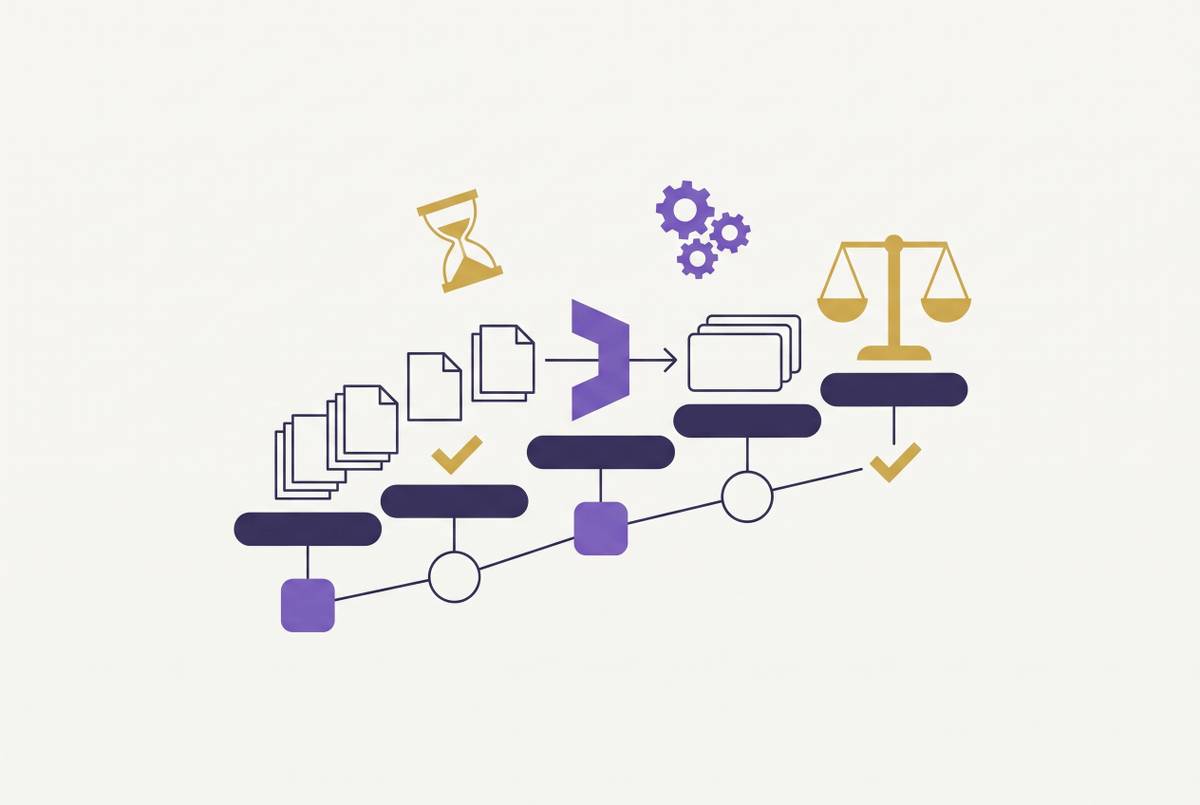
Legal teams must name owners for every stage before agents run.
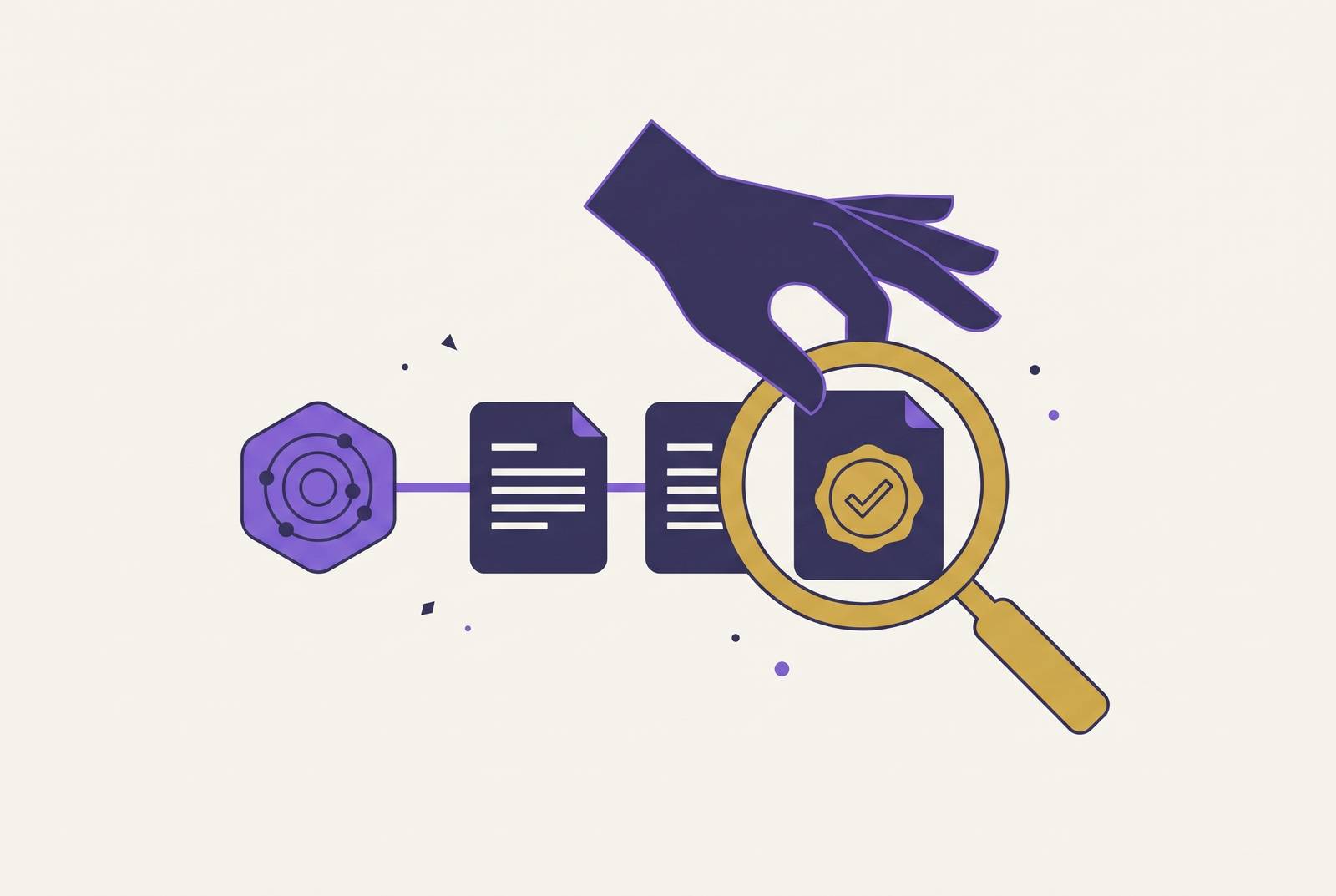
Quality ownership in AI-executed legal workflows must be designed before an agent touches live work. Delegating execution does not transfer professional responsibility. Legal teams need named owners for inputs, outputs, review gates, and exceptions so that the lawyer responsible for the result can actually supervise it. The test is not whether an agent finishes a task quickly, but whether it produces work a lawyer can sign.
Why AI agents executing legal work create an accountability gap that tools don't
A chatbot answers a question, while an agent executes a delegated task. GC AI’s agent guide draws that distinction through behavior, describing an agent that plans, runs intermediate steps, checks its own work, and delivers the requested format. The human no longer performs each intervening action. When something goes wrong, the failed step may therefore have no human participant whose role naturally establishes responsibility for it.
That changes the structure of supervision while leaving the duty attached to the result unchanged. In a human-run workflow, the people selecting sources, applying standards, and drafting conclusions provide identifiable points of accountability. An agent can execute those steps without reproducing that ownership structure. Legal work makes this separation especially consequential because professional duties attach to the output, regardless of who or what performed the underlying work.
Spellbook’s 2026 agent overview makes attribution concrete by noting that accepted redline suggestions appear under the lawyer’s name. Execution and attribution are already separate at the action level. The same holds when a lawyer signs a brief drafted by an agent. The signature establishes responsibility, but it does not establish that the lawyer had the evidence or review opportunity needed to exercise it.
What professional ethics rules already say about who owns agent output
The State Bar of California’s 2026 guidance assigns meaningful supervision and review to lawyers before agents make substantive legal determinations, communicate legal advice, prepare and file pleadings, or otherwise act in a representative capacity. Agent autonomy does not transfer the duty of competence. Quality ownership belongs to the supervising attorney as a professional obligation. This gives legal operations teams a fixed anchor for workflow design.
ABA Formal Opinion 512, issued in July 2024, establishes that lawyers must have a reasonable understanding of the capabilities and limitations of the specific AI technology they use. Supervision is therefore more than a recorded approval. A lawyer must understand enough about the system to judge the work it produces and the limits of that work. An approval gate without the means to make that judgment cannot substitute for competent review.
This distinction makes ambiguous ownership both an operational risk and a professional conduct risk. The organization can use a contract to define the responsibilities and evidence that allow the attorney to meet the continuing obligation of accountability. The rules answer who owns the output, but they do not specify how to structure the organization so that owner can do the job.
Why most legal AI deployments skip ownership design and what breaks when they do
GC AI describes how Nicole Altman, Associate General Counsel at Instacart, and Kelly Noguchi, Instacart’s Senior Legal Technology and Operations Manager, built an AI-first legal culture at public-company scale by standardizing work before automating it. The agent came last. Their sequence addressed the gap between one lawyer’s personal productivity and a repeatable enterprise process. Noguchi’s formulation is that teams cannot “glaze over” the work of turning excitement into execution.
The guide also describes teams that automate before they write down intake questions, review order, and always/never rules. Those teams get fast output that nobody wants to sign. The central failure is not simply a model error, but the absence of a named human accountable for each stage before deployment. An agent can accelerate an undefined process without resolving any of its ownership questions.
The Agentic AI Institute’s 2026 enterprise adoption research finds that most firms running agents in production have no formal governance. Live execution can become an established practice before responsibility has been codified. In legal work, this leaves the supervising attorney accountable for a process whose checkpoints may never have been defined.
This leaves the workflow without a verification layer. An agent may follow a plausible path rather than the correct legal path, yet deliver an output that reads convincingly. Review must therefore preserve retrieved sources, explain why a citation was used, and expose unresolved issues. Without that evidence, the attorney cannot reliably tell whether the legal work is complete or just looks convincing.
The five components of a designed ownership structure for AI-executed legal workflows
Workflow documentation defines what the agent is supposed to execute. GC AI places standardization before delegation, with the agent inheriting an established workflow. The documentation must set out the intake questions, review order, always/never rules, and output format. This is the operational brief for the task. It gives reviewers a standard against which to judge execution.
Named role assignment gives people work to do at each stage so they can meet their professional duties. The California guidance establishes the supervising attorney’s duty, while workflow design must identify who prepares inputs, reviews outputs, and handles exceptions. Each responsibility needs a named human owner. A general statement that the legal department supervises AI leaves the handoffs unresolved. The design must make clear who acts when the workflow reaches each gate.
Input accountability establishes whether the task is qualified to run. Before the agent runs, a named person must check that the documents, sources, and parameters meet the workflow’s requirements. The enterprise AI agent production guide frames this qualification through what the agent may read and change, supported by a resource and action matrix. Broad credentials are a disqualifying condition.
Output review gates make lawyer review a required action. GC AI structures its Playbooks as multi-step contract review in which the lawyer grades the deliverable. The agent executes, but the attorney judges the result. To support that judgment, the verification layer must retain sources, explain citation use, and identify unresolved issues. The gate is only useful when the reviewer can verify the agent’s legal path.
Escalation and stop rules name who is responsible when the work cannot safely go on or someone finds an error after the output has been used. The production guide calls for explicit stop rules, incident handling, and a tested rollback path before an agent is ready for production. The organization must be able to identify what the agent did, reverse actions it took, and assign remediation.
How the five highest-volume legal agent workflows map to ownership requirements in practice
GC AI identifies five workflows in-house teams run most, namely first-pass contract review, regulatory monitoring, vendor terms re-checks, research memos, and document extraction. All have repeatable structures and a lawyer at the end of the line. Their ownership requirements nevertheless differ. The relevant control depends on whether the agent is applying negotiation standards, monitoring change, analyzing law, or extracting defined fields.
For first-pass NDA/MSA review, the input owner must confirm that negotiation standards and the playbook are current and approved. A stale playbook gives the agent the wrong benchmark. The agent returns findings with quoted language, and the reviewing attorney confirms that it flagged the right issues against the right standard. That review is a different task from simply rereading the contract. Its brief must direct attention to the agent’s application of the approved positions.
For regulatory monitoring, GC AI’s Regulatory Monitoring Skill Creator uses the jurisdictions, risk areas, and materiality threshold set for the task. The agent verifies flagged items against primary sources and returns a prioritized action-items table on the set schedule. A human must still judge materiality based on the risk to the organization. The named owner must document that threshold and periodically reconfirm it. Otherwise, even a scan that runs the same way each time may look for the wrong things.
For vendor terms re-checks, the guide describes quarterly comparisons of current terms for five named vendors against the versions on file. The agent flags changes to data use, subprocessors, or liability, quotes changed language exactly, and delivers a one-page summary marked review-needed or no-action. The label does not settle the legal decision. A named attorney reads the summary and decides whether to act. Accountability includes the decision to take no action.
Research memos have the highest hallucination risk of these five workflows because they involve legal analysis across primary law. Citation errors are a documented failure mode in legal-specific AI tools. Readability is therefore an inadequate review standard. The required review gate is source-level verification: the attorney must be able to reach each cited source and confirm that the memo characterizes it accurately.
Document extraction is the most bounded workflow because its scope is limited to retrieving information. Its tasks include pulling renewal dates, liability caps, and change-of-control triggers from a stack of contracts. The named owner must define the fields before deployment. That owner must also spot-check extractions against source documents on a defined schedule, since accuracy degrades as document formats become more variable. The narrower task limits the scope of error but does not remove the need for review.
What an AI Operations Audit covers when the workflow being audited is a legal agent
An AI Operations Audit examines evidence that the claimed ownership structure is operating as designed. Its purpose is to distinguish documented intentions from functioning responsibilities, approvals, and recovery arrangements. For a legal agent, the central question is whether the supervising attorney has both an assigned role and the means to perform it.
The production guide defines readiness through a named owner, a qualified workflow, a unique identity, and least-privilege tools. It also includes durable and replayable state, explicit approval and stop rules, trace-level evaluation, cost limits, incident handling, and a tested rollback path. Model quality alone does not establish readiness. The audit must examine both the conditions under which the agent acts and the quality of a selected deliverable.
The EU AI Act, as amended by the Digital Omnibus on AI, brings conformity assessments and human oversight mechanisms into scope from December 2, 2027, for systems qualifying as high-risk under Annex III, including those used in the administration of justice. That category does not cover legal services as a whole. Where those duties apply, the audit must produce evidence that people can review, such as access reviews, audit trails, and exposure reports. A narrative self-assessment is not an adequate substitute.
How to measure whether a legal agent's quality ownership structure is actually working
Measurement begins before deployment, with a credible baseline. Pre-deployment data is necessary to separate claimed improvements from seasonal variation or concurrent process changes and isolate the ownership structure’s contribution. The supervising attorney, general counsel, and audit committee need evidence suited to their responsibilities, but that evidence must rest on the same comparison between prior performance and agent-executed work.
Citation accuracy shows whether research-memo review keeps errors out of the legal analysis. It must be assessed through source-level verification. Review gate utilization measures the share of outputs for which an attorney’s review action is on record. A low rate indicates that the gate is largely inactive. Together, these measures distinguish the quality of the work from the actual use of the review process.
Escalation frequency measures how often execution ends in an “escalated” or “blocked” state. Rates that are unusually high or unusually low both need a closer look. Incident rate and time to rollback then measure how often output requires correction after use and how quickly the named owner can identify and remediate the failure.
Faster output alone cannot show that the ownership design is working. Leaders can trust the work when evidence shows that citations are accurate, review gates are used, escalation happens when it should, and remediation works. Measurement turns a lawyer’s name on the review from an attribution convention into evidence of supervision. That is how governance becomes trust in work a lawyer will sign.