RAG Evaluation for Legal Document AI
It shows how to test whether legal AI cites real, valid authority.

Legal document AI needs a RAG evaluation standard that tests more than whether an answer matches retrieved text. It must measure whether the system found authoritative material, used it correctly, and cited valid authority for each legal claim. Those tests must also account for the operational cost of error. Together, they distinguish a persuasive answer from an output that can withstand professional review.
Why general RAG evaluation standards don't transfer to legal document AI
General enterprise RAG evaluation checks whether the retrieved context supports an answer. Legal evaluation must also ask whether that context is the right authority and whether the answer survives a lawyer’s reasonable inquiry. A productivity error and a fabricated legal citation are not the same category of failure. Eigenomic, an enterprise AI agent builder that puts complete workflows, including legal case briefing, into production within weeks, treats that gap as an evaluation problem. Mata v. Avianca illustrates the distinction through ChatGPT-generated citations to cases that did not exist. The resulting sanctions make the stakes concrete without requiring any assumption about a system’s overall accuracy.
The Stanford/Yale study supplied a separate empirical reason to reject general assurances about RAG. Its first preregistered empirical evaluation of the legal research tools found hallucination rates of 17–33% across Lexis+ AI and Westlaw AI-Assisted Research. LexisNexis had publicly claimed RAG enables “hallucination-free” legal citations, while Thomson Reuters had claimed it “dramatically reduces hallucinations to nearly zero”. Neither claim was accompanied by empirical evidence at the time it was made.
The difference also lies in the questions legal systems must answer. Case law builds on precedent in cumulative layers, and a legal query may not admit one unambiguous answer. Retrieval thus calls for judgments about which authority applies and what is relevant, which a benchmark of clear factual questions may never test. A contract-review system that misses a withdrawn clause and a research system that cites an outdated CFR amendment have related weaknesses. Both can give answers that seem grounded yet fail at the legal task, so the evaluation standard must check the authority behind the text.
The retrieval layer is where legal-specific precision must be measured first
Retrieval quality is the first dependency because a faithful generator cannot repair the selection of the wrong case or statutory version. Hybrid search, vector chunking, and long-context retrieval-augmented generation may shape how a system is built, but using them does not prove that its legal retrieval works well. Evaluation must test whether the selected material supplies the authority needed for the task. That test must use the indexed legal corpus. Case law, statutes, CFR paths, and firm-internal precedent each supply the material used to judge what is relevant.
Precision@k measures how much of the top-k retrieved material is relevant, so authority that does not apply can be spotted before it enters generation. Recall@k measures whether the relevant information was captured at all, including provisions whose absence could change the answer. MRR measures whether a correct document appears early in the ranking, while nDCG measures how relevant the results are and where they rank, distinguishing strong rankings from those that bury the authority needed. These metrics answer different questions, so a high score on one cannot stand in for the others.
The indexed universe matters as much as the ranking. Evaluation over Westlaw, Lexis, CourtListener, Federal Register, state codes, or a firm-internal precedent library must reflect the particular corpus used by the system. Production legal RAG systems maintain cryptographic signatures of source documents, indexing timestamps, document versions, and flags for changed source material. These controls make source identity and currency part of the retrieval layer. Contract analysis that references an outdated agreement version is therefore a retrieval failure even if the generator describes that version accurately.
Coverage across the corpus is a further concern when the task spans jurisdictions. Diversity metrics test whether retrieval keeps returning a narrow range of material or the same material instead of finding the authorities the task requires. In a 50-state survey, a concentration of relevant results from prominent state codes cannot establish complete coverage. LaborBench treats relevant statutory provisions not captured as a distinct retrieval error.
Citation fidelity is a generation metric with no adequate equivalent in general RAG
Once the right material has been retrieved, generation introduces a separate question about what the answer claims. Faithfulness tests whether the output is grounded in that material, while answer relevance tests whether it addresses the question. Hallucination rate and citation coverage add useful measures of unsupported content and source use. None alone establishes that a specific legal claim rests on a real, correctly identified, still-valid authority. Citation fidelity measures that relationship between the claim and the law it invokes.
The cited authority must exist, it must say what the output claims, and it must remain valid law. A source attached to a sentence is not proof that these conditions hold. Even when a system retrieves the correct case, it can misstate the holding during generation. Post-retrieval support verification is consequently a separate evaluation target.
Mata v. Avianca and Park v. Kim show why fabricated citations require this specific treatment. The first led to sanctions, while the second led to a grievance referral. ABA Model Rule 3.3 places candor toward the tribunal within lawyers’ professional duties, making fabricated authority more than an answer-quality defect. ABA Formal Opinion 512 (July 2024) requires lawyers to have a reasonable and current understanding of the capabilities and limitations of each specific GAI tool they use. Citation fidelity results provide evidence for that understanding, although a metric does not itself discharge the lawyer’s duty.
Tool selection must preserve the same distinction. Patronus AI’s Lynx targets hallucination and faithfulness failures in RAG outputs, while CopyrightCatcher targets verbatim reproduction of copyrighted content. Neither is documented as specifically targeting the citation-fabrication failure mode illustrated by Mata v. Avianca and Park v. Kim. Legal evaluation needs explicit evidence about citation fidelity rather than an assumption that a general hallucination check covers it.
Statutory multi-jurisdictional tasks expose retrieval and reasoning failures that citation metrics alone miss
Citation fidelity can establish that the authorities used support the claims made without establishing that the research is complete. A multi-jurisdictional statutory survey must also find the relevant provisions across its full scope and interpret their relationships correctly. The need to account for exceptions and cover every jurisdiction makes statutory surveys a demanding test of both retrieval and reasoning. It also explains why citation metrics cannot serve as the final measure of legal research quality.
LaborBench benchmarked RAG models on U.S. state unemployment insurance laws against ground truth compiled by U.S. Department of Labor attorneys over six months. The study was presented at the ACM Symposium on Computer Science and Law (March 3–5, 2026, Berkeley, CA). Standard RAG outperformed the commercial alternatives on Boolean tasks. Westlaw AI scored 58%, and Lexis+ AI also scored below standard RAG, even though both platforms market their ability to carry out AI statutory surveys.
STARA (Statutory Research Assistant) was much more accurate than the commercial platforms because its specialized retrieval used domain-specific preprocessing and took statutory structure into account. Its adjusted accuracy was higher still when omissions in the DOL attorney ground truth were taken into account. That adjustment matters because the reference answer can itself be incomplete. Evaluation must distinguish a system’s error from a gap in the benchmark used to judge it.
LaborBench’s most useful contribution to evaluation design is its separation of error types. Retrieval failures involved relevant provisions not captured, while reasoning errors included confusion between related legal concepts and misinterpretation of statutory exceptions. A single accuracy score or F1 collapses those distinct causes into one result. A legal RAG benchmark must instead attribute errors to retrieval or generation and reasoning so remediation targets the responsible component.
End-to-end evaluation must account for the operational cost of getting legal reasoning wrong
Component scores are necessary, but the final output must also be correct, auditable, and operationally usable. End-to-end evaluation therefore includes correctness versus factuality, latency and cost under load, and safety or compliance refusal rates. A factually accurate statement may still fail to answer what the user has asked about the law, just as a correct answer may lack the evidence trail needed for review. These dimensions test whether the complete system meets the conditions under which its work will be used.
Failures can also have a direct financial cost. The $86,000 sanction imposed on Florida attorney James Martin Paul in ByoPlanet v. Johansson for systematic AI misuse gives that exposure a concrete measure. FRCP Rule 11 and Rule 26(g) impose reasonable-inquiry requirements on AI-generated filings. Evaluation must produce records that let lawyers look into a particular output as well as an overall benchmark result. A system with strong average performance but no per-output traceability leaves that professional requirement unanswered.
Operational trade-offs belong in the same evaluation rather than in a separate discussion after quality testing. Raising k can improve recall, but it also increases latency and spend, so the trade-off must be measured. Enterprise deployments may also require structured identifier sensitivity, case issue identification accuracy, compliance with prescribed reasoning order, and multi-turn resolution alignment. These dimensions test whether the system preserves the details and sequence required by its assigned work. An evaluation that excludes them cannot establish fitness for that work, even when its general language-quality scores are strong.
What a production-grade legal RAG evaluation framework actually looks like
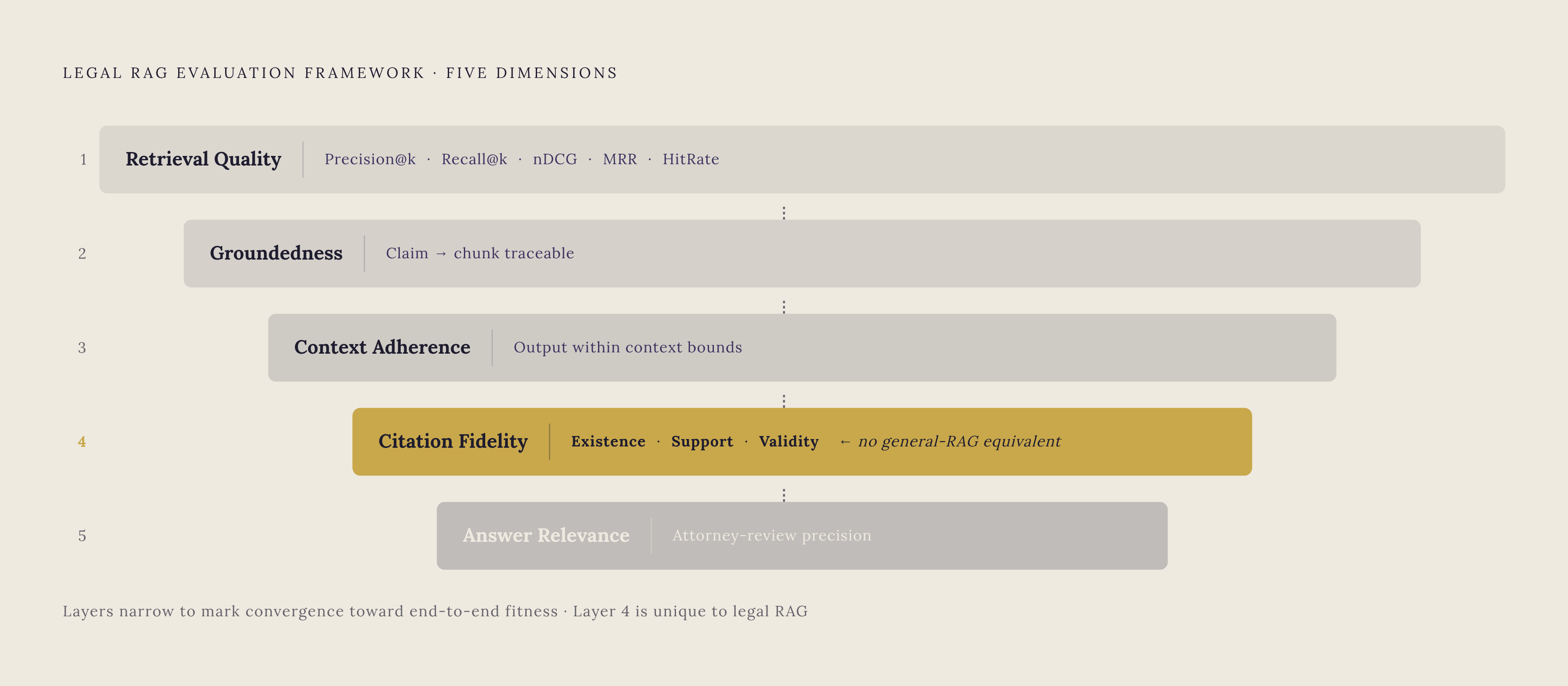
A production-grade framework turns these requirements into five instrumented dimensions, with end-to-end testing around them. Retrieval quality measures performance over the specific legal corpus through Precision@k, Recall@k, nDCG, MRR, and HitRate. Groundedness or faithfulness tests whether each claim is traceable to a retrieved chunk. Context adherence tests whether the output stays within what that context licenses, while citation fidelity tests the existence, support, and continuing validity of each authority. Answer relevance then asks whether the output addresses the actual legal question at the precision a supervising attorney requires.
To meet that standard, golden datasets should cover the full scope of the legal corpus and balance routine queries with edge cases. Frozen sets give each evaluation cycle the same basis for comparison. Governance rules must also permit updates without destroying that comparability. The framework should retain error attribution by layer so a change in the overall score can be traced to retrieval, reasoning, or another measured dimension.
Evaluation must keep going after deployment because a fixed benchmark cannot cover every change in the corpus, model drift, or new failure mode. Batch or online A/B tests, monitoring dashboards, and governance checkpoints provide the continuing assessment described by the framework. An auditable evidence trail connects that assessment to individual outputs and professional review. This combination makes monitoring useful for remediation. It also keeps operational cost and compliance auditability within the definition of quality.
The evaluation environment must also meet the confidentiality requirements of the deployment. Those requirements typically push legal systems toward self-hosted or private deployment. Evaluation tooling must therefore operate within the firm boundary. Cloud-only evaluation platforms may be disqualified on data-handling grounds before technical scoring begins. The resulting standard is demanding but coherent, testing the authority retrieved, the reasoning applied, the citations produced, and the evidence available for review. That is the basis for judging whether legal document AI can hold up in production.