Measuring Outside Counsel Spend Reduction From AI Deployment
Legal teams can measure AI's value by tracking work that never reached outside counsel.

Measuring outside counsel spend reduction from AI deployment means documenting fees never incurred. A defensible CFO case connects work kept in-house to comparable historical invoices, subtracts the full cost of deployment, and reports recovered lawyer capacity separately. The evidence starts with intake, before outside counsel starts billing.
Why outside counsel spend is the wrong place to look for AI savings — and where to look instead
A legal team deploys AI, believes it has improved productivity, and reaches a CFO meeting without a number it can defend. Lawyers report faster research and review, but those gains do not identify which external fees disappeared. The reporting layer misses the cost mechanism. Hours saved on a task are not automatically money saved from a budget.
The difficulty is that preventive savings leave no invoice. They arise from work that never escalated, research calls never made, and first-pass reviews never commissioned. Billing analytics and e-billing enforcement operate downstream, after outside counsel is engaged and the clock is running. Establishing which charges were prevented requires evidence from the work entering the department and the decisions made about where it went.
What AI actually does upstream of the outside counsel invoice
Intake triage routes work to a firm or keeps it in-house. Routing low-complexity work to a high-rate firm creates an avoidable cost before substantive work begins. The allocation framework sorts requests as they come in by value and risk so that low-value, low-risk work stays in-house. AI makes that sorting sustainable at volume.
Associate time reading, flagging, and marking up contracts accounts for much of the billing before partner review. AI applies pre-built playbooks against company standards and returns a structured issue list. The first pass can therefore remain in-house. Where external advice is needed, an annotated draft replaces a cold read.
An unfamiliar employment question or regulatory issue can begin with an internal AI research session with citations rather than a call that generates a multi-thousand-dollar memo. Ritesh Patel, CLO at Viant Technology, uses this pattern. Better-prepared handoffs also reduce orientation time on work that legitimately requires external expertise. Invoice review remains useful after engagement, but its scope is bounded by work already committed and billed.
The baseline problem: what you need to measure before AI arrives
A sound baseline comes from the department’s invoices, request records, and finance-approved rates. Finance needs the department’s actual comparison point. Outside counsel spend must be separated by matter type, with records showing when requests arrived, when legal responded, when firms were engaged, and what the work cost.
GC AI’s legal metrics guide specifies the underlying documentation. Each request needs an ID, type, complexity, owner, relevant dates and times, and outcome, with measure sources documented, original timestamps preserved, and exclusions counted. That detail makes later comparisons possible. A single spend total can conceal ordinary budget fluctuations, while a defined cohort can show NDA first-pass review costs falling to zero even as complex litigation spend holds steady. Recording both currency incurred and outside counsel’s share of total legal cost also supports allocation and forecasting.
The four metrics that make spend reduction visible in the numbers
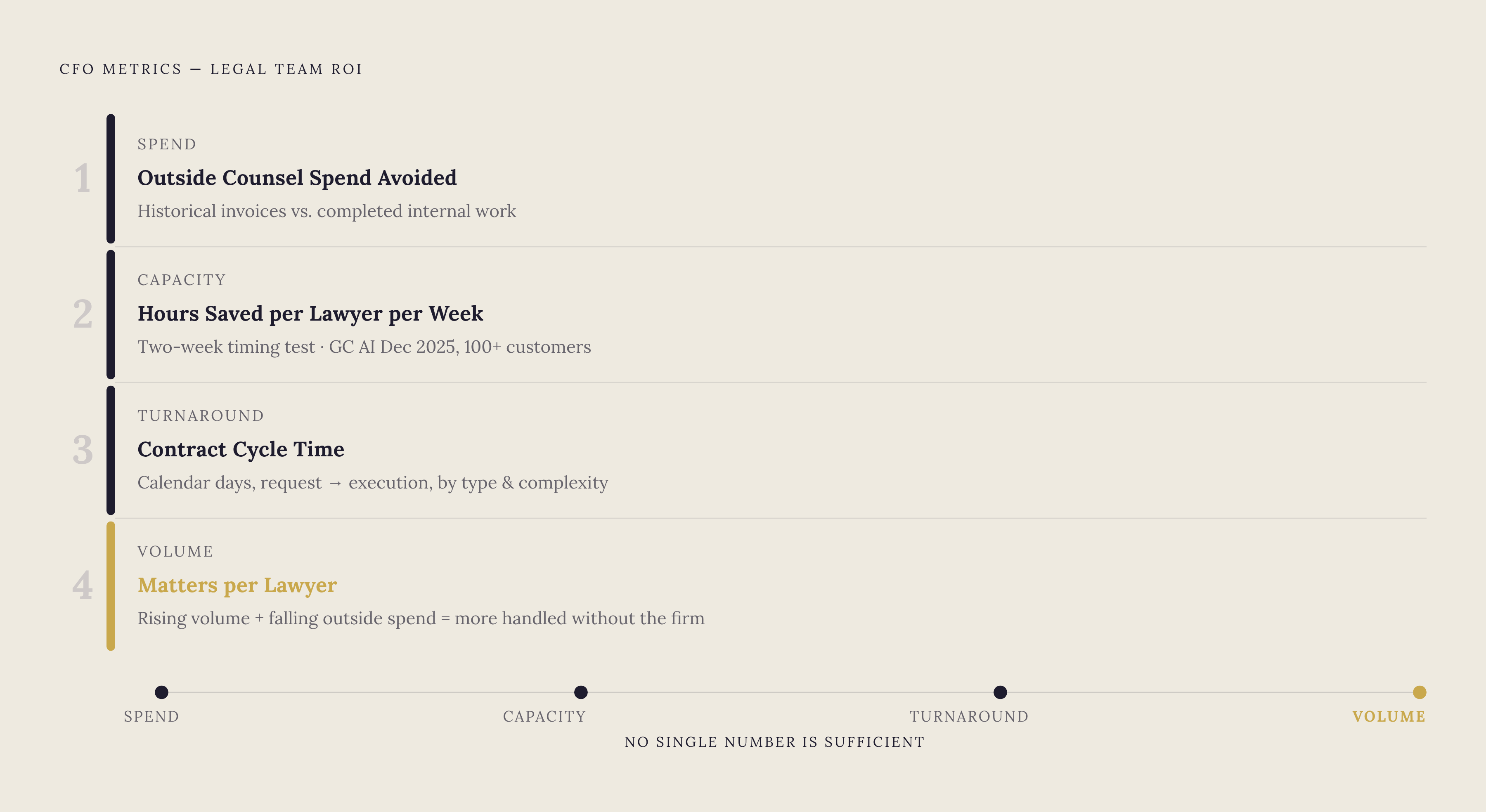
Outside counsel spend avoided, measured by matter type, answers the first financial question. What previously purchased work demonstrably stayed in-house at acceptable quality? The groups to compare are contract reviews that recur, research memos, standard-form negotiations, and repeat multi-jurisdiction questions. GC AI’s ROI framework builds this line from invoices. Historical fees establish the reference cost, while completed internal work establishes that the expense was avoided.
Research requires a particularly careful quality comparison. The AI work done in-house must use the same jurisdiction, business facts, and legal question that were sent to the firm. Counsel then compares the result with the paid work product and decides whether the analysis is complete and usable. Similar subject matter alone is insufficient evidence. A cheaper answer to a different question does not demonstrate avoided spend.
Hours per lawyer per week shows how much time a lawyer has for each task. A two-week timing test establishes the departmental starting point by timing three recurring tasks without the platform, then timing the same work with it and verifying the findings before counting savings. GC AI’s December 2025 ROI study of more than 100 active customers reported meaningful weekly time savings and supplies context. Departmental evidence must stand on its own. Data on how the platform is used and records of requests then show whether those gains hold up in the work done.
Contract cycle time tests whether internal completion improved. The measure runs from complete request to execution in calendar days, grouped by contract type and complexity. A cohort might consist of routine NDAs supplied by the other party. Consistent business hours, holiday calendars, time zones, original timestamps, and recorded exclusions keep reporting periods comparable. Faster completion within that cohort supports the explanation that lower external spend reflects internal delivery.
Matters per lawyer, tracked against headcount, shows how much work the team handles. Rising volume with falling outside counsel spend shows the team handling more work without the firm. Together, the four measures address capacity, spend, and risk, volume, and turnaround. They serve different purposes in the financial case. GC AI’s ROI calculator can provide an initial estimate, but the CFO presentation requires reproducible departmental records behind each line.
Building the CFO case: separating cash savings from capacity value
The framework’s worked example begins with external fees and other expenses avoided, less additional cash costs of completing the work internally. That produces net cash savings before investment. Annual investment includes subscription, usage charges, required add-ons, implementation, training, and ongoing support, plus material internal rollout time at a finance-approved rate. Costs paid only in year one are identified separately. Savings-only ROI is then net cash savings less annual investment, with that result divided by annual investment.
The illustrative example produces a first-year net benefit exceeding the investment and full cost recovery well within the first year. It is not a departmental forecast. The adaptable template is the calculation sequence, populated with the department’s own invoices and deployment costs. It must show what work stayed internal, what comparable external work cost, and the net cash position after investment.
Capacity value occupies a separate column, calculated from verified hours used for other legal work multiplied by the hourly lawyer cost approved by finance. Overlapping hours must be excluded from that additional value. If the time saved made insourcing possible and the avoided fees have already been counted, those same hours cannot be counted again as another benefit. Contracts reviewed, deviations caught before signature, volume, and turnaround help show that the time was well used without adding another dollar line. The Thomson Reuters Institute’s Future of Professionals 2026 report found most corporate legal professionals facing pressure to adopt AI faster and financial pressure to act faster, increasing the need for this distinction.
What "avoided spend" actually looks like across matter types
NDA and standard contract review offer a readily defined comparison group for teams processing hundreds of NDAs annually. KT Farley, Chief Privacy Officer and Associate GC at Helix, states, “The cost of a license is a couple of hours of outside counsel time, and it will completely transform your outside counsel budget”. The NDA intake example illustrates the workflow change behind that economic opportunity. A CFO-initiated request that previously took three attorneys and nearly three days runs in minutes through a standard template and AI-assisted first review.
Routine research also belongs in this review when employment questions, regulatory issues, or unfamiliar contract clauses used to lead to memos from outside counsel. The earlier quality comparison governs whether those fees qualify. Recurring multi-jurisdiction questions and standard-form negotiations offer another useful cohort because defined patterns make both playbooks and before-and-after comparisons repeatable.
Chuck Kable, General Counsel at Innovative Renal Care, provides an allocation example. At Emerus, before legal AI existed as a product category, he built an internal function and reduced the unnecessary category of external spend to zero. He described that work as “stuff that we kind of categorized as otherwise being able to be handled internally”. The boundary remains important with AI deployment. Complex litigation, M&A, and regulatory work requiring specialized judgment are not automatically avoidable, and work deferred or declined is not work successfully insourced.
Why the billing-hour disruption makes this measurement work urgent now
Documented insourcing creates evidence for outside counsel negotiations as well as internal reporting. The Everlaw/Wakefield Research 2026 In-House Innovation Report surveyed 300 in-house legal professionals. Among respondents whose departments use outside counsel, a majority said AI had already reduced the volume sent externally, and nearly all the remainder expected a reduction within the next year. Teams that have costs and cycle times for each cohort can use those figures to compare which work should stay with outside counsel.
The same survey found most respondents engaging firms expected clear disclosure of AI use, measurable efficiency or outcome gains, and lower fees or fewer billed hours. A large majority expected outcome-based pricing to overtake the billable hour within five years. Fifty-seven percent expected flat or fixed fees to become the most widely adopted alternative fee arrangement for AI-enhanced work.
Nevertheless, the survey reported widespread savings from outside counsel’s AI use after most in-house respondents had seen none in the prior year. A department tracking its own avoided spend has a basis for requesting comparable evidence from firms. It can ask where AI reduced hours on its work and why fees did or did not change.
The measurement gaps that let avoided spend go unrecorded
Systems that track spend may miss the fees a team avoids. Legal data is often siloed, inconsistently formatted, and unsuitable for querying across comparable periods. Without time-stamped records by type, the avoided-spend claim remains an estimate. Invoice records alone cannot fill that gap because they show work bought from firms and leave out work kept in-house.
Attribution therefore needs prospective intake tracking before deployment. Each incoming request needs its type, complexity, and routing decision logged so that allocation before and after AI can be compared. Outcome records establish whether the work was completed. The existing documentation standard supplies the IDs, ownership, timestamps, sources, and exclusions needed to reconstruct the comparison.
A quieter quarter or a shift toward simpler work can reduce invoices without any AI contribution. Comparisons need to match contract types and complexity bands and account for the time of year when demand is seasonal. The final reconciliation is between time and money. Documenting overlap by task or matter prevents recovered hours used for insourcing from appearing again as additional capacity value.
What a production-ready measurement framework requires before AI deploys
A department preparing deployment needs six readiness conditions in place before the first request enters the workflow. Business readiness means a bounded, measurable problem, such as first-pass review for a defined cohort. Data readiness means typed, time-stamped, queryable records already exist. Security requires access controls and audit logging. In regulated industries, GDPR, HIPAA, and sector-specific frameworks shape the architecture before deployment.
Governance requires named owners for routing decisions and exceptions, including decisions to send apparently routine work externally. Operations requires the ability to monitor, support, and stop the workflow. Rollback capability is part of auditability. Measurement requires continuous tracking of value and failures before go-live. Together, these conditions address governance, integration, and auditability gaps that can prevent a pilot from becoming an accountable production process.
Use-case selection also needs three deployment criteria. Volume must support a statistically meaningful before-and-after comparison, the great majority of cases must follow a demonstrable rule or pattern, and a clear outcome measure must exist before deployment. An AI Operations Audit tests candidate workflows against those criteria and the six readiness domains. It identifies which categories are ready for insourcing and establishes the baseline standards for IDs, timestamps, cohort definitions, and routing logs. The CFO case then rests on documented completed work that displaced an external purchase, rather than an efficiency claim assembled after the event.