Corporate Compliance Monitoring Workflows Using AI Agents
Agents need audit trails, clear ownership, and data controls built in before deployment.

AI agents can move corporate compliance monitoring from manual triage to systems that run continuously and own workflows with a defined scope. Production readiness, however, depends on audit trails, named ownership, and data readiness built in before deployment. With those foundations, an agent can stay within clear boundaries, escalate decisions that have serious consequences, and produce evidence that compliance leaders can defend.
Why traditional compliance monitoring breaks down when AI agents enter the workflow
A compliance team expects to govern an application with defined permissions and predetermined logic. An AI agent instead makes contextual decisions, accesses multiple systems, and adapts its behavior over time. That changes the unit of oversight. A review of access to one application cannot show whether an agent stayed within its delegated authority as it took a series of actions across several applications.
Traditional controls were not designed for that distinction. Firewall rules, access lists, and periodic audits establish boundaries, but do not by themselves govern autonomous decisions within those boundaries. Conventional logs record a timestamp, actor, resource, and outcome without explaining the policy or approval behind an agent’s action. Shadow AI widens this gap when unsanctioned agents bypass security controls and operate outside the audit perimeter. A technically functional deployment can therefore remain an unmonitored risk.
What the EU AI Act and emerging standards require from enterprises running autonomous agents
The EU AI Act makes this architectural gap a legal concern for enterprises operating agents subject to its high-risk requirements. Its risk-based approach puts the agent’s use and consequences at the center of the compliance assessment. Agents can generate text, start workflows, approve transactions, and affect what happens in the real world. Their autonomy therefore demands scrutiny, although autonomy alone is not a sufficient explanation of a particular system’s regulatory classification.
For high-risk systems, the requirements translate into transparent and auditable technical documentation, operations open to external monitoring, structured human oversight, and mechanisms to stop, correct, or override the system. These are architecture decisions. An agent cannot support meaningful intervention if its workflow has no intervention points. Likewise, documentation cannot explain decisions if the system preserves only their final outcomes.
The EU AI Office has described its agent-specific regulatory considerations as preliminary, leaving enterprises to apply essential requirements with interpretive judgment. ISO/IEC 42001:2023 provides a complementary, auditable AI management standard. Certification can take more than a year, depending on organizational maturity. That planning horizon reinforces the need to design governance before deployment, since retrofitting oversight into a running agent is more costly and time-consuming.
The six governance domains an AI agent must satisfy before it can run compliance workflows in production
For pre-deployment decisions, the requirements can be organized into six practical domains drawn from the operational gaps above, namely scope, ownership, data readiness, security, integration, and measurement. Each needs a concrete answer before release. Scope defines the workflow and its action boundaries, while ownership identifies who approves deployment and intervenes when decisions exceed those boundaries. Together, they distinguish delegated authority from unrestricted autonomy.
Data readiness establishes which regulated information the agent may access and use. Security establishes enforceable permissions, identity controls, and the evidence needed to review access. Integration addresses how policy validation, escalation, and logging work across the systems the agent touches. Measurement defines the baseline, value metrics, and failure metrics. A model’s capabilities cannot substitute for these decisions.
The Microsoft Cloud Adoption Framework for AI agents provides a complementary view through four layers, including data governance and compliance, agent observability, agent security, and agent development. The framework recommends aligning these layers with existing enterprise governance structures. That alignment makes the requirements enforceable and auditable. The pre-deployment test is consequently not whether each domain has a policy document, but whether the proposed workflow has the controls, accountable people, and evidence those policies require.
The agent audit trail: what it must capture and why human-era logging is not sufficient
An agent audit trail must explain authority as well as activity. Delegated user and agent identity establish on whose behalf the agent acted and which agent performed the work. The tool invoked and resource accessed establish where it operated. The action and its parameters show what the agent tried to do, while a comparison of requested scope and actual scope shows whether the action stayed within its intended boundary. These details link events across applications so that people can review the agent’s behavior across systems.
The policy version in effect answers which rules governed the decision at that moment. The decision and its reason explain the basis recorded for proceeding or refusing. Approval state distinguishes human-approved, auto-approved, and escalated actions. The downstream result then shows what happened after execution, rather than treating a permitted request as proof of a successful outcome. Together, these records support correction and regulatory review.
Consistency across deployments is essential to that evidence. The Microsoft framework recommends a centralized governance layer with consistent identity, ownership, access control, and continuous monitoring. Token expiration enforcement and continuous permission audit logging support the integrity of the access record. Without centralized logging, untracked deployments can remain absent from the audit inventory even while they act on enterprise systems.
Defining ownership: why compliance agents fail without clear accountability across IT, legal, and operations
A complete log does not authorize anyone to intervene. The Microsoft framework recommends assigning agent governance to leaders already responsible for cloud governance, security, and compliance. This avoids a parallel structure in which established teams retain responsibility for enterprise risk but lack clear authority over agents.
With cross-functional oversight, IT, Legal, Compliance, and Operations take part in the same decisions. It does not replace a named owner. Defined approval workflows establish who can authorize a new deployment, while documented escalation paths establish who handles high-risk decisions. Exception-handling rollback procedures and decision-logging requirements make override authority explicit and preserve accountability when it is exercised. These are management decisions with direct regulatory consequences.
An agent registry is the minimum infrastructure for maintaining that accountability across deployments. It records each agent’s owner, purpose, platform, and access scope, making the agent a managed organizational resource. The framework identifies untracked deployments as security and cost risks. For compliance leaders, the decisive issue is whether every agent has an accountable human and a documented route to intervention.
Data readiness as a prerequisite: how agents fail when data classification and segmentation are missing
Even an accountable owner cannot govern access to data without knowing which rules apply to it. Data classification mapping shows which categories are regulated before an agent encounters them. Segmented storage environments then restrict visibility to authorized information. Without those foundations, a scoped access policy may set a boundary on paper that cannot be enforced in practice. Good decision logic cannot compensate for that upstream gap.
Sensitive records also require encryption enforcement in transit and at rest. Restricted model training datasets protect against unauthorized use beyond the immediate workflow. Training boundaries are an audit concern as well as a matter of data hygiene. If data was used without authorization, the resulting compliance liability traces back to the decisions that permitted that use.
Vendor evaluation must establish clear data ownership policies, exportable logs, defined model training boundaries, and documentation of regulatory alignment. Gartner identifies lack of AI-ready data as a reason AI projects are abandoned, making readiness both a deployment risk and a performance concern. The practical questions belong in the pre-deployment audit, before missing classification or segmentation becomes a post-incident finding.
How compliance monitoring workflows operate end-to-end when agents are built to own them
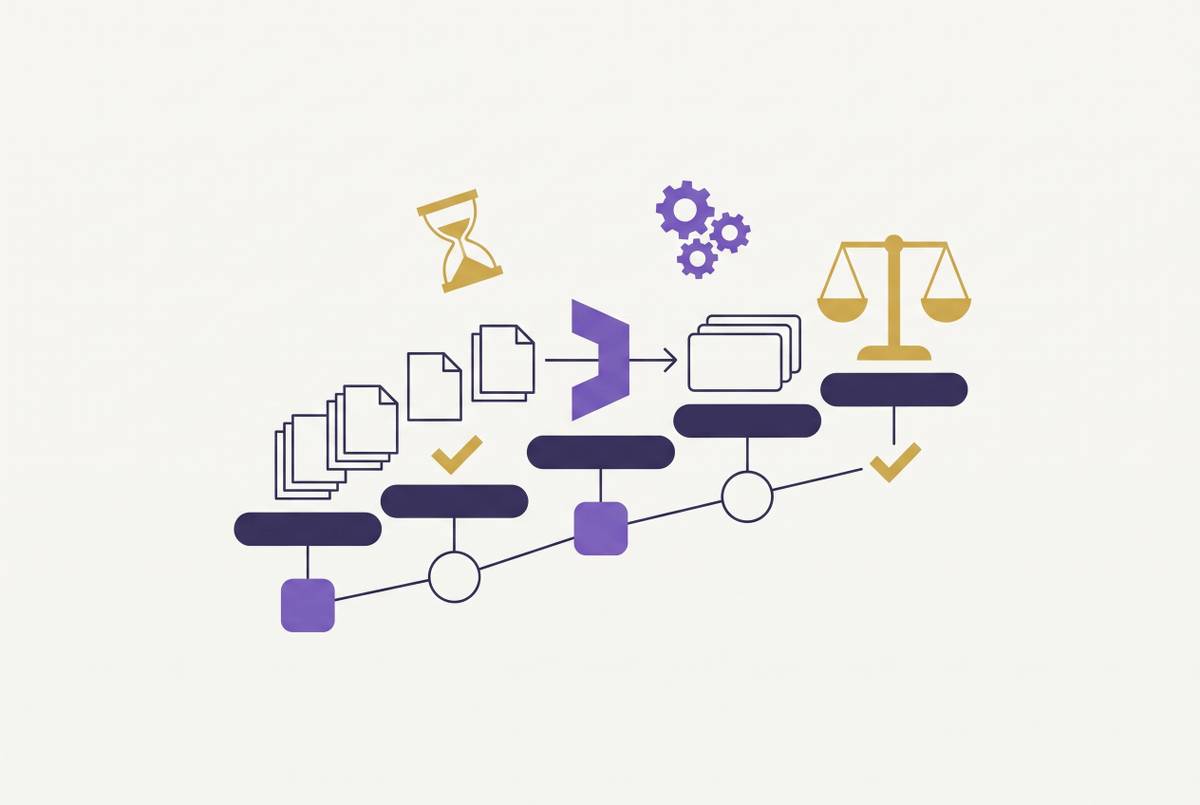
With these prerequisites in place, an agent can own a defined monitoring workflow rather than merely assist an analyst with isolated tasks. The sequence begins with continuous ingestion from enterprise systems. Incoming information supports anomaly detection against policy parameters, with confidence scoring and source references that make flags auditable.
Before executing an action, the agent’s planner validates it against the applicable compliance ruleset. The boundary depends on the workflow. Actions in healthcare must stay within HIPAA boundaries, actions in legal work must stay within privilege scope, and actions in finance must follow SOX authorization matrices. Defined escalation routes send edge cases and high-risk decisions to people for review, keeping decisions with serious consequences from going ahead through unrestricted automation.
Continuous records connected to a security monitoring system capture actions, decisions, and escalations in the audit format established before deployment. Automated reporting uses that same evidence to create executive summaries and material for the audit committee, so people do not have to piece events together again by hand.
What compliance monitoring agents look like in automotive, legal, and healthcare deployments
Automotive agentic testing embeds constraints including FMVSS, ISO 26262, and SOTIF into evaluation logic, assessing software revisions for compliance implications as well as functional correctness. Controlled assessments reported improved safety-compliance readiness in pre-release evaluations. Dealership workflows face a separate legal constraint. The FTC Safeguards Rule, under 16 CFR Part 314, requires monitoring and logging of authorized user activity, and per-action agent logging is a recommended way to meet that requirement, though the rule does not explicitly call for it. Its service-provider oversight requirements also make contractual safeguards and periodic assessment of AI vendors handling dealer customer data a legal obligation.
Legal agents stay within privilege scope as they track regulatory change, review contracts, and check compliance. Regology uses workflows built for regulatory change and compliance to map the laws that apply and changes to those laws to obligations, controls, and policies. Such work can identify potential issues and suggest remediation strategies. Privilege remains the boundary before each action. This example establishes a concrete workflow role for agents without implying that autonomous legal judgment or a quantified deployment outcome has been demonstrated.
Healthcare workflows similarly require HIPAA action boundaries and controlled use of sensitive information. Omega Healthcare automated document processing and reported a substantial reduction in time spent on documentation tasks. The FDA has also authorized more than a thousand AI/ML-enabled medical devices, demonstrating that regulated deployment and AI can coexist, though device authorization is distinct from compliance monitoring. Across these contexts, the regulatory constraint changes, but the need for evidence, ownership, and bounded access remains.
Measuring compliance monitoring ROI in a way that survives audit committee scrutiny
For the leader defending the investment, measurement starts before deployment. A pre-deployment baseline gives later claims a point of comparison, while value metrics and failure metrics define what counts as success. Without that foundation, a faster workflow may be visible without a defensible account of the value it created. An AI Operations Audit addresses measurement as a pre-deployment domain so that reporting rests on an established record.
Continuous monitoring can translate audit efficiency gains into time-saved and cost-reduction measures. Tokens consumed, uptime, and latency are still operational metrics, but on their own they cannot show whether compliance work costs less or gets better results. Direct measurement of AI value in the P&L strengthens the investment case by connecting the deployment to financial results.
The audit trail supplies the evidence for that connection. Reports built from the same records of actions, decisions, escalations, and outcomes can link what the agent did to the value and failure metrics agreed before release. A compliance agent without a measurement framework remains a pilot.