Legal Hold Notice Automation for In-House Teams
Automation ties notices to preserved data, creating a defensible record.
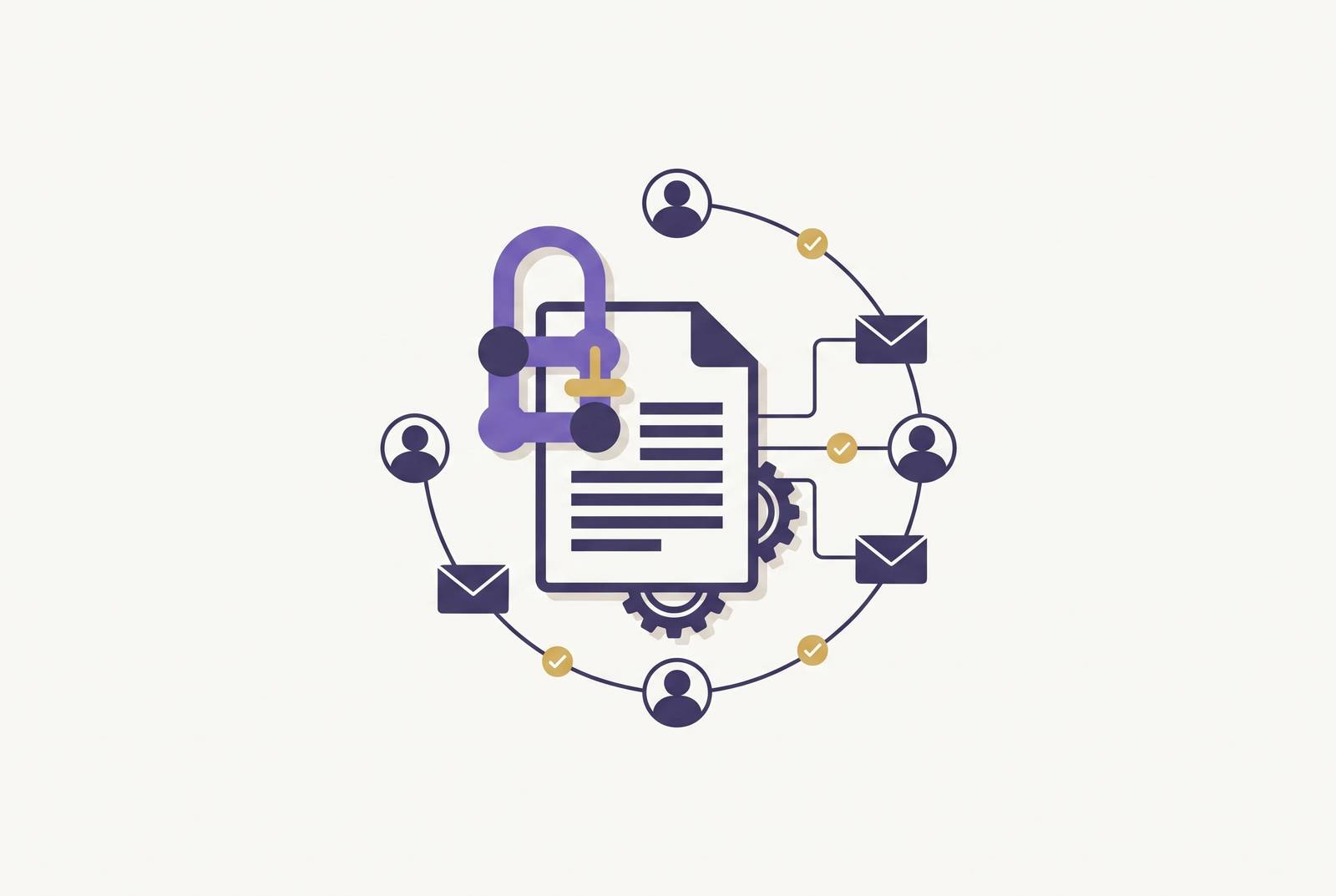
Legal hold notice automation for in-house teams is about controlling preservation. Its value lies in connecting custodian identification, notification, acknowledgment, escalation, data preservation, and documentation into one managed workflow. A defensible process must show what happened across that chain without depending on someone to reconstruct it from email threads and spreadsheets.
Why legal hold still fails in-house teams despite decades of eDiscovery practice
With email notices and spreadsheet tracking, the instructions are kept apart from the evidence that people followed them. That separation becomes an operational gap when a custodian never acknowledges a notice, leaves the company, or holds relevant data across email, Teams, shared drives, and cloud apps. A sent message proves only so much. It does not establish that the underlying data was preserved or that an unanswered notice received follow-up.
Lean in-house teams face this problem most acutely. A single-attorney department issuing holds across a distributed workforce has no manual fallback that scales with every custodian, system, and change in scope. Yet litigation scrutiny turns on what the organization can document.
What the duty to preserve actually requires once litigation is reasonably anticipated
The duty to preserve begins when litigation is reasonably foreseeable, even before a lawsuit is filed. Demand letters, whistleblower reports, and regulatory inquiries can bring that duty into effect. Courts evaluate whether reasonable steps followed promptly. Delay creates exposure because relevant data may disappear while the organization is still deciding how to execute its hold.
The team must define the scope before notices go out. That definition covers the custodians, systems, data types, and timeframe relevant to the dispute. A hold that is too broad adds work, while one that is too narrow leaves gaps that may come to light during discovery. The notice must translate that scope into plain-language responsibilities while establishing the foundation for a defensible record.
That record needs timestamps for initiation, notification, reminders, preservation actions, and release. It must connect the people instructed to preserve with the data actually preserved. Speed and documentation are inseparable here. Automation must provide both speed and documentation because fast delivery alone cannot show that the preservation process was reasonable.
What the preservation workflow actually looks like end-to-end, and where manual processes break at each stage
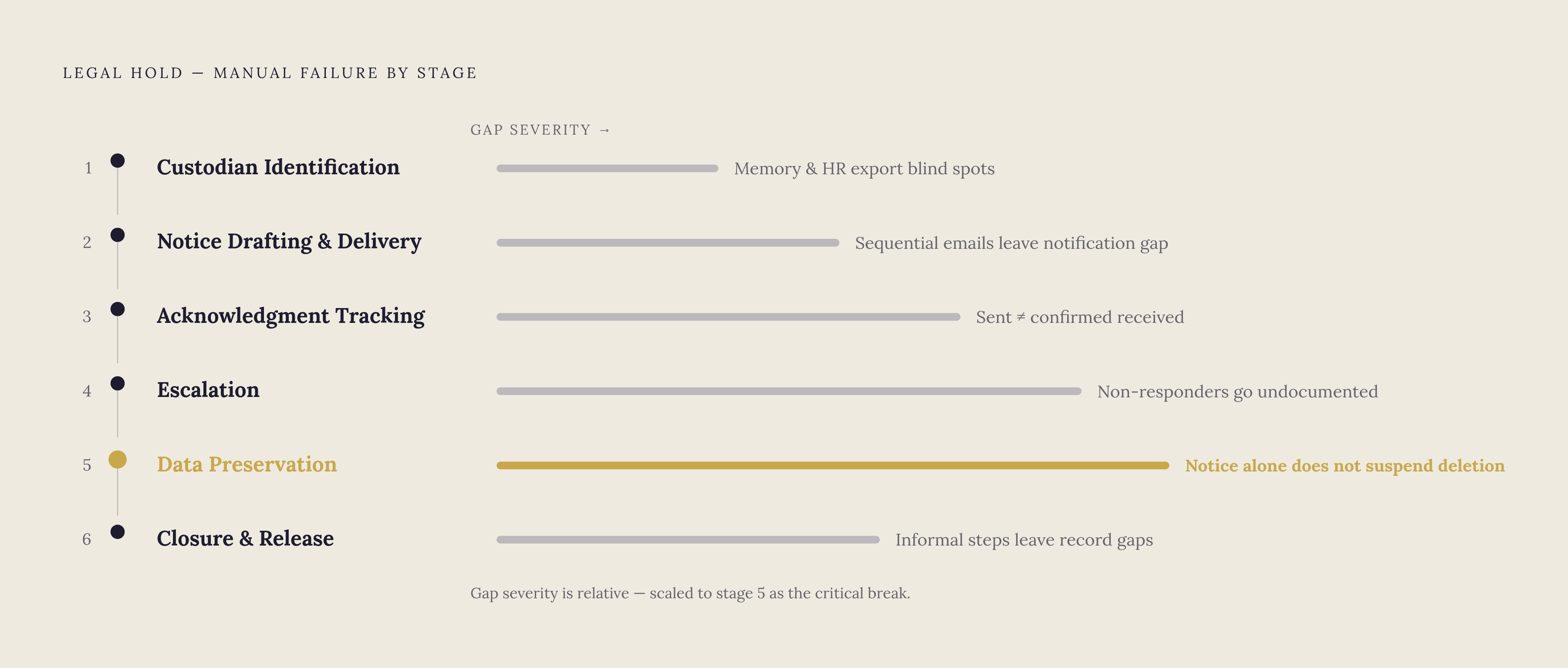
Custodian identification starts with finding out who has relevant data. Org charts help, but communication patterns and document metadata can show who contributed to a project and which contractors and employees did work tied to the dispute. Memory and HR exports leave blind spots. Every later step is weaker when people are missing from the custodian list because they never receive notices or follow-up.
Notice drafting and delivery come next. Instructions must be clear enough to follow, use plain words, and reach every custodian at the same time. Sequential emails leave a window in which some people have not yet been told to stop routine deletion. After delivery, acknowledgment tracking must distinguish a sent notice from a custodian’s response. Persistent non-responders require documented follow-up and escalation to managers.
Email, Teams, Slack, shared drives, and cloud storage can continue deleting data unless their underlying settings change. A notice alone does not suspend deletion.
The workflow continues as custodians join, leave, or change roles and as the scope expands. Each change requires a documented update, so the original list cannot serve as a permanent account of the hold. Closure also requires a formal release documenting what was preserved and when. When teams handle that last step manually, they often do it informally, so the record has gaps even after the work of preservation ends.
Generative AI tools are a new preservation gap that standard hold notices do not reach
A notice designed for email and shared drives does not automatically reach ChatGPT, Copilot, or Gemini interactions. Those platforms have their own deletion schedules. Naming a shared drive may capture an AI output pasted into a document without preserving the exchange that produced it. Relevant records can also exist in platform logs or in summaries forwarded through Slack or email.
The federal court in In re OpenAI held in May 2025 that generative AI prompts and outputs are ESI, discoverable under Rule 34 and subject to preservation duties. The court narrowed the order in September, and later proceedings fully ended the requirement to preserve data going forward. Those changes limit what can be inferred from the order’s duration. They did not eliminate the broader principle that AI content is discoverable ESI.
Preserving that content requires more than retaining the final answer. Custodians need specific guidance to identify relevant interactions, while manual copy-paste exports strip timestamps and session metadata. Context is part of the evidentiary record. An output separated from its full prompt chain is difficult to authenticate and easier to challenge because the exchange that explains its production is missing.
The practical response is to name AI tools explicitly, including personal and free-tier accounts used for relevant work. Custodians need to be told not to clear conversation history or let it auto-expire, while IT needs instructions at the same time to disable or extend enterprise auto-delete settings. Timing closes a distinct preservation gap. Platforms that connect the hold workflow to enterprise AI settings can coordinate action at the source in a way that a manually drafted notice cannot.
What automated legal hold platforms actually do across the full workflow
AI-supported custodian identification can use org charts, communication patterns, and document metadata to find relevant people who may be missing from a basic HR export. This addresses omissions at the workflow’s entry point. Simultaneous deployment then issues notices across the identified group and can activate preservation in connected systems within minutes, shortening a process that can take days.
Acknowledgment workflows address a different failure mode. They track responses, send reminders to non-responders, and escalate persistent silence to managers, with timestamps documenting those steps. The record distinguishes delivery from acknowledgment and shows how the organization responded when a custodian did not answer.
In-place holds suspend deletion at email, collaboration, and cloud storage sources rather than relying entirely on custodians to preserve their own data. Platforms that monitor HR data can also flag departures or role transfers in real time. This lets the team link employee changes to preservation steps while the hold is active.
Audit documentation ties these actions back to the dispute. Notices, acknowledgments, escalations, and preservation actions become a timestamped record produced during execution. The distinction is operational. It gives the organization documentation relevant to FRCP 37(e) and makes it less dependent on records that team members keep separately.
How the leading platforms cover the workflow, and what distinguishes them
Platform fit depends on data source coverage, integration with the legal team’s existing environment, and the breadth of work that follows preservation. The relevant distinction is whether the team needs preservation management alone or a connected investigation and review workflow. That distinction is especially important for a growing company approaching its first significant dispute.
Casepoint covers legal hold, preservation, collection, processing, review, analytics, and production in a single environment. Its scope extends beyond the hold itself. It serves government agencies, enterprises, and compliance teams handling complex investigations, FOIA requests, and regulatory work. This makes it a strong fit when preservation is the entry point to a larger managed review workflow.
OpenText Core Legal Hold centralizes and automates hold management in a cloud-based platform for legal, compliance, HR, and IT teams. It includes automated notifications, custodian questionnaires, audit trails, dashboards, and configurable expert process workflows. Shared departmental responsibility is central to its fit. It suits teams that have large amounts of data and need to work across departments to preserve it.
Lean teams can instead use an AI workflow layer built for this work without having to set up a full enterprise suite. Such a system can handle custodian reasoning, notice drafting, and acknowledgment tracking, with an audit trail built to meet FRCP 37(e) documentation standards. Breadth still requires careful distinction. A system that handles those core tasks may still lack the data source connections or tools for later review that a broader suite has.
What a defensible hold notice must contain in a world where AI tools are in scope
For teams reviewing their templates, the starting point is a plain-language explanation of the dispute and why preservation is required. The notice should identify the relevant timeframe and covered data, including emails, chat messages, drafts, spreadsheets, shared drive content, cloud files, and mobile data. Specificity gives custodians an instruction they can follow. A template limited to email and shared drives leaves collaboration platforms and other relevant sources outside its stated scope.
The notice should direct custodians to suspend deletion and alteration, including auto-delete rules, inbox policies, and scheduled purges. It should also name an escalation contact and require acknowledgment. These elements serve different purposes. The deletion instructions govern conduct, while the contact and response requirement create a route for questions and documented follow-up.
AI coverage needs equally explicit language. Preservation should extend to any AI tool used for relevant work, including personal and free-tier accounts, and should prohibit clearing, deleting, or allowing conversation history to auto-expire. The full prompt-and-output chain belongs in scope. IT should receive instructions on enterprise AI auto-delete settings when the custodian notice goes out, so technical preservation starts at the same time.
Instructions that custodians can understand help them acknowledge notices and preserve their own data better than language written only to maximize legal coverage. Automated templates and approval workflows can help prevent issuance before scope is finalized or source preservation is addressed. Even a well-drafted notice in a manual workflow, however, still depends on a person to track who acknowledged it and who needs escalation.
How to evaluate whether your current hold process is defensible before litigation tests it
A pre-litigation assessment should test the record the process produces. Four questions expose the main dependencies. The first asks whether the team can produce a timestamped record showing when every custodian was notified for any dispute in the past three years, including reminders and escalations. The second asks whether it can show which data sources were placed under preservation and when preservation of each source was confirmed for active or recently closed disputes.
Third, does the notice template clearly cover AI tools, collaboration platforms, and mobile data, or does it still cover only email and shared drives? The fourth tests employee changes. When a custodian leaves during an active hold, does the process automatically flag the change and trigger preservation, or does action depend on someone noticing.
Answers that require reconstructing events from emails reveal a documentation weakness. Answers that depend on who managed the dispute reveal a consistency weakness. At litigation scale, neither provides a dependable preservation process. The assessment should separate gaps that need automation from policy gaps that need work no matter which platform the team chooses.
An AI Operations Audit provides a structured version of that evaluation by mapping how the stated workflow diverges from its actual documentation. It produces a baseline and remediation roadmap before a dispute forces the organization to explain missing records under pressure. That preparation supports evidence of reasonable steps, but does not replace execution after the preservation duty arises. This week, the team can answer the four questions and decide whether the gaps are manageable manually or warrant a structured assessment.