Legal Request Intake Automation Without a New Hire
AI agents can handle the full intake workflow if firms let them execute all six steps.
- Written by
- Marcus Delgado-HaraStaff Writer, Legal Technology
- Published
- October 12, 2026
- Reading time
- 11 min read
What this covers
A prospect calls a law firm at 6:15 PM, reaches voicemail, and calls two competitors before signing with whichever one answers first. That sequence repeats daily at firms that already run a chatbot on their website, because the chatbot was never built to close the gap between an inbound call and a routed, qualified matter. This piece lays out why legal intake automation only replaces a coordinator's job when the AI agent executes the full workflow, not just the parts that look good on a sales page, and what that full execution actually requires.
Why Legal Intake Still Bottlenecks Firms That Already Have AI Tools
Most firms that have adopted AI in intake have adopted a narrow slice of it. A chatbot sits on the website, answers a question about practice areas, maybe captures a name and phone number, and then hands the lead to a person. Everything downstream of that handoff, the conflict check, the classification of the matter, the routing to the right attorney, the memo that briefs whoever picks up the file, still runs through a human being. The tool assists the first thirty seconds of a conversation that can take days to actually resolve.
The 6:15 PM call makes the cost of that gap obvious. The prospect isn't going to wait until the next business day if a competitor's phone gets answered first. A voicemail box or a chatbot that just logs a lead doesn't change the outcome, because nothing happens with that lead until a coordinator sits down the next morning and works through it. By then, the prospect has already retained someone else.
Firms chose tools built to assist a human through part of the process rather than tools built to execute the process. That's a deployment decision, not a technical ceiling, and it's the decision this piece argues firms need to revisit if they want intake automation to actually move the needle on headcount and on how fast a prospect becomes a scheduled consultation.
What a full intake workflow actually requires a coordinator to do
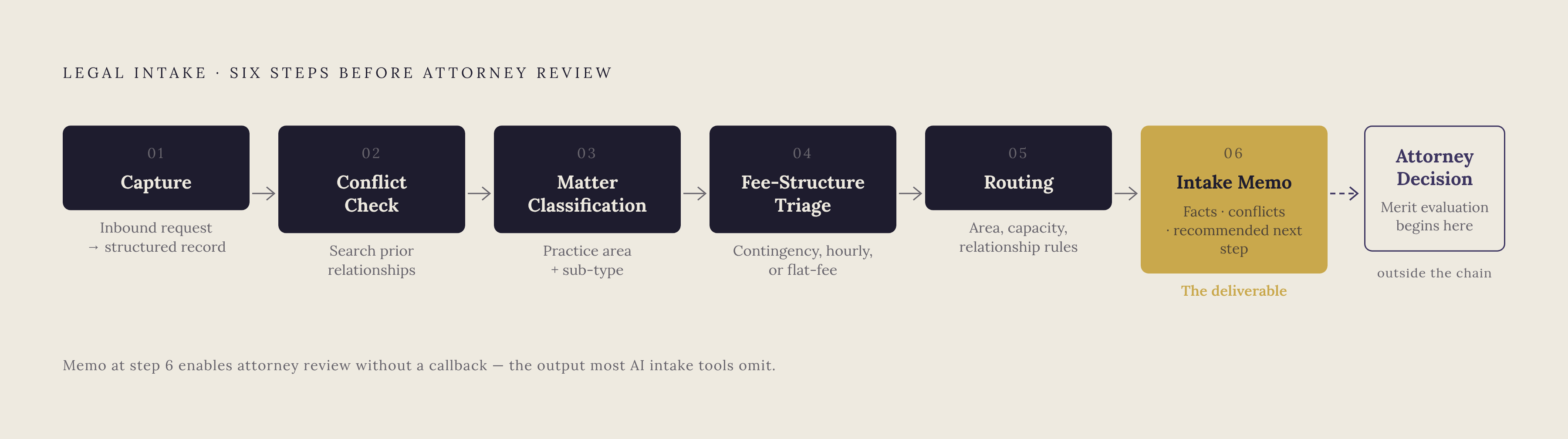
Before arguing that software can take over this job, it helps to lay out what the job actually is. An intake coordinator's work breaks into six discrete steps, and because they're discrete and rule-governed, rather than open-ended judgment calls, the role is a strong candidate for full automation.
The first step is capture: the inbound request has to be received wherever it shows up, whether that's a phone call, an email, a web form, or a message in Slack or Teams, and turned into a structured record with nothing left blank. The second step is the conflict check, where the coordinator searches the firm's matter history for any prior relationship between the prospective client and existing clients or adverse parties. Third comes matter classification, assigning the request to the right practice area and sub-type based on the facts the prospect actually described, not a category the prospect picked off a dropdown menu that may not match what they're dealing with.
Fourth is fee-structure triage: deciding whether the matter fits the firm's contingency, hourly, or flat-fee model, and catching a mismatch before an attorney spends any time on a case the firm can't actually take on the terms the prospect expects. Fifth is routing, sending the matter to the right attorney or team based on practice area, current capacity, and any rules about which attorney handles which client relationships. Sixth is the intake memo itself, a structured brief covering matter type, key facts, conflict status, and a recommended next step, written so the attorney can act on it without calling the prospect back to ask questions the coordinator already answered.
Notice what's missing from that list: the decision of whether to actually take the case. That call happens at the consultation, after all six steps are done, and it belongs to the attorney. The coordinator's job, in other words, is almost entirely process. Streamline AI, among other platforms built for this space, structures its system around exactly this sequence, moving a request through intake, orchestration, and execution, with the software handling classification, routing, and SLA tracking, and logging every action along the way so attorneys can step in only where their judgment is actually needed.
How AI Agents Reason Through Each Step
A form and an agent are not the same thing, and the difference matters for every one of the six steps above. A form collects fields. An agent reads the matter, decides what to do with it, pulls information from the right systems, and adjusts when a prospect's answer shifts the classification mid-conversation. Executing a workflow means reasoning through it; logging data points from one does not.
Older intake automation worked on simple if-this-then-that logic: a web form sends personal-injury responses to one queue and family-law responses to another. That breaks the moment a prospect describes facts that span both categories, or uses language the form's designer never anticipated. A reasoning agent doesn't have that ceiling, because it isn't matching keywords to a list, it's working through the facts the way a trained coordinator would.
Run the 6:15 PM scenario through this kind of system. The prospect calls after hours, and instead of hitting voicemail, the agent captures the details of the matter in real time. It checks those details against the firm's matter history for conflicts and produces a reasoning trace, not just a hit or no-hit flag, but an explanation an attorney can actually evaluate in the morning. It classifies the matter using the firm's own practice-area taxonomy, built from how the firm has actually routed similar matters in the past, not a generic category list. Streamline AI describes this as agents that "learn from past decisions and apply them consistently," a precise way of saying the system is a classifier trained on the firm's own history.
The payoff is visible in follow-up questions, too. A prospect who calls back a few days later with an additional detail, say a change in who else was involved in the incident, needs the agent to update the conflict check and the classification without starting the intake over from scratch. That's the same thing a good coordinator does without thinking twice about it, and it's precisely where generic, off-the-shelf tools fall short. A workflow built around a specific firm's routing rules, conflict logic, and classification taxonomy produces a memo attorneys can trust. A generic tool, lacking that context, produces output attorneys learn to double-check, and a tool that needs double-checking on every file stops saving anyone time.
By the time the office opens the next morning, the matter has been captured, conflict-checked, classified, triaged for fee structure, routed, and written up in a memo, all before a human read the first email. The six steps running overnight instead of waiting for a coordinator's 9 AM start is the entire value of closing the after-hours gap.
The Compliance Boundary the Agent Must Never Cross
The strongest objection to this entire argument is the risk of unauthorized practice of law, and it deserves a direct answer.
The line works like this: "Yes, we handle that type of matter" is intake language, fine for an agent to say. "Based on your facts, you have a strong case" is legal advice, and no automated system should ever generate it. The distinction is between routing a matter and evaluating its merits. An agent confined to the six-step workflow, capture, conflict check, classify, fee-structure triage, route, memo, never gets near that line, because none of those six steps requires evaluating whether the prospect's case has merit. That evaluation happens only when an attorney reviews the memo and speaks with the prospect directly.
Enforcing that boundary is a matter of what the agent is built to say and what it's built to refuse to say. Its prompts are scoped to intake language only, and any question from a prospect that asks for an assessment of their case, something like "do I have a good case" or "what are my chances," triggers an escalation flag and routes straight to a human. Streamline AI builds this directly into its system: attorneys step in where judgment is required, and every action the agent takes is logged and reportable. That log is the actual compliance record. The safeguard isn't an attorney reviewing every single intake transaction as it happens; it's a documented, auditable trail showing the agent stayed inside its lane, paired with hard escalation triggers that catch the moment a prospect asks for something the agent isn't permitted to give.
The common objection that AI will never fully replace human oversight is correct, and it's also beside the point for intake specifically. The agent prepares a complete, conflict-checked, classified brief for the attorney ahead of the consultation, so the attorney sits down with answers already gathered instead of a blank legal pad and forty-five minutes of questions the coordinator should have asked already.
What production-ready intake automation looks like versus a pilot
Plenty of firms have tested intake automation. Far fewer have put it into production, and the distance between a pilot and a production system is mostly a matter of operations and governance, not a limit of the underlying technology.
A production system handles enough inbound volume each month to justify having automated it in the first place, follows a routing pattern consistent enough that the agent gets the classification right on the large majority of matters without a human stepping in to correct it, and has a clear before-and-after number attached to it, with cycle time from inquiry to routed brief being the cleanest metric for intake specifically. A firm with low volume, highly unusual matters, and no baseline metric to measure against isn't ready for this kind of deployment, no matter how good the underlying software is.
What separates firms that get a system into production from firms that stay stuck running a pilot indefinitely usually comes down to one structural choice: naming someone to own the intake automation function, distinct from IT and distinct from the attorneys using the system day to day. That person watches the straight-through rate, catches misclassifications as they happen, and manages the escalation rules so they stay current as the firm's practice areas or routing preferences shift. Spreading that responsibility across people who already have full-time jobs doing something else tends to leave the pilot exactly where it started, running indefinitely and never actually scaled.
Streamline AI describes a production deployment as one where requests get classified and routed the instant they arrive, SLA timers start at the moment of submission rather than whenever a person gets around to opening the file, and every action the system takes is logged and reportable. Those are operational facts to check for, not marketing claims to take on faith. A full deployment typically runs on the order of four to eight weeks, considerably faster than hiring and training a new coordinator, and that speed is evidence that automation, done properly, is a genuine substitute for a new hire.
The straight-through rate, the share of intake matters that complete all six steps with no human intervention at all, is the single number that tells a firm whether it has reached production. On standardized inputs, a strong production deployment clears a clear majority of cases without any manual correction. Any vendor promising full automation at real volume isn't being straight with the firm; matters are too varied, and some fraction will always need a human hand. A firm chasing a perfect number instead of a strong, honest one is chasing the wrong target.
How to measure whether the agent is actually replacing a hire rather than adding overhead
The claim that intake automation means skipping a new hire only holds up if a firm tracks the right numbers against a real baseline from before deployment. Usage counts and satisfaction surveys don't prove anything about headcount. Time per matter and straight-through rate do.
Four categories of metrics matter here, and the first is cost: the attorney and paralegal hours spent on intake tasks each week, measured before the system goes live and again after, which is the most direct way to see whether headcount pressure actually eased. The second is cycle time, the hours between an inbound inquiry and a routed brief landing in an attorney's hands, and shrinking that number is both the client-experience win and the competitive edge on exactly the kind of after-hours lead described at the start of this piece. The third is quality: the rate of misclassified matters, the rate of conflict checks that miss something they should have caught, and the number of incomplete intake records that force a second call back to the prospect, all of which expose the hidden costs that a poorly built automation can quietly rack up. The fourth is capacity, the number of matters a firm can take in per attorney each month, and growth in that number without adding staff is the most direct answer to the question this entire piece is built around.
The data backs up the stakes of getting this measurement right. The Thomson Reuters 2025 Future of Professionals Report found that law firms with a visible AI strategy were twice as likely to see revenue growth compared with firms taking an informal approach. Firms that measure their deployment have a strategy; firms that don't have a tool nobody is accountable for.
Firms should set an early checkpoint, somewhere in the first few months after going live, and check whether the straight-through rate and the cost per intake transaction have actually moved against the baseline. If they haven't, the deployment isn't on track, and that's useful information early enough to fix the problem before a firm has sunk real money into it. Infrastructure cost has to be tracked as its own line item set against the attorney time recovered, rather than folded into general IT spending while the time savings get reported separately, because that kind of accounting hides whether the ROI case actually holds up. And firms that take stock of their own readiness before signing a contract, checking how complete their matter database is for conflict checking, how well their routing rules are documented, and what their baseline intake metrics actually are, give themselves a far better shot at reaching production with numbers that mean something. An audit of those gaps before deployment costs far less than discovering them after the system is already live and the firm is trying to explain to a partner why the promised headcount savings haven't shown up.