Contract Metadata Extraction Accuracy in Production Legal Systems
Extraction accuracy varies by field and architecture, and wrong values do the most damage.
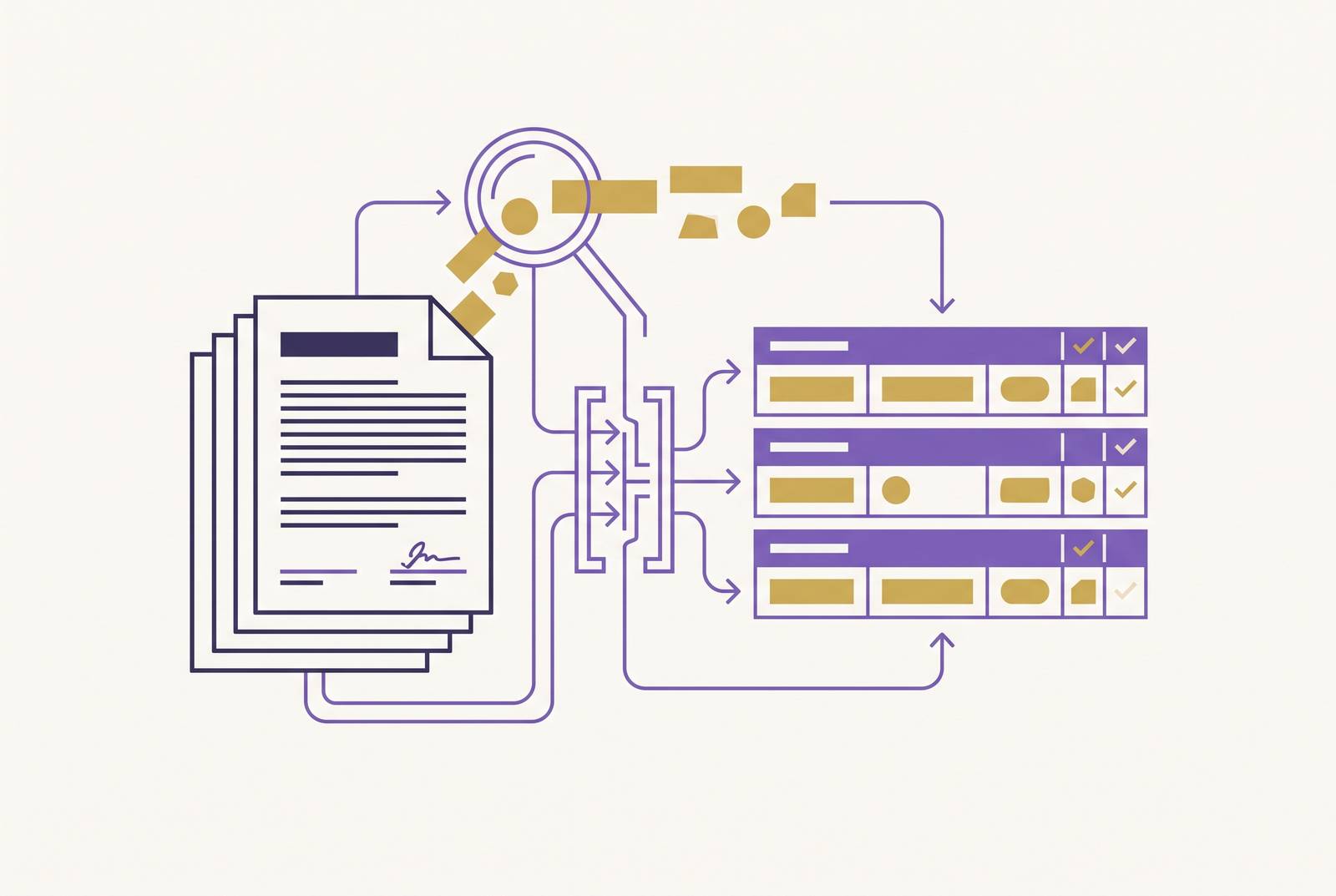
Contract metadata extraction accuracy fractures by field type, document quality, and system architecture. Treating it as one aggregate figure is the root cause of silent downstream failures in production legal systems. The question is not whether a model reads contracts well. It is which fields it reads reliably, under which document conditions, and what happens when a wrong value flows into a system that trusts it.
Contract metadata means the structured fields pulled from contracts: renewal dates, notice periods, counterparties, payment terms, governing law. Not the full text. Each field type carries a different extraction difficulty profile and a different risk profile if wrong. A missed expiration date can trigger a missed renewal. A corrupted liability cap can flow into litigation strategy. Practitioners must internalize a two-part accuracy distinction. ContractSafe's accuracy guide draws a hard line between field-level accuracy, which asks whether the AI extracted the right field from the document, and contextual accuracy, which asks whether the system understands how amendments, addenda, and exhibits relate to the parent agreement and which terms actually control. Many extraction failures are not reading failures. A system can correctly read every document on its own and still produce wrong metadata because it fails to resolve cross-document relationships.
Wrong metadata is categorically more dangerous than missing metadata. A blank field signals "go verify this." A filled field signals "you're good." That false confidence is where downstream damage begins. Errors propagate into alerts, dashboards, ERP and CRM integrations, and budget planning. A wrong renewal date quietly corrupts every system that trusts it, and no downstream system has any way to know the value came from a misread.
Which fields extract reliably and which ones do not
Extraction accuracy is not uniformly distributed across field types. Simple, well-anchored fields perform reliably. Relational, conditional, and amended fields are where accuracy degrades and legal risk concentrates. The distinction is structural, not incidental. Fields that appear in predictable locations, use consistent phrasing, and carry low semantic ambiguity extract with high reliability. SpotDraft's metadata reporting guide designates eight fields as the Tier 1 minimum that every legal team needs regardless of size or maturity: counterparty name, contract type, effective date, expiration date, auto-renewal clause, contract owner, signed status, and governing law. These fields are structurally anchored. An expiration date sits in a date field. A counterparty name appears in a signature block. A governing law clause uses phrasing that varies narrowly across documents. The extraction task is closer to pattern recognition than to interpretation.
Relational and conditional fields sit at the other end of the spectrum. Renewal logic depends on notice periods triggered by specific events, so it requires understanding relationships between clauses. Liability caps with carve-outs require parsing conditions and exceptions. Multi-party obligations require attributing duties to the correct entity across a document's structure. These fields carry the legal risk precisely because they are interpretive, and because a system that handles the anchored fields well may still fail the relational ones without any visible signal that it has done so.
Party name normalization is a special failure mode that deserves attention because it corrupts reporting even when extraction is technically correct. Acme Inc. in one record and Acme, Inc. in another are the same entity. Without normalization rules, reports don't add up, and stakeholders stop trusting the data. The failure is not in reading the document. It is in the absence of a rule layer between extraction and reporting. That distinction matters because it means accuracy problems can originate entirely outside the model, in the operational layer that most accuracy discussions ignore.
Why document quality and document structure compound the field-type problem
The accuracy of any given field extraction is a function of both the field's semantic complexity and the physical and structural quality of the document. Degraded or non-standard documents push every field toward the lower end of its accuracy range. Contracts are the hardest document type to extract automatically, for structural reasons that do not apply to invoices, receipts, or forms. ForageAI's extraction architecture analysis identifies four compounding conditions: contracts are negotiated, meaning variable layout. Signed, meaning file degradation from scanning and handling. Amended, meaning cross-document linkage requirements. And written in legal terminology where the same word carries different meanings across jurisdictions. No single component of a generic IDP stack handles all four simultaneously.
Document-quality failure modes appear throughout production environments. Scanned copies with faded toner, double-sided bleed-through, and handwritten margin notes produce OCR errors that propagate into every downstream field. Amendments that reference the original agreement by number, not by inclusion, present a different problem: the extraction system sees two separate files and has no architectural mechanism to link them. The insurance-claims parallel is instructive: extraction pipelines confidently process claims while missing the rider or endorsement that determines the actual payout. This is a structural pattern, not a legal-specific quirk.
The amendment problem is a production-specific risk that most legacy repositories carry. A meaningful share of contracts in existing systems has been amended since initial storage, and the amendment is often stored as a separate file with no programmatic link to the parent. The consequence is that a system can correctly extract the liability cap from the parent agreement and still be operationally wrong, because the governing value was modified by an amendment the system treated as a standalone document. High field-level confidence scores do not catch this failure. The system reports high confidence on the wrong value, and every downstream consumer of that value has no way to detect the error.
Why purpose-built contract extraction outperforms adapted generic pipelines
The architecture of the extraction system determines whether the structural challenges of contract documents are actually solved or only partially handled. The distinction is between purpose-built contract extraction and a generic document pipeline with a legal mode toggle, and it matters more than most deployment decisions because it sets the ceiling on what the system can ever get right. Most generic IDP tools solve two of the five contract-specific challenges. Enhanced OCR handles variable layouts, and general-purpose LLMs handle legal terminology to a limited extent. But neither system handles cross-references, amendments, or nested-clause semantics without explicit architectural support. The failure mode is not obvious error. It is false confidence. A system that extracts faster but misses an amended liability cap is worse than manual review, because it fails silently.
Purpose-built contract extraction requires four architectural layers, not a configuration change on a generic tool. The distinction is structural, not superficial. The architecture must accommodate negotiated layouts, degraded files, cross-document linkage, and jurisdiction-specific legal semantics as first-class problems rather than edge cases. Volody's 2026 AI contract management overview makes the integration point explicit: modern AI contract tools must connect with ERP, CRM, and HR systems to centralize contract data and link contracts to related processes. The integration is not a later phase. It is part of what the extraction architecture is built to support.
The accuracy gap between architectures is measurable and meaningful. Purpose-built contract extraction achieves materially higher clause accuracy than general-purpose LLMs on the same test sets. The gap is large enough to determine whether a deployment is safe for production use on high-stakes fields. A legal platform trained on jurisdiction-specific contract patterns carries domain accuracy that a general-purpose model cannot approach on complex, non-standard fields. The point is not that one vendor performs better than another. It is that two architectural classes differ in what they can structurally guarantee, and the distinction determines whether extracted metadata is safe to act on.
How teams in production currently manage the accuracy gap — and where that falls short
The standard production response is AI extraction followed by human review. That approach addresses the accuracy gap in principle, but only works when validation is structured by risk level, ownership is assigned, and corrections are logged. Most current implementations lack at least one of these. Four failure points recur in contract metadata capture regardless of extraction quality. SpotDraft's metadata reporting guide identifies manual entry errors such as date format drift, counterparty name inconsistency, and blank fields from uncertainty. Inconsistent standards across teams. One-time capture at signature that ignores amendments. And fields that exist but are never validated. These failure points compound. An inaccurate field captured at signature, entered inconsistently, and never reviewed after an amendment generates a report that is wrong in multiple compounding ways.
Risk tiering is the structural response that current best practice recommends. ContractSafe's accuracy guide advises classifying contract metadata by risk before automating anything downstream. Human review is required for renewal logic, amendments, obligations, and other high-stakes fields before those fields trigger alerts, payments, renewals, or reporting. High-risk fields get reviewed before they drive automated actions. Lower-risk fields are eligible for bulk approval. That structure is what makes human review fast enough to happen in practice, not just in process diagrams. Volody's extraction guide adds that accuracy improves with human review and confidence scoring, and that model learning is gradual. The loop between review decisions and model improvement is itself an operational process that must be designed and owned.
Good audit trail practice matters beyond compliance. ContractSafe's accuracy guide states that audit logs should show why metadata changed and allow teams to identify repeat extraction problems. That capability enables continuous model improvement, not just regulatory defensibility. SpotDraft's metadata reporting guide makes traceability an operational requirement: AI extraction is only useful for reporting if the team can see the source clause behind every extracted value and correct it when it is wrong. The governance gap that makes current practice fragile is that a large share of organizations running AI extraction in production lack formal governance over who owns validation, what triggers a correction, and how correction history is preserved. The extraction runs, but the control layer does not. In legal contexts, the gap is especially dangerous. Tamper-resistant logging and source traceability are compliance requirements, not optional practices.
What a production-grade deployment gets right that pilots typically miss
Production-grade contract metadata extraction is not primarily a model accuracy problem. It is an operational design problem, and the decisions that determine reliability are made at the workflow, governance, and integration layers, not at the AI layer. Starting narrow is the mechanism by which trust gets built. Volody's extraction guide recommends targeting five to ten pivotal fields within a single contract category to demonstrate tangible benefits before broader implementation. That focus is not a limitation. It is how extraction accuracy is validated against real documents before it drives real decisions.
Integration is a production requirement, not a later phase. Modern AI contract tools connect with ERP, CRM, and HR systems, and that integration centralizes contract data, links contracts to related processes, and eliminates manual re-entry errors that would otherwise corrupt downstream systems. A wrong party name or duplicate vendor record originating from contract extraction can ripple across multiple integrated systems and turn reporting into fiction. Normalization rules must be in place before integration goes live. The downstream payoff of accurate extraction is obligation tracking and lifecycle management. AI monitors contract commitments, deadlines, and renewal dates and sends alerts for upcoming actions. That capability only works if the underlying extracted fields are accurate and kept current after amendments. AI also evaluates contract outcomes and flags underperforming agreements. Performance analytics are only as valid as the metadata feeding them.
The operational controls that separate production from pilot are specific and checkable. Defined ownership assigns who validates each field tier, who resolves extraction conflicts, and who updates metadata after amendments. Correction history logs what changed, when, and why, serving both compliance and model improvement. Source traceability links every extracted value to the specific clause it came from, so a reviewer can confirm or correct it without opening the whole document. SpotDraft's metadata reporting guide identifies source clause visibility and correctability as the requirements that make AI extraction trustworthy for reporting. Without them, stakeholders cannot trust the dashboard and default back to manual PDF review.
How to assess whether your current extraction system is production-ready
A structured assessment starts with field-type coverage. Map current extracted fields against the high-reliability and lower-reliability categories established earlier. Identify which fields in the portfolio are relational or conditional, such as renewal logic, liability caps with carve-outs, or multi-party obligations, and confirm that human review is required before those fields trigger any automated action. The test is not whether the model claims to handle these fields. It is whether the workflow enforces review before action.
Document-quality and amendment-handling checks come next. The amendment-linkage failure is architectural. Confirm whether the system has explicit cross-document linkage, or whether amendments are processed as standalone files. A sample audit picks a set of contracts known to have amendments and verifies that the extracted values reflect the controlled, amended terms rather than the original. Governance and audit trail checks ask whether the team can show why a metadata field holds its current value. ContractSafe's accuracy guide advises defining who owns validation, system rules, and correction history before rollout. If that ownership is undefined, the review process exists only on paper. Audit log completeness asks whether the team can identify when a field was changed, by whom, and what triggered the change. If not, the system cannot support compliance requirements or continuous improvement.
The downstream trust check is the practical test of production readiness. If stakeholders faced with a report default back to opening PDFs to verify the numbers, the metadata layer has not earned operational trust. Operations teams relying on contract data for budgeting and vendor planning, IT teams connecting metadata to CRMs and ERPs, and legal teams using extracted terms for risk reporting all need independent assurance that the fields they rely on are accurate and current. A formal readiness assessment is the mechanism for closing identified gaps. Catching data inaccessibility, amendment-handling gaps, and governance gaps before they corrupt production workflows is the operational case for a structured audit. The cost of a gap discovered in production, whether a missed renewal or a corrupted liability figure flowing into litigation, is materially higher than the cost of finding it in a structured assessment beforehand.