AI Workflow Deployment Timelines in Enterprise Legal Departments
Preparation and scope matter more than technology when deploying AI in legal departments.
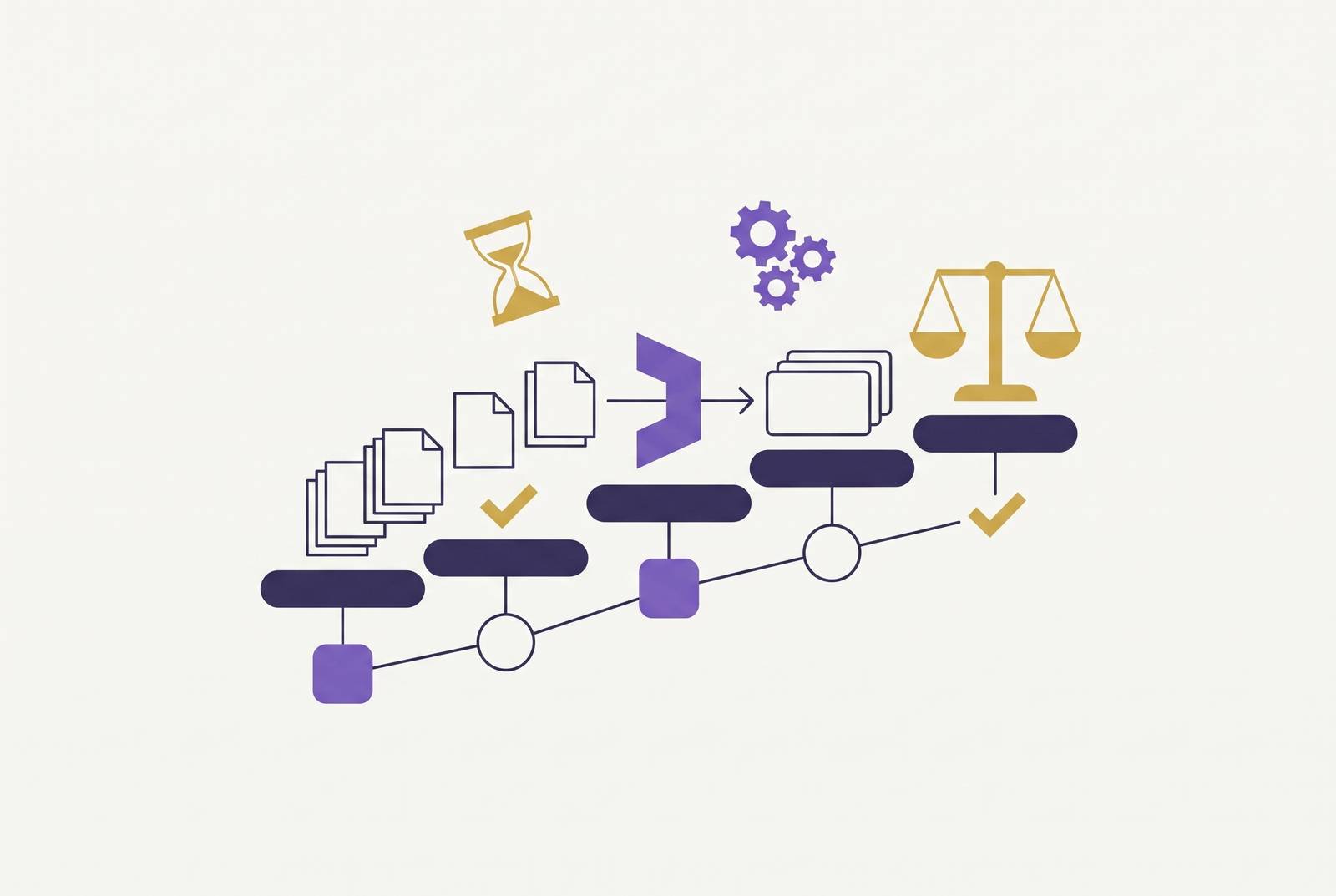
AI workflow deployment timelines in enterprise legal departments depend less on model capability than on readiness and scope. The fastest deployments resolve approval requirements, platform constraints, workflow design, and accountability before rollout begins. That preparation shortens the path to production without removing the controls that legal work requires.
Why legal AI deployments stall before they start
A demo that goes well proves that a tool can do a task. It does not prove that the organization can authorize its use in production. The familiar sequence is a convincing demo, an approved pilot, and then a stalled project awaiting legal, compliance, or governance decisions. Engineering is not necessarily the blocked workstream. The organization has reached questions that the deployment plan did not anticipate.
The approval package is often the first fault line. Legal needs specific material, including a DPA, SOC 2 documentation, and a data flow diagram, that a standard vendor sales package may omit. Without that material, reviewers cannot finish the assessment even if the pilot went well. The submission is missing information, which by itself does not show that the tool is unacceptable. When IT, privacy, legal, and procurement then review it sequentially, missing information becomes a repeated obstacle.
Scoping creates a related structural problem before configuration begins. A department may have selected a capable tool without settling the boundaries of the work or the authority needed to perform it. Those omissions become harder to ignore as the pilot approaches live use. The broader gap between enterprise pilots and organization-wide agent deployments reflects this distinction between technical performance and operational readiness. A working pilot establishes capability, while production requires permission, ownership, and support.
What the internal approval process actually costs in time, by organization size
For organizations of roughly five hundred employees, internal legal approval can take four to six weeks. That is an approval cycle. It covers the internal clearance needed before a workflow goes live and therefore belongs in the deployment schedule as its own workstream. Treating it as an administrative formality leaves the plan without time for a predictable phase. The size of an organization gives a sense of how long approval may take, but preparation determines how smoothly it goes.
Architecture can resolve some review questions before submission. In regulated industries, self-hosted AI deployments can clear legal review meaningfully faster than equivalent cloud AI tools because data residency and access-control questions have already been addressed at the architecture level. This changes what remains unresolved when the submission reaches legal for review.
Legal should be involved early and given the required documentation in the right sequence. A complete approval package gives reviewers the information needed to assess the proposed use, rather than requiring them to reconstruct it from sales material. Putting legal last has the opposite effect. A poorly scoped submission can occupy the same legal team for six months, while the right documents and sequencing can support approval in four to six weeks. The difference need not reflect a change in organizational risk appetite, because preparation changes the work required to reach a decision.
How platform choice sets the deployment ceiling before scoping begins
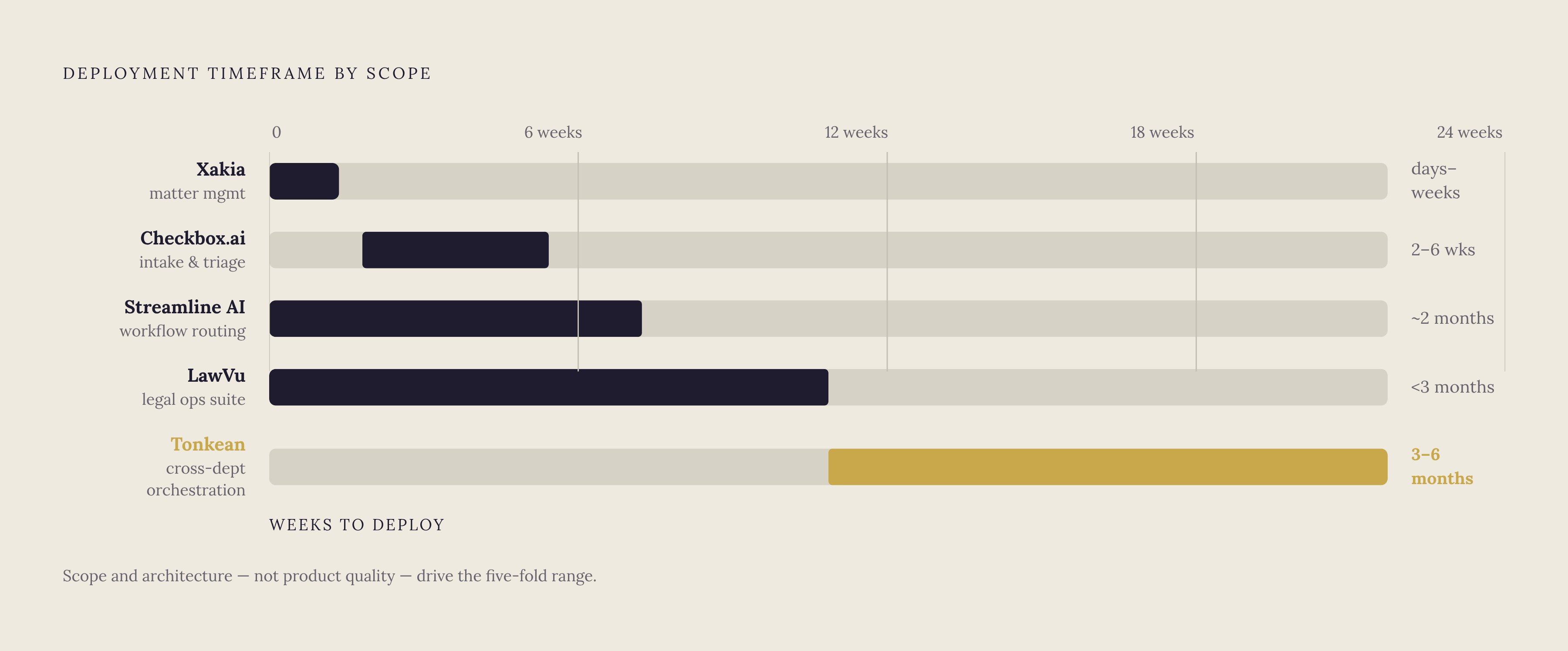
Platform selection establishes constraints that approval preparation alone cannot remove. A focused intake system, a no-code workflow builder, a broad enterprise suite, and a custom-built agent do not represent equivalent implementation commitments. Their scope and architecture bound the work that follows. Consequently, a timeline is useful only when it is attached to the kind of platform and problem being considered.
The available platform landscape shows a wide spread. Xakia, aimed at small and mid-sized in-house teams, has a deployment range of days to weeks, while Checkbox.ai supports no-code visual workflow building with a range of two to six weeks. Streamline AI, focused on legal intake, triage, and request routing, has a deployment timeframe of approximately two months. These ranges describe different implementation propositions. They are not a ranking of product quality or a promise that every department will achieve the same result.
Broader operational scope changes the comparison. LawVu covers matters, contracts, spend, and intake, with a deployment timeframe of under three months. Tonkean addresses cross-department process orchestration, with a range of three to six months. Those longer ranges need to be read against the work being connected, rather than treated as evidence that a narrower product is inherently preferable.
For a department selecting a platform, the relevant starting point is its bottleneck. Intake and triage, contract throughput, and outside counsel spend are different problems, even when the tools offer some of the same features. Selecting against the wrong problem creates avoidable delay because the platform decision and the intended outcome are misaligned. Preparing before deployment can help the work go well when the architecture fits. It cannot make a mismatched implementation equivalent to a focused one.
Why end-to-end workflow design compresses timelines more than any single feature
Within those platform constraints, connected workflow design is a stronger guide to deployment speed than any single feature. Tools that are not connected add handoffs that cause integration delays and data-quality problems. Each task may work on its own while the full sequence is hard to run. End-to-end design instead treats continuity of information and responsibility as part of the workflow, rather than as work to be added after individual tools have been selected.
That continuity can be assessed through concrete questions. The relevant tests include whether the same client and matter information remains available throughout the platform, whether drafting, redlining, signing, and filing form a continuous path, and whether another attorney can continue from the same research memo. A single audit log for the entire matter provides another test of connected operation. These are structural questions. They distinguish a workflow that holds together from a collection of useful capabilities.
Contract lifecycle management, litigation management, and legal intake illustrate the distinction. Contract work can connect drafting, review, and routing, while litigation workflows can connect document review, pleading drafting, and research. Intake can connect request capture, assignment, and tracking instead of relying on email, a spreadsheet, and a separate matter system. The deployment benefit comes from reducing the breaks between tasks. With those breaks in place, later phases bring repeated integration and data-quality work.
Streamline AI’s State of Legal Efficiency report found average team efficiency at roughly half of potential and identified operational design, rather than talent or headcount, as the binding constraint. Even when a handoff is removed, someone still needs to be accountable. As connected workflows progress toward consequential actions, the authority to act becomes a deployment requirement in its own right.
The governance gap that stops production-ready workflows at the threshold
A technically validated workflow can still lack permission to operate. Written authorization policies, oversight mechanisms, and rollback protocols are prerequisites for responsible agentic deployment, yet departments often reach the production threshold without them. This is the most acute readiness failure. The remaining obstacle is not whether the system performs its task, but whether the organization has defined who controls it and how intervention works.
A more demanding test of readiness checks for written authorization policy, rollback protocols, stale-context failure testing, and vendor liability terms. Organizations may say they are ready even when they cannot meet those conditions. The distinction is consequential because confidence does not establish authority or recovery arrangements.
Shipped products make the need for explicit governance concrete. Ironclad released its Intake Agent and Redlining Agent in early access on 13 November 2025. The Intake Agent extracts metadata from third-party paper, while the Redlining Agent flags missing clauses, risky terms, and compliance gaps against playbook rules. Ironclad’s materials emphasize human-in-the-loop governance that is transparent, auditable, and controllable. Thomson Reuters launched CoCounsel Legal with agentic workflows and Deep Research in August 2025, further placing agentic capability within legal production planning.
To close the governance gap, departments should make clear what developers, deployers, and users are each responsible for. Human oversight must be able to intercept or override actions with material real-world impact. Least-privilege access, pre-deployment testing, progressive rollouts, and real-time monitoring provide the technical controls, while users need clear capability boundaries and escalation contacts. A governance framework can help departments organize that work before launch.
What a formal readiness assessment covers before any workflow scales
A formal AI operations audit assesses readiness through evidence. It checks whether the proposed workflow can deliver value, work within the controls set for it, and be supported after launch. The assessment spans six domains, namely business, data, security, governance, operations, and measurement. None stands alone. A valuable use case cannot compensate for unreliable inputs, just as strong access controls cannot compensate for undefined decision ownership.
The business domain establishes whether the problem is valuable and bounded. The data domain asks whether inputs can be used lawfully and relied on, while security checks how access and sensitive information are controlled. Governance identifies the owners of decisions, exceptions, and risk. Operations tests whether the system can be monitored, supported, and stopped. Measurement establishes whether value and failure can be assessed continuously.
Data readiness is often the decisive finding. Projects can be abandoned because their inputs are not AI-ready, and platform quality cannot substitute for documented data management practices. Legal departments face an additional governance weakness when no policy specifies which roles may activate, modify, or suspend an agentic workflow. Some production deployments still lack that documentation, while it is even less common among pilots. The audit exposes these omissions before scaling makes them part of ordinary operations.
The corresponding organizational intervention is a dedicated AI operations function, distinct from both IT and the business unit. It is responsible for evaluation frameworks, production monitoring, and incident response. Those responsibilities need an explicit home. When they remain diffused across existing functions, the department lacks the operational ownership needed to move beyond repeated pilots. The assessment therefore concerns not only the system being deployed, but also the function that will sustain it.
The 90-day phased rollout that converts a readiness-cleared workflow into a production system
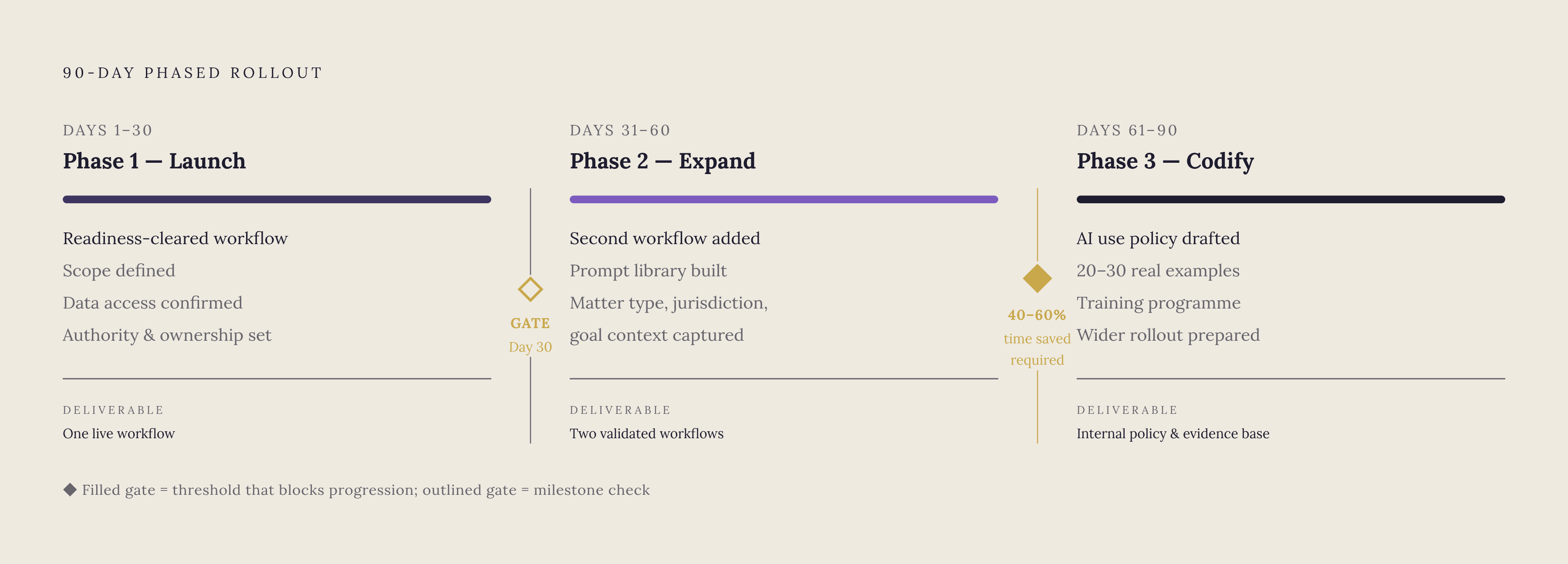
The 90-day rollout model begins from a readiness-cleared workflow. Its schedule assumes that scope, data, authority, and operational ownership have already been addressed. That boundary is essential to interpreting the timeline. The purpose of phasing is to validate and extend operational use, rather than discover structural prerequisites after launch.
During days 31–60, expansion to a second workflow is conditional on the first workflow’s results. Time savings on the targeted task should be in the range of forty to sixty percent at this stage. If they are not, the cause should be resolved before expansion. The second workflow should be related to the first but different, with different document types and different attorneys, while keeping the same care in how results are measured. This provides a broader test without abandoning the basis for comparison.
The same phase should establish a shared prompt library that captures matter type, jurisdiction, and goal. That context helps the organization learn from what worked for individuals. By day 60, the intended foundation is two validated workflows, a prompt library in progress, and measurable ROI from at least twenty to thirty real examples. Those examples give the department enough evidence of how the workflows work to write an internal policy.
Days 61–90 turn that evidence into policy, training, and wider rollout. The AI use policy should define which tools are approved for which tasks, how outputs are reviewed before client delivery, how billing is handled when AI substantially reduces task time, and which data may enter each tool. The ABA Formal Opinion on AI is the relevant framework for US firms. EU-market organizations must also account for full EU AI Act application from December 2027 for high-risk Annex III stand-alone systems, following the Digital Omnibus on AI delay of the original August 2026 deadline.
The commercial consequence extends beyond internal efficiency. Corporate legal departments are deploying faster than law firms, and in-house teams building AI capabilities expect to depend less on outside counsel. Firms that cannot show those capabilities and be clear about how they deploy them risk losing work. In either organization, each workflow that goes live adds to prompt libraries, monitoring infrastructure, and the clarity of policy, so less preparation is needed for the next deployment.